
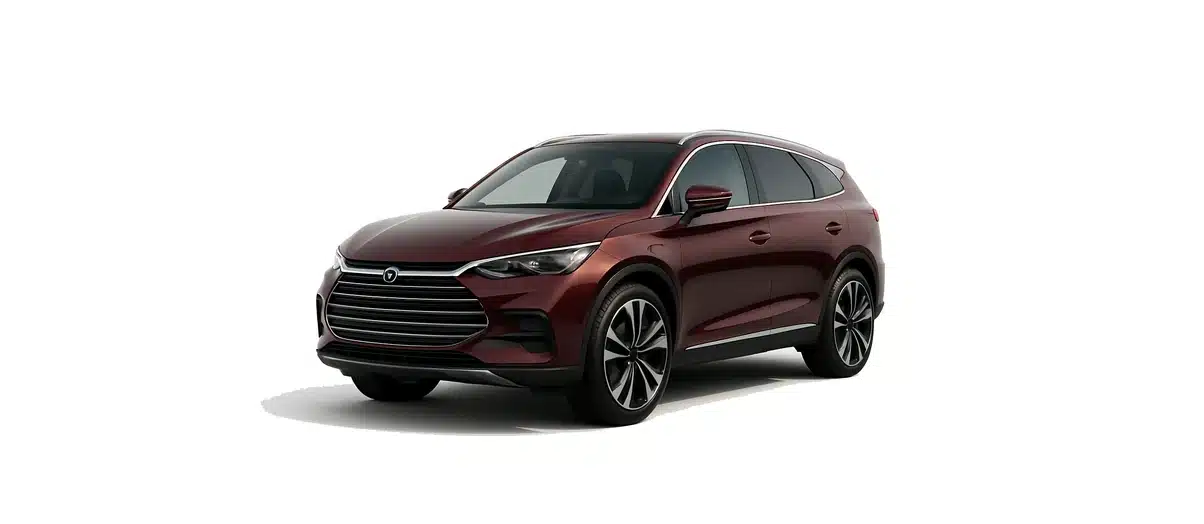
The BYD Tang is a large seven-seat electric SUV sold in parts of Europe, but UK buyers should approach its charging specifications with care. At the time of writing, the Tang is not shown on BYD UK’s current model list, and independent data sources list the Tang and Tang Flagship as not available in the United Kingdom. That means many UK-based Tang drivers are likely to be dealing with a European-specification import, or with a vehicle whose charging details need confirming from the handbook, charge-port label or VIN-specific documentation.
This guide focuses on the European battery-electric BYD Tang and Tang Flagship, not the Chinese-market Tang DM-i or DM-p plug-in hybrid versions. It explains the main battery and charging differences between the earlier 2022–2024 European Tang and the newer European Tang Flagship, because those differences affect cable choice, AC charging speed and rapid charging expectations.
BYD Tang Battery and Charging Specifications
For European specification cars, the BYD Tang uses Type 2 AC charging and CCS Combo 2 DC rapid charging. EV Database lists the charge port as being on the right-side rear of the vehicle for the European Tang. However, because UK availability is not confirmed and imported vehicles can vary, owners should always check the actual vehicle before buying a cable or relying on a published charging figure.
The current European BYD Tang Flagship is a pure-electric seven-seat SUV with BYD’s Blade Battery using LFP chemistry. BYD Europe quotes a 108.8 kWh battery and a WLTP combined range of 530 km, which is approximately 329 miles. EV Database estimates a real-world range of around 460 km, or about 286 miles, for the Tang Flagship. It supports up to 11 kW AC charging where a compatible three-phase supply is available and up to 170 kW DC rapid charging on suitable CCS chargers.
The earlier European Tang, sold in some countries from 2022 to November 2024, is different. EV Database lists an 88.0 kWh nominal battery, 86.4 kWh usable capacity, a WLTP range of 400 km, and lower AC and DC charging rates. This is the key point for UK drivers: not every BYD Tang has the same charging capability.
Battery Options
There are two main European battery specifications to be aware of. The newer European Tang Flagship is associated with a 108.8 kWh Blade Battery. BYD media information describes this as gross capacity, while EV Database lists 111.0 kWh nominal and 108.8 kWh usable. Because capacity wording differs between sources, it is sensible to refer to it cautiously as the current European Tang Flagship’s 108.8 kWh battery specification.
The earlier 2022–2024 European Tang uses a smaller battery. EV Database lists this version at 88.0 kWh nominal and 86.4 kWh usable. This earlier model is still a large-battery electric SUV, but its charging hardware and quoted range are not the same as the newer Flagship version.
If you are buying, importing or already running a BYD Tang in the UK, do not assume the battery size from the registration year alone. Check the exact model, production period, country of original sale and onboard charging information.
AC Charging Speed
AC charging is the type of charging used by home wallboxes, workplace charge points and many destination chargers. The European BYD Tang uses a Type 2 connector for AC charging, which is the standard AC connector across the UK and Europe.
For the current European Tang Flagship, the onboard AC charger is listed at 11 kW three-phase. This means the car can make use of an 11 kW AC charge point where a suitable three-phase electrical supply is available. In a UK domestic setting, however, most homes have single-phase electricity and a 7.4 kW wallbox. On a typical 7.4 kW home charger, the Tang Flagship will charge below its 11 kW maximum, because the limiting factor is the supply and wallbox rather than the car.
The earlier 2022–2024 European Tang should be treated differently. EV Database lists country-dependent AC onboard chargers of 7.4 kW or 6.6 kW, rather than 11 kW. For this reason, it would be misleading to say that all BYD Tang models charge at 11 kW AC. If you have an earlier Tang, check the onboard charger rating before choosing charging equipment or estimating charge times.
DC Rapid Charging Speed
DC rapid charging is used for longer journeys and high-speed charging stops. European BYD Tang models use CCS Combo 2 for DC charging, which is the standard rapid charging connector across the UK and most of Europe.
The current European Tang Flagship supports up to 170 kW DC rapid charging on a suitable charger. BYD quotes a 30–80% charging time of around 30 minutes. For route planning, however, a 10–80% figure is often more useful because many drivers arrive at a rapid charger with a lower battery percentage. EV Database estimates the Tang Flagship’s 10–80% DC charging time at about 48 minutes.
The earlier 2022–2024 European Tang has a lower DC charging specification, with EV Database listing up to 120 kW and an estimated 10–80% time of around 35 minutes. That shorter time reflects the smaller battery and different charging curve, not a higher peak charging rate.
As with any EV, the peak charging speed is only achieved under favourable conditions. Battery temperature, charger capability, state of charge and the vehicle’s charging curve all affect the real charging speed. Charging also normally slows noticeably after around 80%, so it is usually quicker to stop at 70–80% during a journey unless you need a higher charge level for the next leg.
Range and Efficiency
The current European BYD Tang Flagship has a WLTP combined range of 530 km, equivalent to about 329 miles. EV Database estimates a real-world range of around 286 miles. In practice, UK range will depend on speed, weather, load, tyre condition, terrain and heating or air-conditioning use.
As a large seven-seat SUV, the Tang is likely to use more energy at motorway speeds than a smaller electric hatchback or saloon. Cold weather, wet roads and roof boxes can also reduce efficiency. The standard heat pump on the current European Tang Flagship should help with cabin heating efficiency in cooler weather, but it does not remove the normal winter range reduction that EV drivers should plan for.
The earlier European Tang has a WLTP range of 400 km, or around 249 miles, according to EV Database. Again, real-world range may be lower depending on conditions. If you are using a Tang in the UK as a family car or long-distance SUV, it is worth learning the car’s actual consumption over your regular routes rather than relying only on brochure figures.
Charging at Home
For most BYD Tang drivers, home charging will be the most convenient and cost-effective way to run the vehicle. A dedicated Type 2 home wallbox is usually the preferred solution. It offers safer, faster and more reliable charging than using a domestic socket, and it can often be paired with off-peak electricity tariffs.
On a typical UK single-phase 7.4 kW wallbox, the current Tang Flagship will not use its full 11 kW three-phase AC capability, but it will still charge at a practical overnight rate. A large battery may take a long time to charge from very low to full, but many owners do not need a full 0–100% recharge each night. In normal use, topping up from around 30–40% to 70–80% is often enough for the following day.
If you have access to a three-phase supply, such as at some commercial premises or certain homes with upgraded electrical infrastructure, the current European Tang Flagship may be able to use up to 11 kW AC. Earlier European Tang models may not benefit from this because their onboard AC charging capability may be 6.6 kW or 7.4 kW, depending on specification.
A 3-pin charger is generally best suited as a backup or occasional charging solution, but can be used regularly if a qualified electrician has confirmed the socket and electrical installation are suitable for sustained EV charging. Because the BYD Tang has a large battery, a 3-pin lead will add range slowly and is not ideal as the main charging method unless your daily mileage is low and the installation has been properly checked.
Public Charging
For public AC charging, the BYD Tang will generally use a Type 2 cable. Many UK destination chargers are untethered, meaning you need to bring your own cable. A suitable Type 2 cable lets you use workplace chargers, supermarket chargers, hotel chargers and public car park chargers. For the current Tang Flagship, an 11 kW-capable three-phase Type 2 cable is useful if you expect to use three-phase AC charge points, although many UK public AC posts are 7 kW single-phase.
For rapid and ultra-rapid charging, the cable is attached to the charger, so you do not need your own DC cable. The Tang connects via CCS Combo 2 on European specification cars. When planning long trips, look for reliable CCS chargers with a suitable power rating, but remember that a 350 kW charger will not make the Tang charge faster than the vehicle’s own limit.
Because the Tang is not currently confirmed as a UK-market new car, imported examples should be checked carefully. European BEV models should use Type 2 and CCS2, but imported vehicles from other regions may differ. Always confirm the connector type visually before relying on a cable recommendation.
Vehicle-Specific Features
The current European BYD Tang Flagship includes several charging-related features worth noting. It has a standard heat pump, which can improve heating efficiency compared with a purely resistive heater in cooler conditions. It also has Vehicle-to-Load capability as standard in European Flagship specification, allowing the vehicle battery to power external electrical devices through compatible equipment. BYD quotes up to 4 kW external discharge, while EV Database lists 3.7 kW, so owners should follow the vehicle handbook and accessory rating.
V2L should not be assumed on all BYD Tang versions. EV Database lists V2L as not supported on the earlier 2022–2024 European Tang. Similarly, current data does not support claiming V2G or V2H capability for the European Tang Flagship. Battery preconditioning via navigation should also not be assumed, as EV Database lists battery preconditioning as not available for both the current Flagship and the earlier European Tang.
Charging Tips
- Confirm your exact model first: Earlier European Tang cars and the newer Tang Flagship have different AC and DC charging specifications.
- Use a Type 2 cable for AC charging: European specification models use Type 2 for home, workplace and destination AC charging.
- Choose cable capacity sensibly: If you have the current 11 kW three-phase Tang Flagship, a three-phase Type 2 cable can be useful, especially for European travel or workplace charging.
- Use CCS for long journeys: Rapid charging is via CCS Combo 2 on European specification cars, with the cable attached to the charger.
- Avoid unnecessary 100% rapid charges: Charging above 80% is usually slower and is best reserved for journeys where the extra range is needed.
- Check imports carefully: Use the handbook, VIN information and charge-port label to confirm connector type and charging limits.
Frequently Asked Questions
Is the BYD Tang sold new in the UK?
Current reliable sources do not confirm the BYD Tang as a new UK-market model. BYD UK’s current model list does not show the Tang, and EV Database lists the Tang and Tang Flagship as United Kingdom not available. UK drivers should therefore treat it as a European/import vehicle unless a UK dealer or VIN-specific source confirms otherwise.
What charging cable does the BYD Tang use?
European specification BYD Tang BEV models use Type 2 for AC charging and CCS Combo 2 for DC rapid charging. For imported cars, confirm the connector on the vehicle before buying a cable.
Can the BYD Tang charge at 11 kW at home?
The current European Tang Flagship has an 11 kW three-phase AC onboard charger, but most UK homes have single-phase 7.4 kW wallboxes. Earlier European Tang models may have 6.6 kW or 7.4 kW AC charging depending on country, so 11 kW should not be assumed for every Tang.
How fast can the BYD Tang rapid charge?
The current European Tang Flagship supports up to 170 kW DC and is estimated at about 48 minutes for 10–80% charging. BYD’s 30-minute figure refers to 30–80%. Earlier European Tang models are listed at up to 120 kW DC.
Does the BYD Tang have V2L?
The current European Tang Flagship has V2L as standard, but this should not be assumed for all Tang model years. The earlier 2022–2024 European Tang is listed as not supporting V2L.
What This Means for Drivers
The main lesson with the BYD Tang is to avoid specification mix-ups. The European Tang Flagship is a large-battery, seven-seat electric SUV with Type 2 AC charging, CCS2 rapid charging, up to 11 kW AC on three-phase supplies and up to 170 kW DC rapid charging. The earlier European Tang has a smaller usable battery and different AC/DC charging limits.
For UK drivers, the most practical setup will usually be a dedicated Type 2 home wallbox plus a suitable Type 2 public charging cable. If you own a current European Tang Flagship and regularly use three-phase AC charging, choose equipment that supports that use case. If you own an earlier Tang or an imported vehicle with uncertain specification, verify the exact onboard charger rating before making assumptions.
Looking for a Charging Cable for BYD Tang?
If you need a charging cable for a BYD Tang, check your exact model year, connector type and onboard charger rating first, then choose a compatible Type 2 cable for home, workplace and public AC charging.
Please note that this information is intended as a guide. Charging specifications may change due to model and year of manufacture. For precise information, always refer to your vehicle user manual.

