
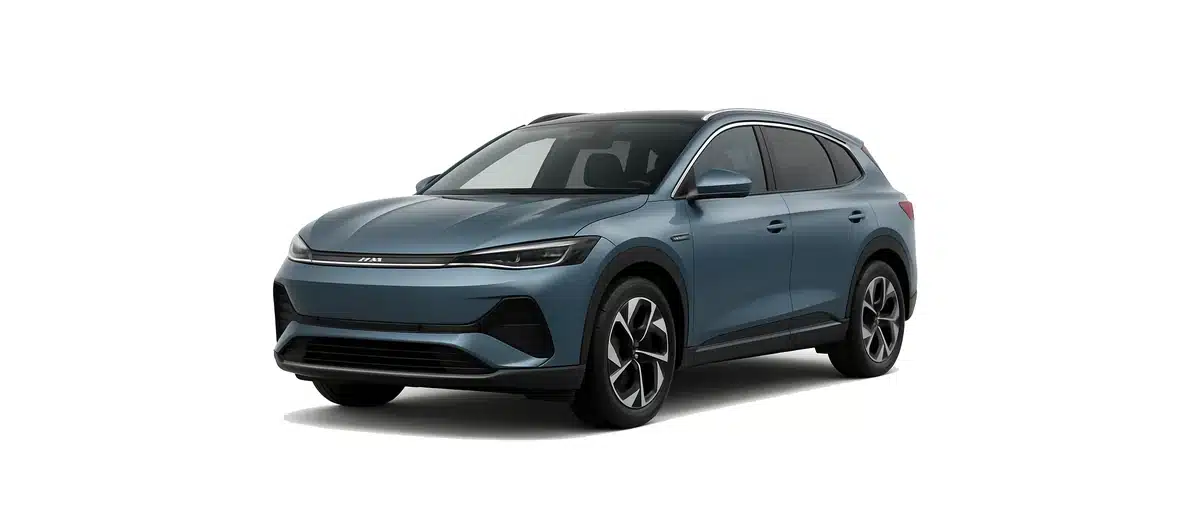
The BYD Sealion 7 is a pure-electric mid-size SUV/crossover and part of BYD’s current UK electric car line-up. UK customer deliveries began in 2025, with three versions available: Comfort RWD, Design AWD and Excellence AWD. All use BYD’s Blade Battery technology and the familiar UK/European charging arrangement of a Type 2 socket for AC charging and CCS Combo 2 for DC rapid charging.
For owners, the key point is that the Sealion 7 is straightforward to charge, but charging expectations vary by trim. Every version supports up to 11 kW AC charging on three-phase power, although most UK homes will charge at up to 7.4 kW on a single-phase wallbox. Rapid charging also differs: Comfort and Design are rated at up to 150 kW DC, while the Excellence AWD is rated at up to 230 kW DC.
View BYD Sealion 7 Charging Cables
BYD Sealion 7 Battery and Charging Specifications
The UK-market BYD Sealion 7 is a battery-electric vehicle, not a plug-in hybrid. It should not be confused with BYD DM-i plug-in hybrid models in other parts of the range. For UK charging, the important specification is simple: the car uses a Type 2 AC connection and CCS Combo 2 for rapid charging.
| Vehicle | BYD Sealion 7 |
|---|---|
| Vehicle type | Pure-electric mid-size SUV / crossover |
| UK trims | Comfort RWD, Design AWD, Excellence AWD |
| AC charging connector | Type 2 |
| DC rapid charging connector | CCS Combo 2 |
| Maximum AC charging | 11 kW three-phase |
| Typical UK home charging | Up to 7.4 kW on a single-phase wallbox |
| Maximum DC rapid charging | Up to 150 kW on Comfort and Design; up to 230 kW on Excellence |
Battery Options
There are two battery capacities in the UK Sealion 7 range. The Comfort RWD and Design AWD use an 82.5 kWh BYD Blade Battery. EV Database UK treats this as usable capacity and estimates the total capacity at around 84 kWh. The Excellence AWD uses a larger 91.3 kWh Blade Battery, with an estimated total capacity of around 93 kWh.
In practical terms, the larger battery in the Excellence AWD gives the highest official WLTP range in the UK line-up, while the Comfort and Design models use the same battery but differ in drivetrain and range. The Blade Battery uses LFP chemistry, and BYD describes the Sealion 7 as being based on its e-Platform 3.0 with Cell-to-Body construction.
| Version | Battery capacity | Official WLTP range |
|---|---|---|
| Comfort RWD | 82.5 kWh Blade Battery | 300 miles |
| Design AWD | 82.5 kWh Blade Battery | 283 miles |
| Excellence AWD | 91.3 kWh Blade Battery | 312 miles |
AC Charging Speed
All UK BYD Sealion 7 versions have an onboard AC charger rated at up to 11 kW. This 11 kW rate requires a suitable three-phase AC supply, which is more common at workplaces, commercial premises and some public AC charge points than at domestic properties.
Most UK homes have a single-phase electricity supply. On a typical 7.4 kW single-phase home wallbox, the Sealion 7 will charge at up to 7.4 kW rather than 11 kW. This is normal and is not a fault with the car or cable. It simply reflects the limit of the domestic electrical supply and wallbox.
As a guide, EV Database UK estimates a full 0-100% charge at about 9 hours on an 11 kW three-phase AC charger for the 82.5 kWh versions, and about 9 hours 45 minutes for the 91.3 kWh Excellence. On a 7.4 kW home wallbox, estimated full-charge times are around 13 hours 15 minutes for the 82.5 kWh versions and around 14 hours 30 minutes for the Excellence. In everyday ownership, drivers rarely charge from completely empty to completely full, so overnight top-ups are usually more relevant than full 0-100% sessions.
DC Rapid Charging Speed
DC rapid charging is where the Sealion 7 range differs most noticeably by trim. The Comfort RWD and Design AWD are rated at up to 150 kW DC. BYD quotes a 10-80% rapid charge time of 32 minutes for these versions under suitable conditions.
The Excellence AWD has a higher peak DC charging rate of up to 230 kW, and BYD quotes a 10-80% rapid charge time of 24 minutes. This faster headline figure does not apply to every Sealion 7, so it is worth checking which version you own or are considering.
For public rapid charging, 10-80% is usually the most useful charging window. Charging speed typically slows significantly above 80% to protect the battery and manage heat, so stopping at 80% and continuing your journey can often be quicker than waiting for a near-full charge. Real-world rapid charging speeds depend on the charger’s capability, battery temperature, state of charge, weather and how busy the charging site is.
Range and Efficiency
The highest official UK WLTP figure for the Sealion 7 is 312 miles, but this applies to the Excellence AWD. The Comfort RWD is rated at 300 miles WLTP, while the Design AWD is rated at 283 miles WLTP. These figures are useful for comparing models, but day-to-day range will vary.
Cold weather, motorway speeds, headwinds, gradients, wheel and tyre choice, cabin heating and payload can all affect efficiency. The Sealion 7 is fitted with a heat pump as standard, which can help improve heating efficiency in cooler conditions compared with relying only on resistive heating, but winter range will still normally be lower than mild-weather range.
For planning longer journeys, it is sensible to use a route planner, leave a safety margin and treat rapid charging stops as part of the journey rather than waiting until the battery is very low. The car’s generous battery capacity means many daily and weekly driving patterns can be covered with home charging alone.
Charging at Home
For most UK Sealion 7 owners, a dedicated home wallbox will be the most convenient charging method. A 7.4 kW single-phase wallbox suits the majority of domestic installations and will provide reliable overnight charging. Although the Sealion 7 can accept up to 11 kW AC, achieving that at home normally requires a three-phase supply and a compatible three-phase charger.
For cable selection at home, treat the BYD Sealion 7 as a Type 2 AC vehicle. If your wallbox is untethered, you will need a Type 2 to Type 2 charging cable. A 32A single-phase Type 2 cable is suitable for most UK home wallbox charging at up to 7.4 kW. If you also want the flexibility to use 11 kW three-phase AC posts where available, a three-phase Type 2 cable is the more versatile choice.
A domestic 3-pin charger is generally best suited as a backup or occasional charging solution, but can be used regularly if a qualified electrician has confirmed the socket and electrical installation are suitable for sustained EV charging. Because the Sealion 7 has a large battery, 3-pin charging will be much slower than using a dedicated wallbox.
Public Charging
On public AC charge points, the Sealion 7 uses the same Type 2 connection as it does at home. Many destination chargers at hotels, car parks, supermarkets and workplaces are untethered, so carrying your own Type 2 cable is useful. The Sealion 7 also has a 58-litre front boot, which can be a convenient place to store a charging cable separately from luggage.
For DC rapid and ultra-rapid charging, the cable is normally tethered to the charger. You connect using the CCS Combo 2 plug attached to the charging unit, so you do not need to use your own Type 2 cable for DC rapid charging. The car and charger communicate automatically to determine the appropriate charging power.
When choosing a rapid charger, Comfort and Design drivers do not need to seek out a 230 kW charger specifically, because those versions are rated at up to 150 kW. They can still use higher-powered CCS chargers where compatible, but the car will not exceed its own limit. Excellence AWD drivers can benefit from higher-powered chargers that are capable of delivering the car’s 230 kW peak, subject to conditions.
Vehicle-Specific Features
BYD confirms that the Sealion 7 has a heat pump as standard across the UK line-up. This is useful in an electric SUV because heating can be a significant energy demand in colder weather. A heat pump does not remove the impact of winter conditions, but it can help the car use energy more efficiently when heating the cabin.
Vehicle-to-load is also standard. BYD quotes up to 3.3 kW V2L output, allowing the car to power suitable domestic items or outdoor electrical equipment through the appropriate adapter. This is separate from normal EV charging and should be used according to BYD’s guidance and any accessory instructions.
The Sealion 7’s charging hardware is otherwise conventional for a modern UK electric SUV: Type 2 for AC, CCS Combo 2 for DC and an onboard AC charger capable of up to 11 kW on three-phase supply.
Charging Tips
- Use a Type 2 cable for AC charging. This applies at home and at untethered public AC charge points.
- Choose the cable around your charging habits. A 32A single-phase cable is suitable for most UK home charging, while a three-phase Type 2 cable gives better flexibility for 11 kW AC charging where available.
- Use the 10-80% window on rapid chargers. This is usually the quickest and most practical range for long-distance charging stops.
- Check your trim for rapid charging expectations. Comfort and Design are up to 150 kW DC; Excellence is up to 230 kW DC.
- Expect variation in real-world charging speeds. Charger output, battery temperature, weather and state of charge all matter.
- Store the cable where it is easy to reach. The Sealion 7’s front boot can be useful for keeping a cable accessible and away from muddy or wet luggage.
Frequently Asked Questions
What charging cable does the BYD Sealion 7 use?
The BYD Sealion 7 uses a Type 2 connection for AC charging. For untethered home wallboxes and public AC charge points, you need a Type 2 to Type 2 charging cable.
Can the BYD Sealion 7 charge at 22 kW AC?
No. The UK Sealion 7’s onboard AC charging rate is up to 11 kW. It can connect to some higher-rated AC charge points, but the car will only draw up to its own AC charging limit.
Will the BYD Sealion 7 charge at 11 kW at home?
Only if you have a suitable three-phase home supply and compatible charging equipment. Most UK domestic properties are single-phase, so a typical home wallbox will charge the car at up to 7.4 kW.
Do all BYD Sealion 7 versions rapid-charge at 230 kW?
No. Comfort RWD and Design AWD are rated at up to 150 kW DC, with BYD quoting 10-80% in 32 minutes. Excellence AWD is rated at up to 230 kW DC, with BYD quoting 10-80% in 24 minutes.
Do I need my own cable for rapid charging?
Usually not. DC rapid chargers have tethered CCS cables attached to the charging unit. Your own Type 2 cable is for AC charging, especially at untethered home, workplace and destination chargers.
What This Means for Drivers
The BYD Sealion 7 is easy to integrate into UK EV ownership because it uses standard Type 2 and CCS Combo 2 charging hardware. The main decision for most drivers is cable flexibility. If you mainly charge from a single-phase home wallbox, a 32A single-phase Type 2 cable will suit the usual 7.4 kW setup. If you regularly use public or workplace three-phase AC chargers, a three-phase Type 2 cable makes better use of the car’s 11 kW AC capability.
For long trips, pay close attention to your trim level. Comfort and Design owners should plan around a 150 kW maximum DC rate, while Excellence AWD owners can take advantage of faster ultra-rapid charging where conditions and charger capability allow. In all versions, the most time-efficient rapid charging strategy is generally to arrive with a reasonably low state of charge, charge to around 80%, then continue the journey.
Looking for a Charging Cable for BYD Sealion 7?
If you need a compatible cable for home, workplace or public AC charging, choose a Type 2 charging cable matched to how you charge your BYD Sealion 7, with single-phase options for typical UK home wallboxes and three-phase options for greater flexibility on 11 kW AC charge points.
View BYD Sealion 7 Charging Cables
Please note that this information is intended as a guide. Charging specifications may change due to model and year of manufacture. For precise information, always refer to your vehicle user manual.

