
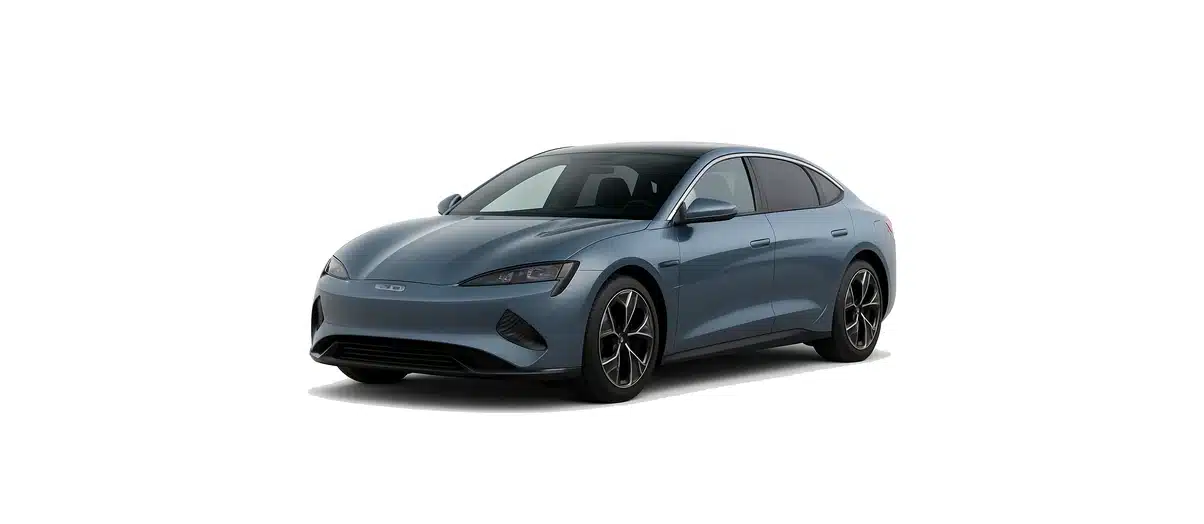
The BYD Seal is a full-electric saloon, not a plug-in hybrid, and the current UK model is the MY26 BYD SEAL available in Design RWD and Excellence AWD trims. It uses BYD’s Blade Battery with LFP chemistry and is built around the brand’s e-Platform 3.0 with Cell-to-Body battery structure. For UK drivers, the most important charging points to understand are that the car supports up to 11 kW AC charging, but most homes will be limited to around 7.4 kW, and that its commonly quoted rapid-charging figures depend on the state-of-charge window being discussed.
In practical terms, the BYD Seal is straightforward to live with if you have access to a home wallbox, workplace charging or regular public charging. It uses the standard Type 2 connection for AC charging and CCS2 for DC rapid charging, with the charge port located at the right rear of the car. This guide focuses on UK ownership, cable choice and real-world charging expectations for the current MY26 Seal saloon.
BYD Seal Battery and Charging Specifications
The current UK BYD Seal uses an 82.5 kWh BYD Blade Battery in both Design RWD and Excellence AWD forms. EV Database lists the pack as 84.0 kWh nominal and 82.5 kWh usable, while BYD UK quotes the 82.5 kWh Blade Battery figure in its UK materials. The Blade Battery uses LFP chemistry, which is known for durability and thermal stability.
For charging, the key figures are:
- AC charging connector: Type 2
- DC rapid charging connector: CCS2
- Charge port location: right-rear
- Maximum AC charging rate: 11 kW, where three-phase AC supply is available
- Typical UK home charging rate: up to around 7.4 kW on a single-phase wallbox
- Maximum DC rapid charging rate: 150 kW
- BYD UK quoted DC charging time: 10-80% in 37 minutes for MY26
- Heat pump: standard on UK specification
- Vehicle-to-Load: standard, using a compatible dedicated discharge cable or adapter
Battery Options
The MY26 BYD Seal range is simpler than many electric-car line-ups because both UK trims use the same headline battery capacity. The difference is mainly in drivetrain and performance rather than battery size.
- BYD Seal Design RWD MY26: 82.5 kWh Blade Battery, rear-wheel drive, with a WLTP combined range of up to 354 miles.
- BYD Seal Excellence AWD MY26: 82.5 kWh Blade Battery, dual-motor all-wheel drive, with a WLTP combined range of up to 323 miles.
The Design RWD has the longer official range, while the Excellence AWD offers the added performance and traction of a dual-motor layout. When planning charging stops, it is worth using the correct trim-specific range rather than assuming one universal BYD Seal figure.
AC Charging Speed
The BYD Seal has an 11 kW AC on-board charger. This is useful at three-phase public or workplace AC charge points, and it can also be useful for drivers who have access to a suitable three-phase domestic or commercial installation. However, most UK homes are single-phase. On a typical 7.4 kW home wallbox, the Seal will not charge at 11 kW because the property supply is the limiting factor.
As a guide, EV Database estimates around 13 hours 15 minutes for a 0-100% charge at 7.4 kW, compared with around 9 hours at 11 kW on three-phase AC. In everyday use, most owners will not be charging from completely empty to completely full. A more common pattern is topping up overnight from, for example, 30% to 80%, which is comfortably achievable on a 7.4 kW wallbox.
For cable selection, the Seal uses a Type 2 charging cable for untethered AC charge points. A 32 amp Type 2 cable is usually the right choice for making full use of a single-phase 7.4 kW wallbox. If you regularly use 11 kW three-phase AC posts, a three-phase Type 2 cable is needed to benefit from the car’s maximum AC capability.
DC Rapid Charging Speed
For long journeys, the BYD Seal uses CCS2 DC rapid charging and has a peak DC rate of 150 kW. BYD UK quotes a 10-80% rapid-charging time of 37 minutes for the MY26 model. That is the figure to use for realistic motorway charging plans, because 10-80% is the usual rapid-charging window used by EV drivers.
You may also see a 26-minute figure associated with the Seal, but this is for 30-80% DC charging, not 10-80%. The distinction matters: charging from 10% to 30% adds a meaningful amount of energy and takes extra time, so the 26-minute figure should not be treated as the time for a fuller rapid-charge stop.
A 150 kW or faster public rapid charger is sufficient to reach the Seal’s stated peak DC charging rate, assuming conditions allow. Using a 350 kW ultra-rapid charger will not make the car charge above its own 150 kW limit. As with all EVs, the actual speed varies with battery temperature, state of charge, charger performance and site conditions.
Range and Efficiency
The MY26 BYD Seal Design RWD has the longer range of the two UK trims, with a WLTP combined figure of up to 354 miles. EV Database gives a real-world estimate of around 295 miles for the Design RWD. The Excellence AWD has a WLTP combined figure of up to 323 miles, with a real-world estimate of around 275 miles.
These real-world estimates are useful because motorway speed, cold weather, wet roads, cabin heating and driving style can all reduce range. The standard heat pump helps improve heating efficiency compared with a purely resistive heater, especially in colder conditions, but it does not remove the normal winter range reduction that EV drivers should expect.
For day-to-day use, many owners will rarely need to charge to 100%. Keeping the car in a comfortable middle range for routine use can make charging faster and more convenient. For long trips, charging to 100% at home before departure can make sense, while en-route charging is usually quickest if you stop around 80% unless the next leg requires more energy.
Charging at Home
For most UK BYD Seal owners, the best charging setup will be a dedicated 7.4 kW home wallbox. It is convenient, safer than relying on domestic sockets, and usually allows you to use lower-cost overnight electricity tariffs if you have a suitable energy plan. A tethered wallbox includes a fixed Type 2 lead, while an untethered wallbox requires you to plug in your own Type 2 cable.
If you choose an untethered charger, keep a compatible Type 2 cable in the car or near the charge point. A 5 metre cable suits many driveways, while a longer cable can be useful if the parking position or charge port location makes access awkward. Since the Seal’s charge port is at the right rear, consider where the car will be parked and where the wallbox will be mounted before choosing cable length.
A 3-pin charger is generally best suited as a backup or occasional charging solution, but can be used regularly if a qualified electrician has confirmed the socket and electrical installation are suitable for sustained EV charging. Because the Seal has a large 82.5 kWh usable battery, charging from a domestic plug is slow and is not the ideal primary solution for most owners.
Public Charging
Public charging falls into two main categories for the BYD Seal: AC destination charging and DC rapid charging. AC chargers are commonly found in car parks, hotels, workplaces and town centres. These use the car’s Type 2 inlet and are best suited to longer stops. If the post is untethered, you will need your own Type 2 cable.
DC rapid and ultra-rapid chargers use the CCS2 connector and are the preferred option for motorway and intercity travel. For the Seal, look for a charger rated at 150 kW or above if you want the best chance of reaching the car’s peak rate. A charger rated below 150 kW can still be useful, but the car will be limited by the charger output. A charger rated far above 150 kW may not reduce the stop time significantly because the vehicle limit remains 150 kW.
For efficient trip planning, aim to arrive at a rapid charger with a reasonably low state of charge and leave at around 80% unless you need the extra range. Charging typically slows at higher states of charge, so the final 20% can take disproportionately longer than the middle of the battery.
Vehicle-Specific Features
The BYD Seal’s Blade Battery and Cell-to-Body structure are important parts of the car’s design. The battery pack is integrated into the vehicle structure, helping with packaging and body rigidity. From a charging perspective, the main owner benefit is that both MY26 trims share the same usable battery capacity and charging hardware, so cable choice and basic charging routines are similar across the range.
Vehicle-to-Load is listed as standard on the UK Seal. This allows the car to power suitable external electrical devices when used with the correct BYD-compatible discharge adapter or cable. Owners should not assume the V2L cable is always included, as BYD notes that a dedicated cable is required and availability can depend on specification or policy.
The Seal does not support V2G or V2H according to the available UK data, so it should not be treated as a vehicle that can export power back to the grid or directly power a home installation. Battery preconditioning for rapid charging is also listed as not available for the MY26 Seal, so journey planning should allow for the fact that charging performance may vary more with temperature and recent driving conditions.
Charging Tips
- Use the right AC expectation: the car can accept 11 kW AC, but most UK home wallboxes will provide up to 7.4 kW on single-phase power.
- Choose cable type carefully: a single-phase 32 amp Type 2 cable suits many home and public AC situations, while a three-phase cable is needed for regular 11 kW AC use.
- Plan rapid stops around 10-80%: BYD’s MY26 10-80% figure is 37 minutes; the 26-minute figure refers to 30-80%.
- Do not chase higher charger numbers unnecessarily: a 150 kW or faster charger is enough for the Seal’s peak DC capability.
- Stop at 80% on rapid chargers when practical: it is usually quicker and more considerate to other drivers.
- Allow for weather: cold, wet and high-speed driving will reduce range, even with the standard heat pump.
- Check V2L equipment: use only a suitable BYD-compatible discharge cable or adapter for Vehicle-to-Load functions.
Frequently Asked Questions
Is the BYD Seal a plug-in hybrid?
No. The UK BYD Seal saloon covered here is a full-electric BEV. It should not be confused with similarly named BYD plug-in hybrid models such as the SEAL 6 DM-i, SEAL 6 DM-i Touring or SEAL U DM-i.
What charging cable does the BYD Seal use?
The BYD Seal uses a Type 2 connection for AC charging and a CCS2 connection for DC rapid charging. For untethered home, workplace and destination chargers, you will need a Type 2 cable.
Can the BYD Seal charge at 11 kW at home?
Only if the property has a suitable three-phase supply and compatible charging equipment. Most UK homes are single-phase, so the practical home charging maximum is usually around 7.4 kW.
How long does the BYD Seal take to rapid charge?
BYD UK quotes 10-80% in 37 minutes for the MY26 Seal. A separate 30-80% figure of 26 minutes is also quoted in BYD materials, but that is a narrower charging window and should not be used as the 10-80% time.
Does the BYD Seal support Vehicle-to-Load?
Yes, Vehicle-to-Load is listed as standard, but it requires the correct compatible discharge cable or adapter. Owners should check whether the cable is included with their vehicle or needs to be purchased separately.
What This Means for Drivers
The BYD Seal is well suited to UK EV life when its charging figures are understood correctly. At home, most owners should think in terms of 7.4 kW overnight charging, not 11 kW, unless they have three-phase power. On the road, the car’s 150 kW CCS charging capability is strong enough for convenient long-distance travel, but realistic planning should use the 10-80% rapid-charge window rather than the shorter 30-80% claim.
The Design RWD is the better choice if maximum range is the priority, while the Excellence AWD trades some official range for all-wheel-drive performance. Either way, the same Type 2 and CCS2 charging setup applies, making cable selection and public charging straightforward.
Looking for a Charging Cable for BYD Seal?
If you need a compatible Type 2 charging cable for home, workplace or public AC charging, We offer BYD Seal charging cables suitable for UK use.
Please note that this information is intended as a guide. Charging specifications may change due to model and year of manufacture. For precise information, always refer to your vehicle user manual.

