
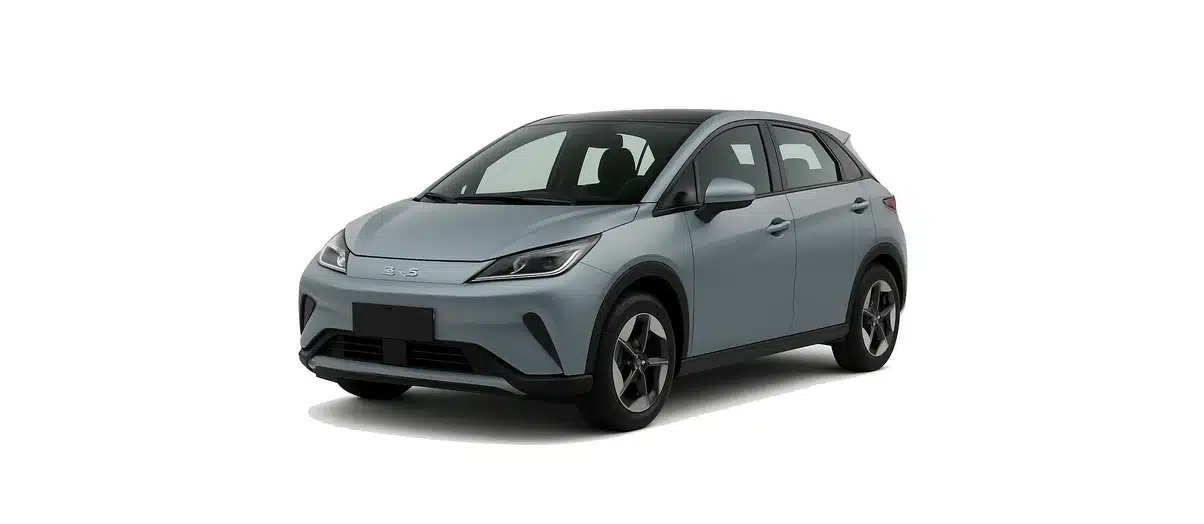
If you are searching for BYD Seagull charging cables in the UK, the first thing to know is that BYD UK sells the UK-market equivalent as the BYD Dolphin Surf. The Seagull name is used in other markets, while UK cars are officially badged Dolphin Surf. For charging, this distinction matters because UK and European Dolphin Surf specifications should be used rather than Chinese-market Seagull or Dolphin Mini figures.
The UK BYD Dolphin Surf is a fully electric 5-door city hatchback. It is available in Active, Boost and Comfort trims, with battery sizes and charging speeds that differ slightly by version. All UK versions use a Type 2 connector for AC charging and a CCS Combo 2 connector for DC rapid charging, which makes them compatible with the standard UK and European EV charging infrastructure.
View BYD Seagull (UK-market equivalent: BYD Dolphin Surf) Charging Cables
BYD Seagull (UK-market equivalent: BYD Dolphin Surf) Battery and Charging Specifications
For UK drivers, the relevant model is the BYD Dolphin Surf. It is a battery electric vehicle only, not a plug-in hybrid, and it uses BYD’s Blade Battery with LFP chemistry on BYD’s e-Platform 3.0. The UK line-up consists of three trims: Active, Boost and Comfort.
Across the range, the charging port arrangement is straightforward: Type 2 for AC charging at home, work and public destination chargers, and CCS Combo 2 for DC rapid charging on motorway and high-power public chargers. All UK Dolphin Surf versions are listed with up to 11 kW AC charging, although achieving the full 11 kW rate normally requires access to a three-phase AC supply.
DC rapid charging varies by battery version. The smaller Active battery is listed at up to around 65 kW DC, while the larger 43.2 kWh Boost and Comfort versions are listed at up to around 85 kW DC. As with any EV, these are peak figures; real charging speed depends on battery temperature, state of charge, charger capability and site conditions.
Battery Options
The UK Dolphin Surf range has two main battery capacities spread across three trims:
- Active 30 kWh: BYD UK lists a 30 kWh battery and a WLTP combined range of 137 miles. EV Database estimates 32.0 kWh nominal capacity and 30.0 kWh usable capacity.
- Boost 43.2 kWh: BYD UK lists a 43.2 kWh battery and a WLTP combined range of 200 miles. EV Database estimates 46.0 kWh nominal capacity and 43.2 kWh usable capacity.
- Comfort 43.2 kWh: The Comfort uses the same 43.2 kWh battery as the Boost but has a more powerful 115 kW motor. BYD UK lists a WLTP combined range of 193 miles.
The Active is the shortest-range version but also has the smallest battery to refill, so it can be very convenient for local use. The Boost is the range leader on official WLTP figures, while the Comfort prioritises stronger performance with a small range reduction compared with the Boost.
AC Charging Speed
All UK BYD Dolphin Surf versions support up to 11 kW AC charging through the Type 2 port. This is useful for a compact EV because many small electric cars are limited to 7.4 kW or less on AC. However, most UK homes have a single-phase electrical supply, so a typical home wallbox will charge at up to 7.4 kW rather than 11 kW.
On a 7.4 kW single-phase home charger, you can expect roughly 5 hours for the 30 kWh Active from empty to full, and roughly 7 hours for the 43.2 kWh Boost and Comfort versions. In day-to-day ownership, charging is often from a partial battery rather than completely empty, so overnight charging should be more than adequate for most drivers.
To use the full 11 kW AC capability, you normally need a three-phase AC charger, such as those sometimes found at workplaces, hotels, business parks and some public destination charging sites. The benefit is most noticeable when you need a faster top-up during the day rather than a slow overnight charge.
DC Rapid Charging Speed
For longer journeys, the BYD Dolphin Surf uses CCS Combo 2 for DC rapid charging. The Active 30 kWh version is listed at up to around 65 kW, with an estimated 10-80% charging time of about 29 minutes. The Boost and Comfort versions, with the larger 43.2 kWh battery, are listed at up to around 85 kW, with an estimated 10-80% time of about 32 minutes.
The most efficient way to use rapid chargers is usually to charge from around 10% to 80% rather than waiting for 100%. DC charging slows significantly at higher states of charge to protect the battery, so the final 20% can take disproportionately longer. On a long trip, two shorter rapid charging stops can sometimes be quicker than one long stop to 100%.
Battery preconditioning is not shown as available for the UK Dolphin Surf in the research data. That means rapid charging in cold weather may be slower than the peak figures, especially if the car has been parked outside or driven only a short distance before arriving at a charger.
Range and Efficiency
The UK WLTP range figures vary by trim, so it is important not to quote a single range for every Dolphin Surf. BYD UK lists the Active at 137 miles WLTP, the Boost at 200 miles WLTP, and the Comfort at 193 miles WLTP. Real-world range will vary with speed, temperature, tyre condition, load, weather and driving style.
As a general guide, the larger-battery versions may deliver around 165 miles in mixed real-world use, although this should be treated as an estimate rather than a guarantee. Motorway driving in winter will reduce range, while urban driving in mild weather can be much more efficient. This is typical for compact EVs, which tend to perform especially well in town use but use more energy at sustained higher speeds.
The Dolphin Surf’s LFP battery chemistry is well suited to regular everyday use. As with any EV, following the guidance in the vehicle handbook for charging limits, storage and battery care is sensible, particularly if the car is left unused for long periods.
Charging at Home
For most UK owners, home charging will be the most convenient and cost-effective way to run a BYD Dolphin Surf. A dedicated 7.4 kW home wallbox is likely to be sufficient for the majority of drivers, even though the car can accept up to 11 kW on suitable three-phase AC supplies. Plugging in overnight can restore a large amount of range by morning, and scheduled charging can help make use of off-peak electricity tariffs where available.
You will need a suitable Type 2 charging cable for untethered home chargers and many public AC charge points. If your home wallbox is tethered, it will have its own attached cable, but carrying a separate Type 2 cable is still useful for workplace and public destination charging.
A 3-pin portable charger is generally best suited as a backup or occasional charging solution, but can be used regularly if a qualified electrician has confirmed the socket and electrical installation are suitable for sustained EV charging. Domestic sockets were not originally designed for repeated high-load EV charging over many hours, so a professionally installed wallbox is normally the better long-term option.
Public Charging
Public charging for the BYD Dolphin Surf falls into two main categories: AC destination charging and DC rapid charging. AC charge points usually require your own Type 2 cable unless the unit is tethered. These are commonly found in car parks, supermarkets, hotels, workplaces and town centres. They are useful when the car will be parked for a few hours.
DC rapid chargers use a tethered CCS cable, so you do not use your own cable for rapid charging. These chargers are best suited to longer journeys or quick top-ups when you need to continue driving. The Dolphin Surf’s charging speeds are not in the ultra-rapid class, but the battery sizes are modest, so 10-80% charging stops can still be relatively short.
When using public chargers, check the connector type, charging power and payment method before you arrive where possible. A higher-powered charger will not damage the car; the vehicle will only take the power it can accept. However, if a lower-powered rapid charger is the only option available, the session will take longer.
Vehicle-Specific Features
The BYD Dolphin Surf supports Vehicle-to-Load (V2L) technology via a Type 2 adapter. This allows the car to provide AC power for compatible external devices, subject to the vehicle’s limits and the correct equipment. EV Database lists V2L output at up to around 3.3 kW, and BYD UK describes the car as having V2L technology.
V2L is different from Vehicle-to-Grid or Vehicle-to-Home. The UK Dolphin Surf is not listed as supporting V2G or V2H, so it should not be treated as a home battery or grid export solution. It is better understood as a practical feature for powering small appliances or equipment when used within the vehicle’s stated limits.
The research data does not show a heat pump as available on the UK Dolphin Surf, and battery preconditioning is also not shown as available. In practical terms, winter efficiency and cold-weather rapid charging may be less strong than in some EVs fitted with those systems. Owners can still help by keeping the car plugged in when possible and allowing extra charging time during colder months.
Charging Tips
- Buy for the UK Dolphin Surf specification: If you are searching under the BYD Seagull name, make sure you use UK Dolphin Surf Type 2 and CCS specifications, not non-UK Seagull figures.
- Choose a Type 2 cable for AC charging: This is the cable used for untethered home wallboxes, workplace chargers and many public AC posts.
- Use CCS for rapid charging: DC rapid chargers have tethered cables, so you do not need to bring your own CCS cable.
- Plan rapid stops around 10-80%: Charging beyond 80% on DC usually slows down, so it is rarely the quickest strategy on a long journey.
- Make use of 11 kW AC where available: Workplace or public three-phase AC charging can be useful, particularly if you need a faster daytime refill.
- Expect seasonal variation: Cold weather, wet roads and motorway speeds can reduce range and slow charging.
Frequently Asked Questions
Is the BYD Seagull sold in the UK?
BYD UK sells the UK-market equivalent as the BYD Dolphin Surf, not the Seagull. For UK charging advice, use Dolphin Surf specifications rather than Chinese-market Seagull or Dolphin Mini data.
What charging cable does the BYD Dolphin Surf use?
The UK BYD Dolphin Surf uses a Type 2 cable for AC charging. This is the cable you need for most untethered home, workplace and public AC charge points.
Can the BYD Dolphin Surf use rapid chargers?
Yes. The car uses CCS Combo 2 for DC rapid charging. The Active is listed at up to around 65 kW DC, while Boost and Comfort versions are listed at up to around 85 kW DC.
How long does it take to charge at home?
On a typical 7.4 kW UK home wallbox, expect roughly 5 hours for the 30 kWh Active and around 7 hours for the 43.2 kWh Boost and Comfort versions from empty to full. Partial top-ups will be quicker.
Does the BYD Dolphin Surf have V2L?
Yes, V2L is supported via a Type 2 adapter. It can provide AC power for compatible external devices within the vehicle’s limits. It is not the same as V2G or V2H, which are not listed as supported.
What This Means for Drivers
The BYD Seagull name can easily cause confusion for UK drivers, but the practical answer is simple: if you are buying or charging the UK car, treat it as a BYD Dolphin Surf. It uses Type 2 AC charging, CCS rapid charging and offers up to 11 kW AC capability across the range. A 7.4 kW home wallbox will suit most owners, while three-phase 11 kW AC charging can be useful at work or public destinations.
The Active is best suited to shorter daily mileage and urban use, while the Boost and Comfort provide the larger battery for more flexibility. For longer journeys, plan around 10-80% rapid charging stops and allow for slower charging in cold conditions. With the right Type 2 cable and a realistic understanding of its charging speeds, the Dolphin Surf should be a straightforward EV to live with in the UK.
Looking for a Charging Cable for BYD Seagull (UK-market equivalent: BYD Dolphin Surf)?
We offer charging cables suitable for the UK BYD Seagull equivalent, sold as the BYD Dolphin Surf, including Type 2 options for home, workplace and public AC charging.
View BYD Seagull (UK-market equivalent: BYD Dolphin Surf) Charging Cables
Please note that this information is intended as a guide. Charging specifications may change due to model and year of manufacture. For precise information, always refer to your vehicle user manual.

