
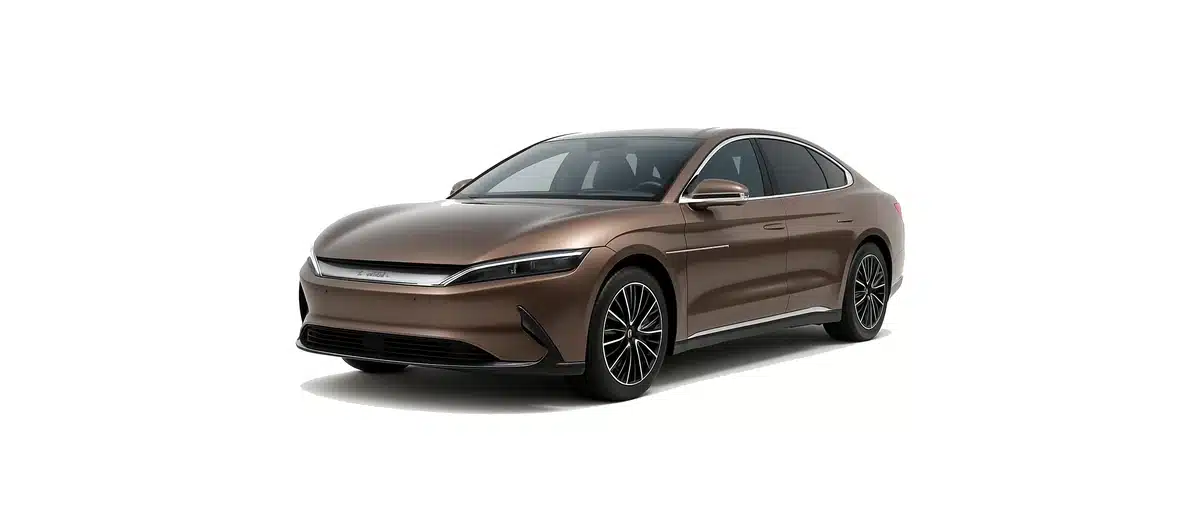
The BYD Han is a large, pure-electric executive saloon that arrived in Europe as one of BYD’s flagship models. In the UK it is now best treated as a rarer or discontinued model rather than a mainstream new-car choice, but for owners and used buyers it remains a capable long-distance EV with a large Blade Battery, all-wheel drive and familiar European charging hardware.
For charging, the key point is simple: the UK/EU BYD Han uses a Type 2 connection for AC charging and CCS Combo 2 for DC rapid charging. Its rapid charging capability is respectable at up to around 120 kW, but its AC charging is more modest than some executive EVs. That means home charging is best planned around overnight sessions, while public rapid charging should be based around realistic 10–80% stops rather than ultra-fast figures associated with newer China-market Han or Han L models.
BYD Han Battery and Charging Specifications
The UK/EU-market BYD Han covered in this guide is a battery-electric vehicle, not a plug-in hybrid. The relevant European specification uses a large BYD Blade Battery with LFP chemistry and a dual-motor all-wheel-drive layout. The charging port is positioned on the right rear side of the vehicle and supports Type 2 AC charging and CCS Combo 2 DC charging.
- Vehicle type: pure-electric executive saloon
- Charging port: Type 2 AC / CCS Combo 2 DC
- Charge port location: right rear side
- AC charging: commonly listed at around 6.6 kW, with some market-dependent 7.4 kW references
- Recommended AC cable: 32A Type 2 charging cable
- DC rapid charging: up to around 120 kW
- WLTP range: up to 324 miles, based on the European 521 km figure
- Estimated real-world range: around 295 miles, depending on conditions
Because the Han’s AC charging capability is limited by the car’s onboard charger, connecting it to an 11 kW or 22 kW AC post will not make it charge at those higher rates. The car will draw only what it can accept.
Battery Options
The European BYD Han was offered with a large Blade Battery pack. BYD’s European material refers to an 85.4 kWh battery capacity, while independent databases differ slightly in how they label gross, nominal and usable capacity. EV Database, for example, lists an estimated 88.0 kWh nominal figure and 85.4 kWh usable capacity, while other sources interpret the figures differently.
For drivers, the practical takeaway is that the Han has a large battery by saloon standards and enough capacity for long motorway journeys, but it also means AC charging from a low battery can take a long time. Overnight home charging suits the car well, while rapid charging is the more appropriate option during longer trips.
The battery uses BYD’s LFP Blade Battery chemistry. LFP batteries are known for robustness and may benefit from occasional charging to 100% for state-of-charge calibration, but owners should still follow the vehicle’s in-car guidance and schedule charging around their journeys, tariff and parking routine.
AC Charging Speed
For everyday charging, the BYD Han uses a Type 2 AC connection. Evidence for the UK/EU model points to single-phase AC charging at around 6.6 kW, with some references to 7.4 kW capability in certain markets. For UK cable selection, a 32A Type 2 cable is the safest recommendation because it supports the Han’s single-phase AC capability and will also work correctly at lower-powered public AC posts.
On a typical 7 kW home charge point, the Han is likely to be limited by the car rather than the charger. A full charge from very low to 100% may take roughly 13 to 15 hours once charging losses and the taper near full are considered. A more typical 20–80% charge is more manageable and can often be completed overnight.
It is important not to confuse AC post ratings with the vehicle’s onboard charger. If you plug the Han into an 11 kW or 22 kW public AC charger, it will not charge at 11 kW or 22 kW. The post may be capable of more, but the Han will draw only its own AC limit.
DC Rapid Charging Speed
For longer journeys, the BYD Han uses CCS Combo 2 rapid charging. The European specification is commonly listed with a peak DC charging rate of around 120 kW. EV Database estimates a 10–80% rapid charge time of about 44 minutes, while BYD has quoted a 30–80% charge in around 30 minutes on a suitable 120 kW charger under favourable conditions.
A 150 kW rapid charger is therefore sufficient to access the Han’s quoted peak charging rate. Using a 350 kW ultra-rapid charger will not push the car beyond its own charging limit, although it may still be convenient if that is the charger available at a motorway site.
As with all EVs, peak charging speed is not held from 0–100%. The fastest part of a rapid charge is usually in the lower and middle part of the battery. For efficient journey planning, it is usually better to charge in the 10–80% window rather than waiting for a slower final top-up to 100% unless you need the extra range.
Range and Efficiency
The BYD Han’s official European WLTP combined range is 521 km, which is approximately 324 miles. In mixed real-world driving, a figure around 295 miles is a useful planning estimate, although actual range will vary with speed, temperature, tyre condition, terrain, payload and use of heating or air conditioning.
On UK motorways in winter, range can be lower than the headline WLTP figure, especially at sustained higher speeds. In urban and suburban driving, the Han may get closer to its official range because EVs tend to be more efficient at lower speeds and can recover energy through regenerative braking.
The Han is fitted with a heat pump in the European specification, which can help reduce energy use for cabin heating compared with a purely resistive heating system. However, cold weather still affects battery efficiency and charging speed, so it is sensible to leave a larger range buffer during winter journeys.
Charging at Home
Home charging is likely to be the most convenient and cost-effective way to run a BYD Han. Because the car has a large battery but relatively modest AC charging power, a dedicated home charge point is strongly recommended where off-street parking is available.
If you have a 7 kW home wallbox, the Han should comfortably add a meaningful amount of range overnight. Many owners will not need to charge from empty to full; instead, they may plug in when the battery drops to a chosen level and schedule charging during cheaper off-peak electricity periods.
If your home charger is untethered, you will need a Type 2 to Type 2 cable. A 32A single-phase Type 2 cable is the practical choice for the BYD Han in the UK. It gives the car access to its available AC charging rate and remains compatible with public AC charge points that require drivers to bring their own cable.
A 3-pin charging cable can be useful in limited situations, but it is generally best suited as a backup or occasional charging solution. It can be used regularly if a qualified electrician has confirmed the socket and electrical installation are suitable for sustained EV charging. Because the Han has a large battery, charging from a domestic socket will be slow and is not the most practical main charging method for most owners.
Public Charging
For public AC charging, the BYD Han uses the same Type 2 connection as most modern European EVs. Many destination chargers at supermarkets, hotels, workplaces and town-centre car parks require your own cable, so keeping a Type 2 cable in the boot is useful.
At AC posts rated 7 kW, 11 kW or 22 kW, the Han will still be limited by its onboard AC charger. This makes public AC charging best suited to longer parking sessions, such as while at work, staying overnight at a hotel or spending several hours in a city centre.
For motorway and long-distance travel, use CCS rapid chargers. The Han’s 120 kW peak means a 150 kW-class charger is a good match. Ultra-rapid 350 kW chargers are not harmful, but they will not make the vehicle charge at 350 kW. Plan stops around practical charging windows and allow for charger availability, weather and the fact that charging slows as the battery fills.
Vehicle-Specific Features
The BYD Han has several features worth noting from a charging and ownership perspective. Its Blade Battery uses LFP chemistry, which is different from the nickel-rich battery packs found in many other premium EVs. LFP batteries are often associated with strong cycle durability, although owners should still follow BYD’s vehicle guidance for charging habits and software prompts.
Vehicle-to-Load support is listed for the European Han, using an appropriate adapter. This can allow the car to power external equipment, which may be useful for camping, work tools or emergency backup for small devices. It should not be confused with Vehicle-to-Grid or Vehicle-to-Home capability; those are not supported for this model based on the available European data.
Battery preconditioning for rapid charging is not listed as available for the European BYD Han. In practice, that means charging performance may be more dependent on recent driving, ambient temperature and battery temperature than in EVs with active preconditioning linked to route planning.
Charging Tips
- Choose a 32A Type 2 cable: this is the most suitable general-purpose cable for UK home and public AC charging.
- Do not rely on 11 kW or 22 kW AC speeds: the Han’s onboard charger is the limiting factor on AC.
- Use CCS for long journeys: rapid charging is far quicker than AC charging when travelling beyond the car’s daily range.
- Look for 150 kW chargers: these are enough to access the Han’s quoted 120 kW peak DC rate.
- Plan around 10–80%: this is usually the most time-efficient rapid charging window.
- Allow more time in winter: cold weather can reduce range and slow rapid charging.
- Use scheduled charging: if your tariff offers cheaper overnight electricity, scheduling can significantly reduce running costs.
Frequently Asked Questions
What charging cable does the BYD Han use?
The BYD Han uses a Type 2 connection for AC charging. For UK use, a 32A Type 2 to Type 2 cable is the recommended option for untethered home chargers and public AC charge points.
Can the BYD Han charge at 22 kW AC?
Available European data points to single-phase AC charging at around 6.6 kW, with some market-dependent references to 7.4 kW. It should not be treated as an 11 kW or 22 kW AC vehicle for UK cable guidance.
How fast can the BYD Han rapid charge?
The European BYD Han is listed with up to around 120 kW DC rapid charging. A 10–80% rapid charge is estimated at about 44 minutes, while BYD has quoted 30–80% in around 30 minutes in favourable conditions.
Is the BYD Han a plug-in hybrid?
The UK/EU BYD Han covered here is a pure-electric vehicle. The wider Han family in China has included plug-in hybrid variants, but those specifications should not be used for UK Han charging-cable guidance.
Does the BYD Han support Vehicle-to-Load?
Yes, Vehicle-to-Load is listed for the European BYD Han when used with a suitable adapter. Vehicle-to-Grid and Vehicle-to-Home support should not be assumed for this model.
What This Means for Drivers
The BYD Han is straightforward to charge in the UK because it uses standard Type 2 and CCS Combo 2 connections. The main ownership consideration is that its AC charging rate is modest for a large-battery executive EV, so the car is best matched with regular overnight home charging and occasional CCS rapid charging on longer trips.
For cable selection, a 32A Type 2 cable is the sensible choice. It covers the Han’s AC charging needs, works with UK public AC posts and avoids paying extra attention to higher AC post ratings that the vehicle cannot fully use. For rapid charging, no separate cable is required because CCS rapid chargers have tethered cables attached to the charger.
Looking for a Charging Cable for BYD Han?
We offer compatible BYD Han charging cables for home and public AC charging, including Type 2 options suitable for UK charging points.
Please note that this information is intended as a guide. Charging specifications may change due to model and year of manufacture. For precise information, always refer to your vehicle user manual.

