
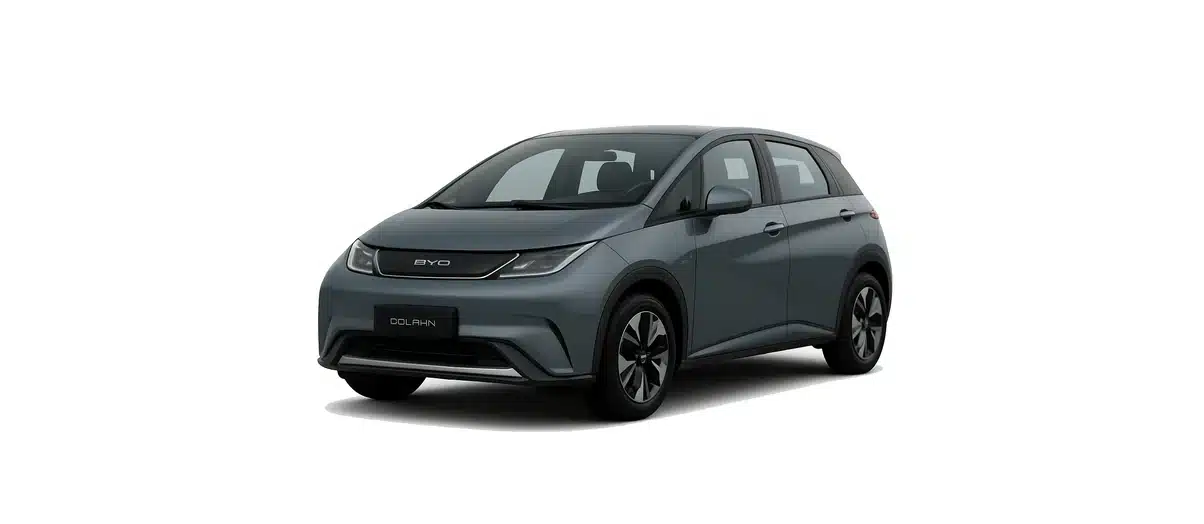
The BYD Dolphin is a pure-electric 5-door hatchback sold in the UK with Type 2 AC charging and CCS rapid charging. It is important, however, not to treat every Dolphin as having the same charging specification. UK cars have been offered with different battery sizes and trim names, and the charging limits can vary depending on whether you have an earlier 44.9 kWh Active or Boost model, or a 60.4 kWh Comfort or Design model.
This guide is written as a practical variant-checker for UK drivers. It explains the battery options, home charging expectations, public charging behaviour and cable choice for the BYD Dolphin, with careful notes where model year and trim differences matter.
View BYD Dolphin Charging Cables
BYD Dolphin Battery and Charging Specifications
The BYD Dolphin is a BEV, meaning it is fully electric rather than a plug-in hybrid, hybrid or range-extender. UK-market cars use BYD’s LFP Blade Battery technology and are based on BYD’s e-Platform 3.0. The charging port arrangement is straightforward: Type 2 for AC charging and CCS Combo 2 for DC rapid charging.
For most UK owners, the most important point is that home charging speed will usually be governed by the onboard AC charger and the property’s electricity supply. Even where a Dolphin can accept up to 11 kW AC, that is typically only possible on a suitable three-phase supply. Most UK homes are single-phase, so a dedicated home charge point will usually deliver up to around 7.4 kW.
| Vehicle | BYD Dolphin |
|---|---|
| Vehicle type | Pure-electric hatchback |
| AC charging port | Type 2 |
| DC rapid charging port | CCS Combo 2 |
| Typical UK home charging | Up to around 7.4 kW on a single-phase home charge point |
| Maximum AC charging | Up to 11 kW on suitable variants and three-phase supply |
| Maximum DC rapid charging | Varies by battery/model year; current MY25 60.4 kWh data lists up to 110 kW |
Battery Options
There are two main battery sizes relevant to UK BYD Dolphin owners.
44.9 kWh Active / Boost: Earlier UK launch and used-market cars may have the 44.9 kWh LFP Blade Battery. BYD UK material lists WLTP range at 211 miles for Active and 193 miles for Boost. EV Database estimates a gross capacity of around 46.0 kWh and usable capacity of around 44.9 kWh for these cars. The Active trim is not generally treated as a current new-car UK trim in the latest data, so this battery is especially relevant for used or recent-stock buyers.
60.4 kWh Comfort / Design: Comfort and Design models use the larger battery. BYD UK material lists rated capacity at 60.4 kWh and WLTP range at 265 miles. EV Database MY25 data estimates around 62.0 kWh gross and 60.5 kWh usable. Current BYD UK retail material has focused on Comfort and Design, but owners should still confirm the exact model year because rapid charging figures have changed across sources and versions.
AC Charging Speed
The BYD Dolphin uses a Type 2 connection for AC charging. This is the charging you will use at home, at many workplace units and at destination chargers in places such as hotels, supermarkets and public car parks.
For current 60.4 kWh Comfort and Design cars, EV Database lists an 11 kW AC maximum, but this requires a suitable three-phase supply. Most UK homes do not have three-phase power, so the realistic day-to-day home charging expectation is up to around 7.4 kW from a dedicated single-phase wallbox. On the larger-battery Dolphin, a full 0-100% charge at 7.4 kW is likely to be an overnight job, with EV Database indicating around 9 hours 45 minutes for the 60.4 kWh car in that scenario.
For earlier 44.9 kWh cars, the specification needs checking carefully. BYD UK launch material listed the Active at 7 kW/7.4 kW AC and the Boost at 11 kW AC, while EV Database lists the 44.9 kWh Boost at 7.4 kW. If you own or are buying a Boost, it is worth checking the vehicle documentation or VIN-specific specification rather than assuming the higher number.
A 22 kW public AC post will not make the Dolphin charge at 22 kW. The car’s onboard charger sets the limit, so the vehicle will draw up to its own supported AC rate, depending on variant and supply.
DC Rapid Charging Speed
For longer journeys, the BYD Dolphin uses CCS rapid charging. This bypasses the onboard AC charger and feeds DC power directly to the battery management system, subject to charger capability, battery temperature, state of charge and the car’s own charging curve.
For current 60.4 kWh MY25 data, EV Database lists up to 110 kW DC charging and around 36 minutes for a 10-80% charge in suitable conditions. That is a useful planning figure, but real sessions can be slower if the battery is cold, the charger is shared or limited, or the car is already at a high state of charge. EV Database lists battery preconditioning as not available for the MY25 60.4 kWh Dolphin, so in cold weather the first rapid charge of the day may not always reach the best-case speed.
Earlier UK material for Comfort and Design listed 88 kW DC and a 30-80% time of 29 minutes. Earlier 44.9 kWh Active and Boost cars are lower again, with BYD UK material listing 65 kW DC and a 30-80% time of around 28 minutes. For the 44.9 kWh cars, a cautious real-world planning estimate is roughly 38-40 minutes for 10-80% rather than using the newer MY25 110 kW figure.
The practical message is simple: do not assume every BYD Dolphin charges at 110 kW. Check the battery size, trim and model year before planning rapid charging stops.
Range and Efficiency
Official WLTP range varies by version. BYD UK material lists 211 miles for the 44.9 kWh Active, 193 miles for the 44.9 kWh Boost, and 265 miles for the 60.4 kWh Comfort and Design. These figures are useful for comparing vehicles, but day-to-day range will depend on driving style, speed, weather, load, tyre condition and use of heating or air conditioning.
EV Database estimates a real-world range of around 215 miles for the 60.4 kWh MY25 car. That makes it well suited to commuting, school runs and regional journeys, with rapid charging available for longer motorway trips. Drivers of 44.9 kWh cars should expect a shorter usable range and may want to plan rapid charging stops a little more conservatively on longer journeys.
Charging at Home
For most BYD Dolphin owners, home charging will be the cheapest and most convenient way to run the car. A dedicated 7.4 kW home charge point is the usual recommendation for a UK single-phase property. It allows the car to charge overnight and makes it easier to take advantage of off-peak EV tariffs where available.
If you have a tethered home charger, the cable is already attached to the unit. If you have an untethered wallbox, you will need a Type 2 charging cable suitable for the BYD Dolphin. Many owners choose a 32 amp Type 2 cable because it is appropriate for 7.4 kW single-phase charging and can also be used at many public AC posts.
A 3-pin charging cable can be useful, but it should be treated carefully. A 3-pin charger is generally best suited as a backup or occasional charging solution, but can be used regularly if a qualified electrician has confirmed the socket and electrical installation are suitable for sustained EV charging. Avoid using extension leads, damaged sockets or unknown outdoor supplies.
Public Charging
Public charging for the BYD Dolphin splits into two main types: AC destination charging and DC rapid charging.
AC destination chargers are often untethered, so you may need to bring your own Type 2 cable. These units are useful when the car will be parked for a while, such as during work, shopping, a hotel stay or a town-centre visit. A 7 kW or 22 kW AC post may look different on the map, but the Dolphin will only draw what its onboard charger and supply arrangement allow.
DC rapid and ultra-rapid chargers normally have their own tethered CCS cable, so you do not use your own Type 2 cable for rapid charging. For the 60.4 kWh MY25 Dolphin, planning around a 10-80% session of about 36 minutes is sensible in good conditions. For earlier 44.9 kWh cars, allow closer to 38-40 minutes for 10-80% and remember that the peak charging speed is lower.
On long trips, it is usually more efficient to rapid charge from a lower state of charge to around 70-80% rather than waiting for the final 20%. Charging speed typically tapers as the battery fills, so the last part of a rapid charge can take disproportionately long.
Vehicle-Specific Features
The BYD Dolphin has several features that are worth knowing about from an ownership and charging point of view.
- LFP Blade Battery: The Dolphin uses BYD’s LFP Blade Battery technology, which is a key part of the vehicle’s engineering.
- Heat pump: Official BYD material confirms a heat pump as standard, helping the car manage cabin heating more efficiently than a simple resistive heater in many conditions.
- Vehicle-to-load: V2L is confirmed as standard, with official material and EV Database listing up to 3.3 kW external discharge. This can be useful for powering suitable external equipment when used correctly.
- No confirmed V2G or V2H: EV Database lists vehicle-to-grid and vehicle-to-home as unsupported for the MY25 60.4 kWh car.
- No battery preconditioning listed: EV Database lists battery preconditioning as not available for the MY25 60.4 kWh car and for the 44.9 kWh Boost, so cold-weather rapid charging may be less predictable than in EVs with active preconditioning.
Charging Tips
- Check your exact variant: Before comparing charging speeds, confirm whether you have a 44.9 kWh Active/Boost or 60.4 kWh Comfort/Design.
- Use 7.4 kW as the normal UK home benchmark: Even if your Dolphin supports 11 kW AC, most UK homes will be limited to single-phase charging.
- Do not chase 22 kW AC posts: A 22 kW AC charger will not override the Dolphin’s onboard AC charging limit.
- Rapid charge in the efficient window: For long journeys, charging to around 80% is usually quicker than waiting for 100%.
- Keep a Type 2 cable in the car: It is useful for untethered public AC chargers and untethered home wallboxes.
- Plan more carefully in winter: Cold conditions can reduce range and slow rapid charging, particularly without battery preconditioning.
Frequently Asked Questions
What charging cable does the BYD Dolphin use?
The BYD Dolphin uses a Type 2 cable for AC charging. For DC rapid charging, it uses the CCS Combo 2 connector fitted to the rapid charger’s tethered cable.
Can the BYD Dolphin charge at 22 kW AC?
No. A 22 kW AC post may be available, but the Dolphin is limited by its onboard charger. Depending on variant and supply, the practical AC limit is generally up to 7.4 kW on a UK single-phase home supply or up to 11 kW where the vehicle and three-phase supply support it.
How fast does the BYD Dolphin rapid charge?
It depends on the version. Current 60.4 kWh MY25 data lists up to 110 kW DC and about 36 minutes for 10-80%. Earlier 44.9 kWh Active/Boost cars have lower rapid charging capability, with roughly 38-40 minutes a sensible 10-80% planning estimate.
Is the BYD Dolphin a plug-in hybrid?
No. The BYD Dolphin is a pure-electric vehicle. It does not have a petrol engine and is not a PHEV or range-extender.
Does the BYD Dolphin support V2L?
Yes. Vehicle-to-load is confirmed as standard, with up to 3.3 kW external discharge listed in official and third-party specification data.
What This Means for Drivers
The BYD Dolphin is easy to charge once you know which version you have. For most UK owners, the daily routine will be a Type 2 cable and a 7.4 kW home charge point, with CCS rapid charging used for longer trips. The key is not to apply one charging figure to every Dolphin. A 60.4 kWh Comfort or Design model has different charging expectations from an earlier 44.9 kWh Active or Boost, especially when rapid charging.
If you are buying used, check the trim, battery size and model year carefully. If you are planning journeys, use the correct DC charging estimate for your car and allow extra time in cold weather or at busy charging sites.
Looking for a Charging Cable for BYD Dolphin?
We offer BYD Dolphin charging cables for home and public AC charging, including Type 2 options suitable for UK charging points. Choose a cable that matches your charging setup, your vehicle specification and how you expect to use the car day to day.
View BYD Dolphin Charging Cables
Please note that this information is intended as a guide. Charging specifications may change due to model and year of manufacture. For precise information, always refer to your vehicle user manual.

