
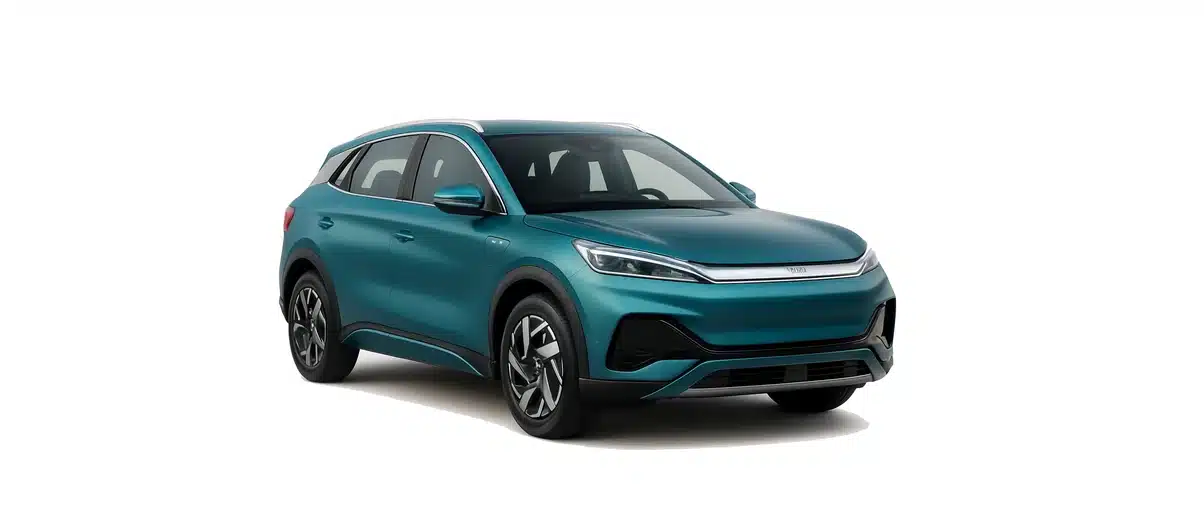
The BYD Atto 3 is a battery-electric compact SUV and one of BYD’s best-known UK models. For charging purposes, the most important point is that UK Atto 3 models use a Type 2 connection for AC charging and a CCS Combo 2 connection for DC rapid charging. That makes cable selection straightforward, but charging performance depends heavily on which version of the car you have.
Earlier UK Atto 3 models, the MY25 update and the newer Atto 3 EVO all share the same general charging hardware format, but they do not all rapid-charge at the same speed. The original MY23-24 car is listed with an 89 kW DC peak, the MY25 version increases this to 110 kW, and the 2026 Atto 3 EVO is a much more substantial update with up to 220 kW DC charging and a larger battery. This guide explains the practical differences for UK home charging, public charging and choosing the right cable.
View BYD Atto 3 Charging Cables
BYD Atto 3 Battery and Charging Specifications
For UK drivers, the Atto 3 should be treated as a fully electric vehicle, not a plug-in hybrid. It uses BYD’s Blade Battery technology and is built on BYD’s e-Platform 3.0 family. The current Atto 3 EVO is described by BYD UK as using the latest e-Platform 3.0 and brings a larger battery, faster rapid charging and updated UK trim choices.
The charging connector format is consistent across the UK Atto 3 family: Type 2 for AC charging and CCS Combo 2 for DC rapid charging. For home and many destination chargers, you will use a Type 2 cable or a tethered Type 2 wallbox. For motorway-style rapid charging, the CCS cable is attached to the charger, so you do not bring a separate CCS cable.
| Model context | Battery | AC charging | DC rapid charging | Typical rapid charging note |
|---|---|---|---|---|
| Atto 3 MY23-24 | 60.5 kWh usable, 62.0 kWh gross | Up to 11 kW | Up to 89 kW | Often around 36-40 minutes for 10-80%, depending on conditions and source |
| Atto 3 MY25 | 60.5 kWh usable, 62.0 kWh gross | Up to 11 kW | Up to 110 kW | Quicker than MY23-24, but not the same as Atto 3 EVO |
| Atto 3 EVO MY26 | 74.8 kWh quoted/usable battery capacity, around 76.0 kWh nominal estimate | Up to 11 kW | Up to 220 kW | BYD quotes around 25 minutes for 10-80% |
Battery Options
The original UK Atto 3 was sold with the larger battery rather than a UK new-car standard-range 48 kWh option. EV Database UK lists the MY23-24 Atto 3 with a 60.5 kWh usable battery and 62.0 kWh gross capacity. The MY25 Atto 3 kept the same stated battery size, but gained a higher DC peak charging rate.
The Atto 3 EVO is the major change. BYD UK media material quotes a 74.8 kWh Blade Battery for the new model, and EV Database UK treats this as 74.8 kWh usable with an estimated 76.0 kWh nominal capacity. It is available in Design RWD and Excellence AWD trims. The Design RWD has the longest official range figure, while the AWD version trades some efficiency for extra performance and traction.
Because there are several specification phases, it is worth checking your registration year, trim and handbook before relying on a single charging figure. A 2023 Atto 3 and a 2026 Atto 3 EVO may use the same Type 2 and CCS connector formats, but their battery size and rapid charging expectations are different.
AC Charging Speed
UK and European BYD Atto 3 models use Type 2 AC charging and are listed with an 11 kW onboard AC charger. This is useful on a suitable three-phase AC charger, such as some workplace, commercial or destination units. However, most UK homes have a single-phase supply, so a typical home wallbox will charge at up to 7.4 kW rather than the car’s full 11 kW AC capability.
At 7.4 kW, an older 60.5 kWh Atto 3 will usually charge comfortably overnight if you are not starting from empty. The larger Atto 3 EVO battery will take longer from a very low state of charge, but daily top-ups are still well suited to overnight home charging. If you have access to a suitable three-phase supply and an 11 kW charger, AC charging times can be reduced, but this is not the normal setup for most UK domestic properties.
For untethered home wallboxes and many public AC charge points, you will need a Type 2 to Type 2 charging cable. If your home charger is tethered, the cable is already attached to the wallbox, so you simply plug it into the car.
DC Rapid Charging Speed
Rapid charging is where the different Atto 3 versions vary most. The MY23-24 Atto 3 is listed at up to 89 kW DC, while the MY25 version is listed at up to 110 kW. These figures are useful for public charging, but they are peak rates rather than speeds you will see for the entire session.
The Atto 3 EVO is significantly faster, with BYD UK quoting up to 220 kW DC charging and a 10-80% charging time of around 25 minutes. That 25-minute figure should be understood as an Atto 3 EVO figure, not a universal claim for every Atto 3. Older cars will take longer, especially in cold weather, at high states of charge, or if the charger is shared, limited or not performing at its advertised rate.
For long journeys, the most efficient rapid-charging window is usually around 10-80%. Charging beyond 80% tends to slow down because the battery management system reduces the charging rate to protect the battery. It is often quicker overall to stop for a shorter top-up and continue, rather than waiting for the last 10-20% unless you need the extra range.
Range and Efficiency
The earlier UK Atto 3 is listed with a 261-mile WLTP range and an estimated real-world range of around 205 miles. The MY25 version keeps the same 261-mile WLTP figure, with EV Database UK estimating around 210 miles in mixed real-world use.
The Atto 3 EVO improves the headline figures. BYD UK quotes up to 316 miles WLTP for the Design RWD model. Independent reporting lists the Excellence AWD at up to 292 miles. EV Database UK estimates around 250 miles of real-world range for the Design RWD, although actual results will vary with temperature, speed, terrain, tyre choice, load and driving style.
Like most electric SUVs, the Atto 3 is most efficient in urban and moderate-speed driving. Motorway driving in winter, roof boxes, heavy loads and repeated high-speed sections will reduce range. For long trips, planning around realistic range rather than the maximum WLTP figure gives a more relaxed charging experience.
Charging at Home
For most UK Atto 3 owners, a dedicated home wallbox is the most convenient charging solution. A 7.4 kW single-phase wallbox can add a substantial amount of range overnight and is usually more practical than relying on public chargers for everyday use. If you are on an off-peak electricity tariff, scheduled overnight charging can also reduce running costs.
If your wallbox is untethered, choose a good-quality Type 2 cable with a suitable current rating for the charger. A 32 amp Type 2 cable is commonly chosen for UK home wallboxes because it supports up to 7.4 kW on single-phase AC and can also be useful at many public AC charge points. Where three-phase 11 kW AC charging is available, the cable and charge point must both support it.
A 3-pin charger is generally best suited as a backup or occasional charging solution, but can be used regularly if a qualified electrician has confirmed the socket and electrical installation are suitable for sustained EV charging. Standard domestic sockets were not designed primarily for repeated long-duration high-load charging, so professional advice is important if you plan to use one frequently.
Public Charging
Public charging falls into two broad categories: AC destination charging and DC rapid charging. AC destination chargers are often found in town centres, hotels, car parks and workplaces. Many are untethered, so you need your own Type 2 cable. Charging speed will depend on the charge point, the electrical supply and the Atto 3’s 11 kW onboard charger limit.
DC rapid chargers are used for shorter stops on longer journeys. These use the Atto 3’s CCS Combo 2 port and the cable is tethered to the charger. You do not need to buy or carry a separate CCS charging cable for rapid charging. Simply connect the charger’s CCS plug to the vehicle, follow the payment or app instructions, and monitor the session through the charger or the car.
One practical model-year difference is the charge-port position. Older UK Atto 3 models have the charge port around the right front wing area. EV Database UK lists the Atto 3 EVO with the charge port at the right rear. This can affect how you position the car at certain public chargers, especially where bays are tight or cables are short.
Vehicle-Specific Features
The Atto 3 family includes several features that are useful for EV ownership. A heat pump is confirmed as standard in the researched UK specification data, including for the Atto 3 EVO. A heat pump can help improve cold-weather efficiency compared with relying solely on resistive heating, although real-world benefit depends on conditions and usage.
Battery preconditioning is also listed as available/standard in the researched data. This can help the battery reach a more suitable temperature for charging or performance, but you should not assume that every version offers automatic navigation-based preconditioning unless your specific car’s software and handbook confirm it.
Vehicle-to-load, or V2L, is confirmed for the Atto 3 and Atto 3 EVO. This allows the car to power external devices using the correct compatible adapter or accessory. It is useful for camping equipment, tools or emergency low-power use, but it is not the same as certified vehicle-to-grid, vehicle-to-home or whole-home backup. The researched UK data does not support claiming V2G or V2H capability for the Atto 3.
Charging Tips
- Know your model year: an MY23-24 Atto 3, MY25 Atto 3 and MY26 Atto 3 EVO have different DC rapid charging expectations.
- Use Type 2 for AC charging: this applies at home, work and most destination AC chargers.
- Use CCS for rapid charging: rapid chargers have their own tethered CCS cable, so you do not bring a separate one.
- Plan around 10-80% on long trips: this is usually the most time-efficient rapid-charging window.
- Expect slower charging in some conditions: cold batteries, high state of charge and charger limitations can reduce the rate.
- Keep a cable in the boot: a Type 2 cable is useful for untethered public AC charging, even if you normally use a tethered home wallbox.
Frequently Asked Questions
What charging cable does the BYD Atto 3 use?
The UK BYD Atto 3 uses Type 2 for AC charging. For untethered home wallboxes and public AC charge points, you will normally use a Type 2 to Type 2 cable.
Does the BYD Atto 3 use CCS rapid charging?
Yes. UK Atto 3 models use CCS Combo 2 for DC rapid charging. The CCS cable is attached to the rapid charger, so owners do not need to carry a separate CCS cable.
Can the BYD Atto 3 charge at 11 kW at home?
The car supports up to 11 kW AC, but most UK homes are limited to around 7.4 kW on a typical single-phase wallbox. 11 kW AC charging normally requires a suitable three-phase supply.
Do all BYD Atto 3 models rapid-charge at 220 kW?
No. The 220 kW DC figure applies to the Atto 3 EVO in the researched UK data. Earlier MY23-24 cars are listed at up to 89 kW, while the MY25 version is listed at up to 110 kW.
Does the BYD Atto 3 support V2L?
Yes, V2L is confirmed in the researched UK data, using the correct compatible adapter or accessory. It should not be confused with V2G or whole-home backup, which are not supported in the same way.
What This Means for Drivers
For day-to-day charging, the BYD Atto 3 is simple to live with: use a Type 2 connection for home and destination AC charging, and use CCS rapid chargers for longer journeys. The key is to understand which version you own. Earlier Atto 3 models have a smaller battery and lower DC peak charging rates, while the Atto 3 EVO has a larger battery, faster 220 kW rapid charging and a different charge-port location.
If you mainly charge at home, the difference between the versions is less dramatic because all researched UK Atto 3 models support up to 11 kW AC, with most homes limited to 7.4 kW. If you regularly drive long distances, the Atto 3 EVO’s faster DC charging and longer range will be more noticeable. Either way, a suitable Type 2 cable remains the key cable to carry for AC charging access.
Looking for a Charging Cable for BYD Atto 3?
We offer BYD Atto 3 charging cables for UK home and public AC charging, including Type 2 options suitable for untethered wallboxes and destination charge points.
View BYD Atto 3 Charging Cables
Please note that this information is intended as a guide. Charging specifications may change due to model and year of manufacture. For precise information, always refer to your vehicle user manual.

