
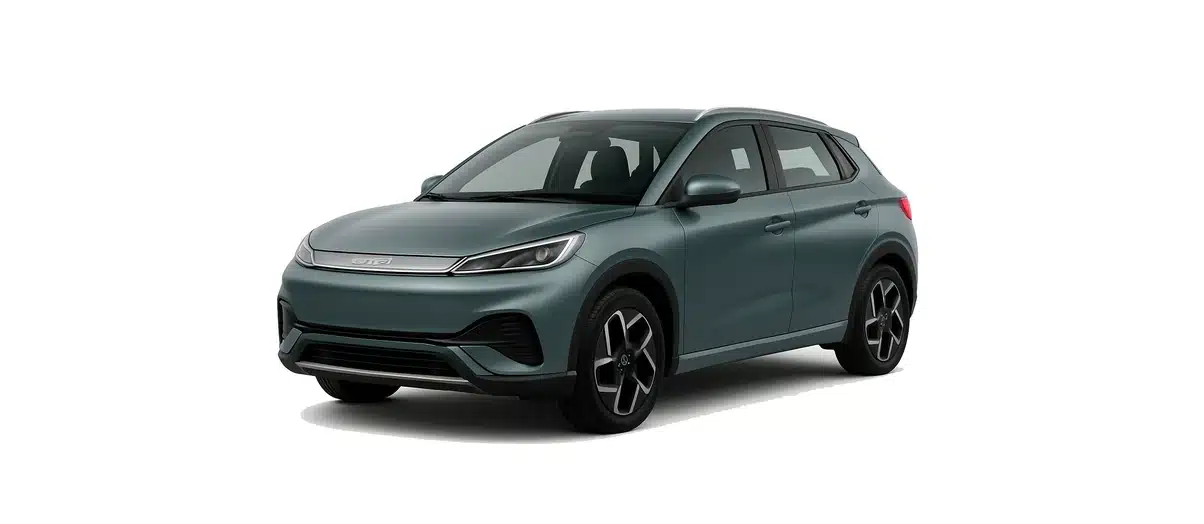
The BYD Atto 2 is a compact electric SUV for the UK market, positioned below the larger Atto 3 and offered as a battery-electric vehicle with BYD’s LFP Blade Battery technology. For charging, the important points are straightforward: UK/EU BEV versions use a Type 2 connection for AC charging and a CCS Combo 2 connection for DC rapid charging.
This guide focuses on the battery-electric BYD Atto 2 BEV, not the separate Atto 2 DM-i plug-in hybrid. That distinction matters because the PHEV has different charging hardware and should not be treated as the same car when choosing a charging cable.
Both main BEV versions, Boost and Comfort, can use the same Type 2 charging cable for home, workplace and many public AC charge points. The differences are in battery size, driving range and DC rapid charging performance, with the larger Comfort version better suited to longer motorway journeys.
View BYD Atto 2 Charging Cables
BYD Atto 2 Battery and Charging Specifications
The UK-market BYD Atto 2 BEV uses BYD’s e-Platform 3.0 with Cell-to-Body construction and an LFP Blade Battery. Public data for the 2025-2026 BEV range shows two main battery specifications: Boost and Comfort.
For AC charging, both versions are listed with an onboard charger of up to 11 kW on a suitable three-phase supply. For DC rapid charging, the Boost and Comfort versions differ significantly: the Boost is listed at up to 82 kW DC, while the Comfort is listed at up to 155 kW DC under suitable conditions.
Important: this guide is for the BYD Atto 2 BEV. BYD also uses the Atto 2 name for the Atto 2 DM-i plug-in hybrid in some UK material. The DM-i is a different type of vehicle with different charging requirements, so BEV cable and rapid charging information should not be mixed with PHEV figures.
Battery Options
The BYD Atto 2 Boost BEV is listed by BYD UK with a 51.1 kWh rated battery capacity. EV Database estimates the nominal battery capacity at 53.0 kWh and usable capacity at 51.1 kWh. BYD quotes a WLTP combined range of 214 miles for this version.
The BYD Atto 2 Comfort BEV uses the larger 64.8 kWh usable Blade Battery. EV Database estimates nominal capacity at 67.0 kWh and usable capacity at 64.8 kWh. Range figures vary slightly by source: BYD UK material has listed 261 miles, while BYD Europe launch material refers to up to 430 km, equivalent to around 267 miles. For practical purposes, the Comfort is the longer-range version and is better suited to regular longer trips.
Both batteries use LFP chemistry. LFP batteries are known for durability and thermal stability, but charging and battery care advice should still follow the owner’s manual rather than generic rules. BYD guidance may recommend periodic full charges for calibration, but drivers should refer to the current handbook for the exact recommendation for their car.
AC Charging Speed
AC charging is the type of charging used at most homes, many workplaces and a large number of destination chargers. The BYD Atto 2 BEV uses a Type 2 socket for AC charging in the UK and Europe.
Both Boost and Comfort are listed with up to 11 kW AC charging on a three-phase supply. This is useful at some workplaces and public AC charge points, but most UK homes have single-phase electricity. On a typical 7.4 kW home wallbox, the car will charge more slowly than its 11 kW maximum, because the home supply rather than the vehicle becomes the limiting factor.
As a guide, EV Database estimates that the 51.1 kWh Boost can take around 8 hours 15 minutes for a full charge on a 7.4 kW single-phase home charger. The 64.8 kWh Comfort is estimated at around 10 hours 30 minutes. Real charging time depends on the starting battery percentage, temperature, charger output, losses and whether the car is actively managing battery temperature.
On an 11 kW three-phase AC charger, BYD UK quotes 0-100% charging times of about 5 hours 42 minutes for the Boost and about 7 hours 12 minutes for the Comfort.
DC Rapid Charging Speed
DC rapid charging is used mainly on longer journeys. Instead of using your own Type 2 cable, you use the tethered CCS connector attached to the rapid charger. BYD Atto 2 BEV owners therefore do not normally need to buy a separate CCS cable.
The Boost version is listed with DC rapid charging up to 82 kW. BYD quotes a 10-80% rapid charging time of 38 minutes under suitable conditions, and a 30-80% time of around 30 minutes.
The Comfort version is the stronger rapid-charging option. It is listed with DC rapid charging up to 155 kW, with BYD stating a 10-80% time of 25 minutes in suitable conditions. This makes the Comfort the more road-trip-friendly Atto 2 BEV, especially for drivers who frequently use motorway rapid chargers.
As with any EV, peak DC charging speeds are not held for the entire session. Charging is fastest when the battery is in the right temperature range and at a lower state of charge, then it tapers as the battery fills. Publicly available data indicates that battery preconditioning is not available on the Atto 2 BEV, so cold weather and charger conditions may have a noticeable effect on real-world rapid charging speed.
Range and Efficiency
The Atto 2 Boost is quoted at 214 miles WLTP combined range. EV Database estimates a real-world range of around 170 miles, although actual range will depend on temperature, speed, tyre condition, route and driving style.
The Atto 2 Comfort is quoted at around 261-267 miles WLTP depending on the source and market material. EV Database estimates a real-world range of around 210 miles. The larger battery makes it the more flexible option for mixed driving and longer routes, while the Boost should suit drivers who mainly charge at home and cover shorter daily distances.
Efficiency will usually be best in town and lower at motorway speeds. Cold weather can also reduce range, although the BEV specification lists a heat pump as standard, which can help improve cabin heating efficiency compared with relying solely on resistive heating.
Charging at Home
For most owners, home charging will be the cheapest and most convenient way to run the BYD Atto 2. A dedicated 7.4 kW wallbox is the most common UK home charging setup and is suitable for overnight charging of both battery versions.
A Type 2 charging cable is used for untethered home wallboxes and many workplace or public AC chargers. If your home charger is tethered, the cable is already attached to the unit, but many drivers still keep a separate Type 2 cable in the boot for destination charging.
A 22 kW public AC post will not make the Atto 2 charge at 22 kW. The vehicle’s AC onboard charger is limited to up to 11 kW, so 11 kW is the maximum AC rate where a suitable three-phase supply is available. On a typical single-phase UK home wallbox, expect up to around 7.4 kW.
A 3-pin portable charger is generally best suited as a backup or occasional charging solution, but can be used regularly if a qualified electrician has confirmed the socket and electrical installation are suitable for sustained EV charging. Standard domestic sockets were not primarily designed for repeated high-load EV charging, so proper inspection and safe usage are important.
Public Charging
For public AC charging, the BYD Atto 2 uses a Type 2 cable. Many lamppost, town-centre, hotel, supermarket and workplace chargers are AC units, and some require you to bring your own cable. A good-quality Type 2 cable is therefore the key accessory for day-to-day public charging.
For rapid and ultra-rapid charging, use the CCS connector attached to the charger. You simply park, open the charging flap, connect the tethered CCS plug and start the session using the network’s app, RFID card, contactless payment or other available method.
On long journeys, plan around 10-80% charging stops rather than waiting for 100%. The final 20% is usually slower, so it is often quicker to stop, charge to around 80%, and continue. This is especially true on the Comfort version, where the 155 kW peak and 25-minute 10-80% figure make mid-journey charging more time-efficient.
Vehicle-Specific Features
The Atto 2 BEV includes several features that affect ownership and charging behaviour. The LFP Blade Battery and Cell-to-Body construction are central to BYD’s electric vehicle platform. The heat pump is listed as standard, which is useful for UK winter driving because cabin heating can otherwise use a noticeable amount of energy.
Vehicle-to-Load is also listed as standard for the BEV. EV Database lists V2L output at up to 3.3 kW AC via a Type 2 adapter. V2L can power suitable external devices, subject to BYD’s instructions and the correct adapter. However, public data does not support claims of Vehicle-to-Grid or Vehicle-to-Home capability for this model, so it should not be treated as a home energy storage system.
There is also no confirmed battery preconditioning feature in the available data. That means winter rapid charging may be less consistent than in some EVs that can actively prepare the battery before arrival at a charger.
Charging Tips
- Choose a Type 2 cable for AC charging. This is the cable used at untethered home chargers, workplaces and many public AC posts.
- Do not buy a CCS cable for rapid charging. CCS rapid chargers have the cable attached.
- Match expectations to the version. Boost is listed at up to 82 kW DC, while Comfort is listed at up to 155 kW DC.
- Use 10-80% stops on long trips. This usually saves time compared with charging to 100% at a rapid charger.
- Remember the AC limit. The Atto 2 BEV charges at up to 11 kW AC, so a 22 kW AC post will not provide 22 kW to the car.
- Check the handbook for battery care. LFP battery guidance can differ from other battery chemistries, so follow BYD’s current advice for your car.
Frequently Asked Questions
What charging cable does the BYD Atto 2 use?
The BYD Atto 2 BEV uses a Type 2 cable for AC charging. For DC rapid charging, it uses the CCS Combo 2 connector attached to the rapid charger.
Can the BYD Atto 2 charge at 22 kW AC?
No. The BEV versions are listed with up to 11 kW AC charging. A 22 kW AC post can still be used, but the car will not charge faster than its onboard AC limit.
How long does the BYD Atto 2 take to charge at home?
On a typical UK 7.4 kW single-phase wallbox, expect roughly an overnight charge: around 8 hours for the 51.1 kWh Boost and about 10.5 hours for the 64.8 kWh Comfort from empty to full, depending on conditions and starting charge level.
How fast does the BYD Atto 2 rapid charge?
The Boost BEV is listed at up to 82 kW DC with a quoted 10-80% time of 38 minutes. The Comfort BEV is listed at up to 155 kW DC with a quoted 10-80% time of 25 minutes under suitable conditions.
Is this guide also for the BYD Atto 2 DM-i?
No. This guide is for the battery-electric Atto 2 BEV. The Atto 2 DM-i plug-in hybrid has different charging requirements and should be checked separately.
What This Means for Drivers
For most BYD Atto 2 BEV owners, the right charging setup is simple: a 7.4 kW home wallbox for regular overnight charging, plus a Type 2 cable for untethered AC charging when away from home. The Boost version is well suited to urban and suburban use with predictable home charging, while the Comfort version adds more range and much stronger DC rapid charging for longer journeys.
The key is to choose the cable for the AC charging you will actually use. A Type 2 cable is the practical day-to-day accessory. Rapid charging is handled by tethered CCS chargers, so no separate rapid charging cable is needed.
Looking for a Charging Cable for BYD Atto 2?
We offer BYD Atto 2 charging cables suitable for UK Type 2 AC charging, including home, workplace and public destination charging.
View BYD Atto 2 Charging Cables
Please note that this information is intended as a guide. Charging specifications may change due to model and year of manufacture. For precise information, always refer to your vehicle user manual.

