
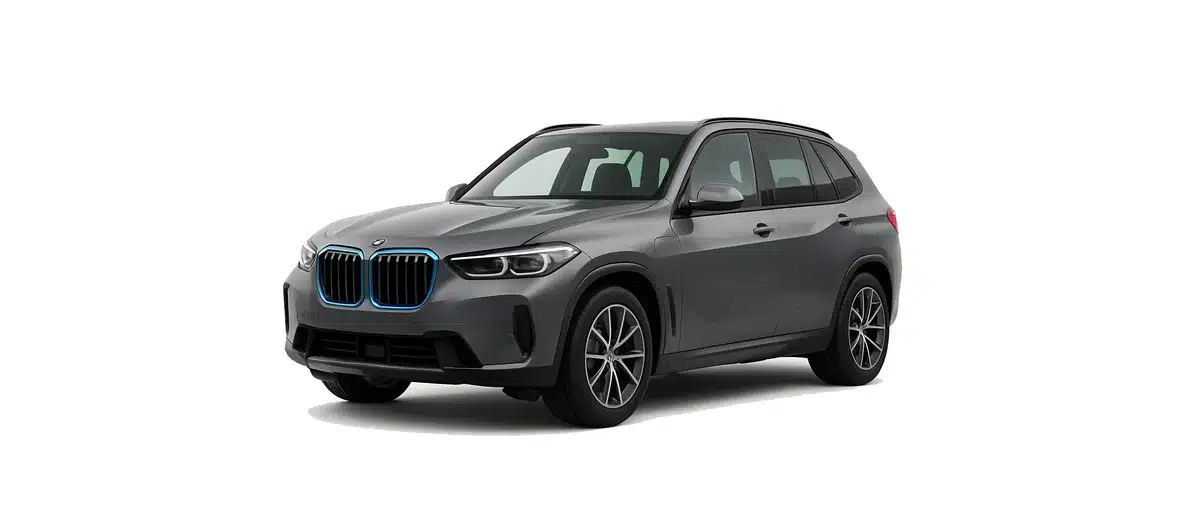
The BMW X5 is a large luxury SUV, but in the UK charging-cable context it is important to be precise: the current plug-in model is the BMW X5 xDrive50e, a petrol plug-in hybrid rather than a fully electric SUV. It has a combustion engine and a mains-rechargeable battery, so the most useful charging advice is different from the guidance you would follow for a full battery-electric vehicle such as the BMW iX.
For the current UK-market BMW X5 xDrive50e, BMW UK lists a 25.7 kWh battery capacity, up to 61–64 miles of WLTP electric range, Type 2 AC charging and a maximum AC charging rate of up to 11 kW. That makes the latest X5 PHEV relatively quick to charge for a plug-in hybrid, although many UK homes are limited to single-phase 7.4 kW charging, so real home charging times may be longer than BMW’s best-case figure.
BMW X5 Battery and Charging Specifications
The current UK BMW X5 plug-in hybrid is the xDrive50e M Sport. It combines a petrol engine with an electric motor and a rechargeable high-voltage battery, allowing many shorter journeys to be completed on electric power when the car is charged regularly.
Key figures for the current UK xDrive50e are:
- Vehicle type: Plug-in hybrid large SUV
- Charging connector: Type 2 for AC charging
- Usable battery capacity: 25.7 kWh, according to BMW Group material
- WLTP electric range: up to 61–64 miles, depending on specification
- Maximum AC charging power: up to 11 kW on current BMW UK data
- Minimum AC 0–100% charging time: around 2 hours 45 minutes in ideal 11 kW conditions
These figures should not be applied to every BMW X5 plug-in hybrid. Earlier X5 PHEV models, including the xDrive40e and xDrive45e, used different battery sizes and different onboard charging hardware. If you are buying a cable for a used X5, it is worth checking the exact model, registration year and charging specification before assuming it matches the current xDrive50e.
Battery Options
The current BMW X5 xDrive50e uses a larger battery than earlier plug-in X5 versions. BMW UK technical data lists 25.7 kWh battery capacity for the current model, while BMW Group press information describes 25.7 kWh as usable energy. Auto Express data also references a 29.5 kWh total battery capacity and 25.7 kWh usable capacity.
For owners and cable buyers, the usable capacity is the more practical figure because it relates more closely to the energy you can use for electric driving. A battery of this size is substantial for a plug-in hybrid and is the reason the latest X5 can offer a WLTP electric range of up to 64 miles under official test conditions.
The discontinued BMW X5 xDrive45e is different. It is commonly listed with a 24 kWh battery pack and around 21.6 kWh usable capacity, and it is typically associated with much slower AC charging. Older xDrive40e models differ again. In short, “BMW X5 PHEV” is not one single charging specification, so generation matters.
AC Charging Speed
AC charging is the main charging method for the BMW X5 plug-in hybrid. The current UK xDrive50e is listed by BMW UK with AC charging at up to 11 kW and a minimum 0–100% charge time of 2 hours 45 minutes. Auto Express also lists 11 kW maximum charging and gives a 0–100% figure of 165 minutes at 11 kW.
However, that 11 kW figure usually requires a suitable three-phase AC supply. Many UK domestic wallboxes are single-phase units rated at up to 7.4 kW. On that type of home charger, the current xDrive50e will still charge effectively, but not at its maximum 11 kW rate. Auto Express lists a 0–100% time of around 255 minutes at 7.4 kW, which is about 4 hours 15 minutes.
If you own an older X5 xDrive45e, the car may be limited to around 3.7 kW AC. In that case, using a higher-rated charging cable or a more powerful wallbox will not make the vehicle charge faster than its onboard charger allows. The car controls the maximum charging rate, not just the cable or charge point.
DC Rapid Charging Speed
The BMW X5 plug-in hybrid should be treated as an AC-charging vehicle for UK charging guidance. The relevant connector is Type 2, and there is no confirmed CCS rapid-charging use case or official 10–80% DC rapid-charge time for the UK X5 PHEV models covered here.
This is normal for many plug-in hybrids. Because the battery is smaller than in a full electric vehicle and the car still has a petrol engine for longer journeys, the day-to-day charging strategy is to top up from AC at home, work or public destination chargers. Motorway rapid chargers are designed mainly for battery-electric vehicles that need high-power DC charging on long trips.
Range and Efficiency
The current UK BMW X5 xDrive50e offers up to 61–64 miles of WLTP electric range, depending on specification. That is a strong official electric range figure for a large plug-in hybrid SUV, and it can make the X5 practical for local commuting, school runs, shopping trips and short business journeys without using much petrol, provided it is charged frequently.
As with any plug-in hybrid, real-world electric range will vary. Cold weather, motorway speeds, heavy loads, roof boxes, towing, wheel and tyre choice, cabin heating use and driving style can all reduce electric range. Conversely, gentle urban and suburban driving is where a PHEV like the X5 can be at its most useful.
The key ownership point is that the electric range only helps if the battery is charged. If the X5 is rarely plugged in, it becomes a large petrol SUV carrying extra hybrid hardware. Regular charging is therefore central to getting the best from the plug-in hybrid system.
Charging at Home
Home charging is usually the most convenient way to run a BMW X5 plug-in hybrid. For many owners, plugging in overnight or between journeys is easier than making special trips to public chargers. Even on a 7.4 kW single-phase wallbox, the current xDrive50e can typically be recharged comfortably within a normal evening or overnight parking window.
A dedicated home wallbox is generally the preferred option for regular charging. It is faster, more convenient and better suited to sustained EV charging than relying on a domestic socket. If your property has three-phase electrical supply and a compatible charge point, the current xDrive50e may be able to make use of its higher 11 kW AC capability. Most homes, however, are single-phase, so 7.4 kW is a more common practical expectation.
A 3-pin charger is generally best suited as a backup or occasional charging solution, but can be used regularly if a qualified electrician has confirmed the socket and electrical installation are suitable for sustained EV charging. Domestic sockets were not originally designed with repeated high-load EV charging as their main purpose, so safety checks and sensible cable management matter.
When choosing a home charging cable for a tethered or untethered setup, match the cable to the car, charge point and likely future use. For the current xDrive50e, a Type 2 cable is the relevant connector type. A three-phase-capable Type 2 cable may be useful if you have access to 11 kW AC charging, while a suitable single-phase Type 2 cable can be adequate for many 7.4 kW home installations.
Public Charging
For public charging, the BMW X5 PHEV uses Type 2 AC charge points. These are common at supermarkets, hotels, workplaces, town-centre car parks and leisure destinations. In the UK, many public AC posts are untethered, meaning you need to bring your own Type 2 to Type 2 cable.
The most useful public charging pattern for an X5 plug-in hybrid is destination charging: plug in while the car is parked for a few hours, then continue the journey with more electric range available. This suits the current xDrive50e well because its battery can be replenished in a relatively short stay when the post and vehicle can supply a suitable AC rate.
Older xDrive45e owners should be aware that a public post advertising 7 kW, 11 kW or 22 kW does not mean the car will accept that full rate. If the vehicle’s onboard charger is limited to around 3.7 kW, the actual session will be limited accordingly. A higher-rated post or cable cannot override the car’s onboard AC limit.
Vehicle-Specific Features
The main vehicle-specific charging point for the BMW X5 is that it is a plug-in hybrid, not a full EV. This affects charging behaviour, cable choice and expectations. You do not need to plan long trips around DC rapid charging in the same way as a battery-electric car, because the petrol engine remains available when the battery is depleted.
The current xDrive50e’s 11 kW AC capability is notable for a PHEV, but it is only fully useful where the electrical supply and charge point support it. On many UK home installations, the practical maximum will be 7.4 kW. On older X5 plug-in hybrids, the onboard AC limit may be lower still.
Auto Express lists the charging port location for the current xDrive50e as the left side front. In daily use, this may influence how you park next to your home wallbox or public AC post, and it can affect the cable length that feels most convenient.
Charging Tips
- Charge regularly: A plug-in hybrid delivers its best economy when you actually use the battery. Plug in at home or work whenever practical.
- Check your exact model: xDrive40e, xDrive45e and xDrive50e models do not all share the same battery and charging specification.
- Do not expect DC rapid charging: For the X5 PHEV, plan around Type 2 AC charging rather than CCS rapid charging.
- Understand the home limit: A current xDrive50e may support up to 11 kW AC, but many UK homes provide up to 7.4 kW from a single-phase wallbox.
- Choose cable length carefully: Consider where the charge port is, where you park, and whether you use public untethered posts.
- Avoid assuming faster is always faster: The vehicle’s onboard charger determines the maximum AC rate it can accept.
Frequently Asked Questions
Is the BMW X5 a fully electric car?
The UK BMW X5 model relevant to this charging guide is a plug-in hybrid. The current xDrive50e has a petrol engine and a rechargeable battery. It should not be confused with BMW’s fully electric iX SUV.
What charging cable does the BMW X5 plug-in hybrid use?
The BMW X5 PHEV uses a Type 2 connector for AC charging. For many UK public AC posts, a Type 2 to Type 2 cable is the relevant cable.
How fast does the current BMW X5 xDrive50e charge?
BMW UK lists up to 11 kW AC charging and a minimum 0–100% time of around 2 hours 45 minutes for the current xDrive50e. On a typical 7.4 kW UK home wallbox, charging is likely to take longer, with Auto Express listing about 255 minutes from 0–100%.
Can the BMW X5 use rapid chargers?
For the UK X5 plug-in hybrid use case, you should plan around Type 2 AC charging. There is no confirmed CCS rapid-charging figure or 10–80% DC rapid-charge time for the X5 PHEV models covered here.
Will a 22 kW public AC post charge the X5 at 22 kW?
No. The car can only accept the maximum rate allowed by its onboard charger. The current xDrive50e is listed at up to 11 kW AC, while some older X5 PHEV models may be limited to around 3.7 kW.
What This Means for Drivers
For current BMW X5 xDrive50e drivers, the ideal charging routine is simple: use a suitable Type 2 AC setup, charge regularly at home or work, and take advantage of public AC destination charging when convenient. The car’s official electric range is high enough for many everyday journeys, but only if the battery is kept topped up.
For used BMW X5 PHEV owners, the most important advice is to verify the exact model. An xDrive45e or xDrive40e may not charge like a current xDrive50e, even if the connector looks the same. Cable compatibility, onboard charger limits and realistic charge times should all be checked against the specific vehicle.
Looking for a Charging Cable for BMW X5?
If you need a suitable Type 2 cable for a BMW X5 plug-in hybrid, choose based on your exact X5 model, home or public charging setup, and whether you need single-phase or three-phase AC compatibility.
Please note that this information is intended as a guide. Charging specifications may change due to model and year of manufacture. For precise information, always refer to your vehicle user manual.

