
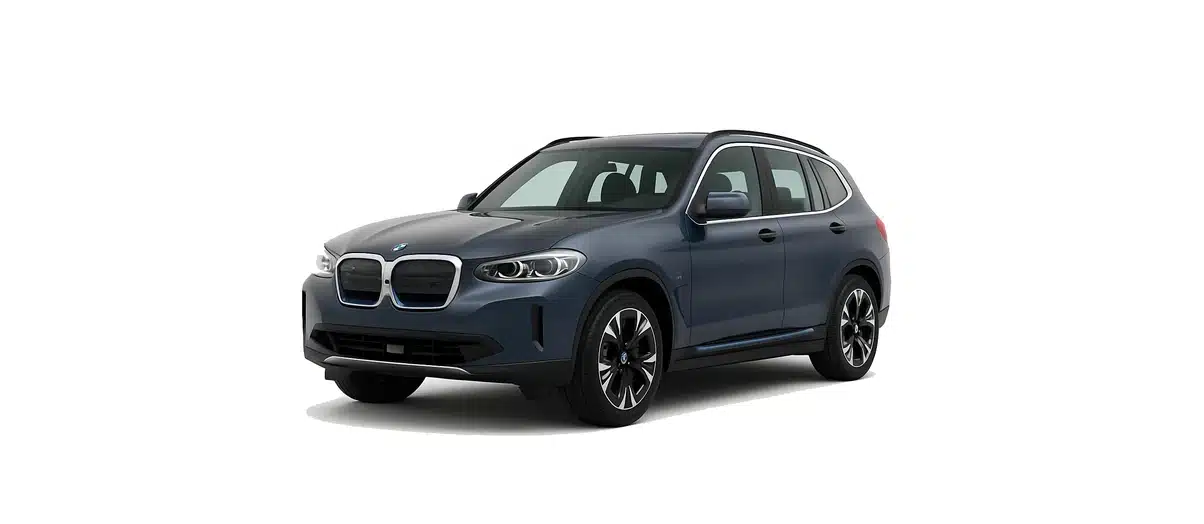
The BMW iX3 is a fully electric SUV, but UK drivers need to be aware that the name now covers two very different generations. The original G08 BMW iX3 was sold in the UK around 2021 to 2024 and is now discontinued. The newer Neue Klasse/NA5 BMW iX3 arrives in the UK from 2026, led by the iX3 50 xDrive, with the iX3 40 joining later in 2026.
That distinction matters because battery size, rapid charging speed, range and some charging features vary significantly between the older and newer cars. The practical cable advice, however, remains straightforward: the BMW iX3 uses a Type 2 connection for AC charging and a CCS connection for DC rapid charging. For most UK owners, a Type 2 cable and a suitable home wallbox will be the main day-to-day charging setup.
BMW iX3 Battery and Charging Specifications
The BMW iX3 should not be confused with petrol, diesel or plug-in hybrid versions of the wider BMW X3 family. The iX3 is a battery-electric vehicle, using Type 2 for AC charging and CCS for public rapid and ultra-rapid charging.
For the older G08 iX3, EV Database UK lists an 80 kWh gross battery with 74 kWh usable capacity, 11 kW AC charging and DC rapid charging at up to around 155 kW. Under favourable conditions, a 10-80% rapid charge is typically quoted at about 35 minutes.
The 2026 Neue Klasse iX3 is a major step forward. BMW UK material lists the iX3 40 with an 82.6 kWh usable battery, up to 395 miles WLTP range, 300 kW DC charging and a 10-80% time of around 21 minutes. For the iX3 50 xDrive, BMW UK lists a 108.7 kWh battery capacity, up to 500 miles WLTP range, DC charging up to 400 kW and a 10-80% time of around 21 minutes. The 108.7 kWh figure should be treated carefully if comparing gross and usable capacities, as published tables may not always label this in the same way.
Battery Options
The older 2021-2024 G08 BMW iX3 used one main battery specification in the UK: 80 kWh gross and 74 kWh usable. This gives it a solid real-world range for family use, commuting and longer journeys, but it is not in the same range or charging-speed class as the new 800 V Neue Klasse model.
The new iX3 40 and iX3 50 xDrive are separate from the older G08 car. The iX3 40 is listed with 82.6 kWh usable battery capacity and a WLTP range of up to 395 miles. The iX3 50 xDrive is the long-range, higher-performance version, with BMW quoting up to 500 miles WLTP range and a listed battery capacity of 108.7 kWh. WLTP figures are useful for comparison between cars, but they are not a guarantee of the range you will see on every journey.
AC Charging Speed
AC charging is what you use at home and at many slower public charging posts. The BMW iX3 uses a Type 2 inlet for AC charging. The older G08 iX3 supports up to 11 kW AC, which generally requires a three-phase supply. Most UK homes have single-phase electricity, so a 7.4 kW wallbox is usually the practical maximum for home charging.
The new 2026 iX3 also lists 11 kW AC charging as standard, with 22 kW AC available on some versions or with suitable optional equipment such as AC Charging Professional. Drivers should not assume that every new iX3 can charge at 22 kW AC. To achieve 22 kW, the car must have the correct onboard charging equipment and the charge point must be capable of supplying three-phase 22 kW AC.
For everyday UK ownership, a 7.4 kW home wallbox will be more than adequate for many drivers. It will usually add a meaningful amount of range overnight, even if it does not use the car’s maximum possible AC capability.
DC Rapid Charging Speed
DC rapid charging uses the lower CCS section of the iX3 charging port and is normally found at motorway services, charging hubs and rapid public sites. You do not use your own Type 2 cable for DC rapid charging, because rapid and ultra-rapid chargers have their own tethered CCS connector.
The older G08 iX3 can rapid charge at up to around 155 kW and is commonly quoted at about 35 minutes for a 10-80% charge in favourable conditions. This is still useful for long-distance travel, but it is materially slower than the new Neue Klasse cars.
The 2026 iX3 uses BMW’s Neue Klasse 800 V architecture. BMW quotes up to 300 kW DC charging for the iX3 40 and up to 400 kW for the iX3 50 xDrive, with 10-80% charging in around 21 minutes where conditions and charger capability allow. In practice, the charging curve, battery temperature, state of charge, charger output and site conditions all affect the actual time.
Range and Efficiency
Range depends heavily on which BMW iX3 you own. The older G08 iX3 has an EV Database real-world estimate of about 235 miles. That can vary with weather, motorway speed, tyre choice, load, heating or air conditioning use and driving style.
The new iX3 40 has a WLTP figure of up to 395 miles, while the iX3 50 xDrive is quoted by BMW at up to 500 miles WLTP. Real-world range will normally be lower than WLTP, especially in cold weather or on sustained motorway journeys. Some independent estimates for newer large-battery EVs sit around the low-to-mid 300-mile mark depending on version and conditions, but owners should use their own driving pattern and the car’s efficiency data as the most useful guide.
For planning purposes, it is sensible to think in terms of usable range between charging stops rather than the absolute maximum figure. Many drivers prefer to arrive at a charger with a comfortable reserve and leave at around 80% when rapid charging, because charging speed often slows at higher states of charge.
Charging at Home
Home charging is the most convenient and usually the cheapest way to run a BMW iX3. A dedicated 7.4 kW Type 2 wallbox is the most common UK solution for single-phase homes. You can choose a tethered wallbox, where the cable is permanently attached, or an untethered wallbox, where you use your own Type 2-to-Type 2 cable.
A tethered unit is convenient if the cable length and parking position suit your driveway. An untethered unit gives more flexibility and keeps the installation looking tidier when not in use, but you will need to plug in your own cable each time. For public AC charging, the same Type 2-to-Type 2 cable is often required, so many iX3 owners keep one in the boot even if they have a tethered home charger.
A 3-pin domestic charger is generally best suited as a backup or occasional charging solution, but can be used regularly if a qualified electrician has confirmed the socket and electrical installation are suitable for sustained EV charging. A dedicated wallbox remains the preferred option for routine charging because it is faster, safer and better suited to repeated high-load use.
Public Charging
For public AC charging, use a Type 2-to-Type 2 cable. These chargers are commonly found in car parks, hotels, workplaces, supermarkets and town centres. Many public AC posts are 7 kW, 11 kW or 22 kW, but the actual charging speed will be limited by the lower of the charger output, the car’s onboard AC charger and the electricity supply.
For rapid and ultra-rapid charging, use the charger’s tethered CCS connector. This is the best option for motorway stops and longer trips. The older G08 iX3 will not take advantage of the very highest 300-400 kW charger outputs, but it can still use CCS rapid chargers within its own charging limits. The new NA5 iX3 models can make better use of high-power 800 V infrastructure, particularly the iX3 50 xDrive on suitable ultra-rapid chargers.
As with all EVs, rapid charging is fastest when the battery is warm and the state of charge is relatively low. Charging from 10-80% is usually a better long-journey strategy than waiting to reach 100% at a rapid charger.
Vehicle-Specific Features
The older G08 BMW iX3 is listed with a heat pump and battery preconditioning, helping efficiency and charging consistency in suitable conditions. It is not generally listed as supporting V2L, V2H or V2G functions.
The new 2026 iX3 is also listed with a heat pump and battery preconditioning. BMW says the new iX3 50 xDrive can pre-condition the battery when a public charging station is set as the navigation destination. For the quickest possible DC charging, it is worth using the BMW navigation system to route to a compatible charger so the car can prepare the battery in advance.
BMW also describes the new iX3 as prepared for future bidirectional charging support, depending on market and equipment. Some data sources list V2L, V2H and V2G support for the new iX3 40, but this should be checked against the exact UK vehicle specification before relying on it. Do not assume these functions are available on the older G08 iX3.
Charging Tips
- Identify your iX3 generation first: the 2021-2024 G08 and 2026 Neue Klasse models have very different charging capabilities.
- Use Type 2 for AC charging: this applies at home and at most destination charging posts.
- Use CCS for rapid charging: rapid chargers have their own tethered CCS cable, so you do not need to provide one.
- Expect 7.4 kW at most UK homes: even if your iX3 can accept 11 kW or 22 kW AC, most single-phase domestic supplies will not deliver those speeds.
- Check before expecting 22 kW AC: the car, charger and electrical supply all need to support it.
- Use navigation preconditioning on newer models: routing to a charger can help the battery reach a better temperature for rapid charging.
- Do not chase 100% on rapid chargers: charging usually slows at higher states of charge, so 10-80% is often more efficient on long journeys.
Frequently Asked Questions
What charging cable does the BMW iX3 use?
The BMW iX3 uses a Type 2 connection for AC charging. For home wallboxes and many public AC posts, a Type 2-to-Type 2 cable is the correct choice if the charger is untethered.
Does the BMW iX3 use CCS rapid charging?
Yes. The iX3 uses CCS for DC rapid charging. Public rapid and ultra-rapid chargers have tethered CCS connectors, so you plug the charger’s cable directly into the car.
Can every BMW iX3 charge at 400 kW?
No. The 400 kW figure applies to the new iX3 50 xDrive under suitable conditions. The older G08 iX3 is around 155 kW, while the new iX3 40 is listed at up to 300 kW.
Can the BMW iX3 charge at 22 kW AC?
Not all versions can. The older G08 iX3 is listed at up to 11 kW AC. The new 2026 iX3 may offer 22 kW AC with the appropriate optional equipment and a suitable three-phase charge point.
Is the BMW iX3 a plug-in hybrid?
No. The BMW iX3 is a fully electric vehicle. Plug-in hybrid versions belong to the wider BMW X3 range, not the iX3.
What This Means for Drivers
For most BMW iX3 owners, charging is simple once you identify which generation you have. The older G08 iX3 is a capable electric SUV with 11 kW AC and useful CCS rapid charging, but it does not match the ultra-rapid performance of the new 800 V Neue Klasse cars. The 2026 iX3 brings much faster DC charging, longer WLTP range figures and additional feature possibilities, but optional equipment and market-specific availability matter.
In day-to-day UK use, the best setup is usually a 7.4 kW home wallbox and a good-quality Type 2-to-Type 2 cable for untethered home or public AC charging. For long journeys, plan around CCS rapid chargers, use battery preconditioning where available and treat WLTP range as a comparison figure rather than a guaranteed real-world result.
Looking for a Charging Cable for BMW iX3?
If you need a suitable Type 2 cable for home or public AC charging, choose one that matches your BMW iX3, your wallbox or charging post, and the cable length you need for everyday parking.
Please note that this information is intended as a guide. Charging specifications may change due to model and year of manufacture. For precise information, always refer to your vehicle user manual.

