
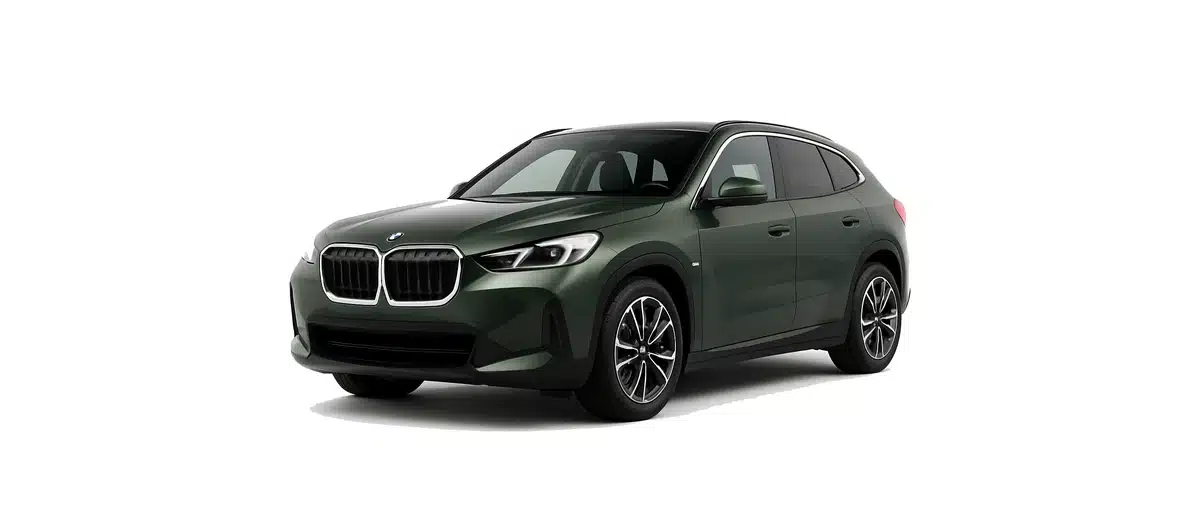
The BMW iX2 is the battery-electric version of BMW’s compact coupe SUV, sold in the UK as part of the iX2 / X2 U10 model family. Current UK models include the front-wheel-drive iX2 eDrive20 and the all-wheel-drive iX2 xDrive30. Both use a Type 2 connection for AC charging and a CCS Combo 2 connection for DC rapid charging, which makes the iX2 compatible with the normal UK mix of home wallboxes, public AC posts and motorway rapid chargers.
The most important point for cable selection is that the charging connector is the same across the current iX2 range. The practical differences are more about charging power, battery size, range and whether a specific car has the optional 22 kW AC on-board charger. In everyday UK use, many owners will charge at around 7.4 kW from a single-phase home wallbox, use 11 kW AC where three-phase AC charging is available, and rely on CCS rapid charging for long journeys.
BMW iX2 Battery and Charging Specifications
| Vehicle type | Battery-electric compact coupe SUV |
|---|---|
| Current UK variants | iX2 eDrive20 front-wheel drive and iX2 xDrive30 all-wheel drive |
| Battery capacity | Current MY26 cars are listed by EV Database at 66.5 kWh nominal and 65.2 kWh usable; BMW UK quotes around 65 kWh depending on variant page |
| AC charging connector | Type 2 |
| DC rapid charging connector | CCS Combo 2 |
| Standard AC charging | 11 kW on-board charger |
| Optional AC charging | 22 kW where the car has the optional 22 kW on-board charger and the supply supports it |
| DC rapid charging peak | Up to 130 kW |
| DC 10-80% time | BMW quotes 29 minutes under suitable conditions |
| Charge port location | Right side rear, according to EV Database |
The iX2’s headline charging numbers are strong for this class, but they need to be understood in context. An 11 kW AC charger is standard, while 22 kW AC is not something to assume on every car. DC rapid charging peaks at up to 130 kW, but as with all EVs, that is a maximum figure rather than a speed the car will hold from 10% to 80%.
Battery Options
Current UK iX2 models use a battery of broadly the same size across the eDrive20 and xDrive30 versions. EV Database lists current MY26 iX2 models with a 66.5 kWh nominal battery and 65.2 kWh usable capacity. BMW UK’s technical pages quote battery capacity around 65 kWh, depending on the specific variant page.
For owners, the main practical difference is not the cable or charging port, but the drivetrain and range. The iX2 eDrive20 uses front-wheel drive and is generally the more efficient version, while the iX2 xDrive30 adds all-wheel drive and stronger performance, with a lower WLTP range depending on trim and equipment.
If you are comparing a used or pre-registered iX2 with a new car, check the exact model year and specification. EV Database separates earlier MY23-25 cars from current MY26 cars, and usable battery and range figures are not identical across every listing.
AC Charging Speed
AC charging is what most iX2 drivers will use most often at home, at work, or on destination chargers. The BMW iX2 has a Type 2 AC inlet and a standard 11 kW on-board charger. BMW UK also references 11 / 22 kW AC charging, and EV Database lists 22 kW AC as optional.
This distinction matters in the UK. Most domestic properties have a single-phase electricity supply, so a typical home wallbox will charge at up to around 7.4 kW regardless of the car’s 11 kW or optional 22 kW capability. On a suitable three-phase AC supply, the standard iX2 can use up to 11 kW, while a car equipped with the optional 22 kW on-board charger may be able to charge faster from a compatible 22 kW AC post.
BMW quotes AC 0-100% charging times of around 6 hours 30 minutes at 11 kW and around 3 hours 45 minutes at 22 kW. EV Database estimates around 10 hours 30 minutes from a 7.4 kW single-phase charge point. These times are useful guides, although real charging time can vary with temperature, starting state of charge, charging losses and the limits of the charge point.
For cable choice, an untethered AC charge point will require a Type 2-to-Type 2 cable. A 32 amp Type 2 cable is a flexible option because it can be used on lower-powered posts as well as more powerful AC posts, subject to the car and charger limits. If you want to make full use of 11 kW or optional 22 kW AC where available, make sure the cable is suitable for three-phase charging.
DC Rapid Charging Speed
For long-distance trips, the iX2 uses the CCS Combo 2 connector for DC rapid charging. BMW quotes a peak DC charging rate of up to 130 kW and a 10-80% rapid-charging time of 29 minutes under suitable conditions. EV Database estimates a very similar figure of around 30 minutes for current MY26 cars.
A 150 kW public rapid charger is therefore sufficient to access the car’s maximum vehicle-side rate when the battery, charger and conditions allow. Using a 350 kW charger will not make the iX2 exceed its own peak charging limit, though it may still be convenient if that is the charger available at the site.
As with any EV, the BMW iX2 does not charge at its peak rate continuously. Charging is usually fastest at a lower state of charge, then gradually slows as the battery fills. For this reason, long journeys are usually quicker when planned around 10-80% charging stops rather than waiting for 100% on a rapid charger.
Range and Efficiency
BMW UK lists different WLTP range figures for different current iX2 variants. The most efficient current eDrive20 listings are quoted at around 296-318 miles WLTP, with one eDrive20 Shadow Edition listing up to 320 miles. Current xDrive30 versions are generally lower, with BMW UK figures around 277-296 miles depending on trim and equipment, or 295 miles for the Shadow Edition listing.
Those WLTP figures are laboratory-based comparison figures, not a guarantee of everyday range. EV Database gives a real-world estimate of around 250 miles for current MY26 models, which is a useful planning guide. In practice, range will depend on speed, weather, tyre choice, wheel size, road type, cabin heating or cooling, and how much motorway driving you do.
For commuting and local driving, many owners will only need to charge a few times per week. For motorway-heavy use in winter, expect the car to need more frequent charging, and plan rapid-charging stops with a realistic buffer rather than relying on the highest WLTP number.
Charging at Home
A dedicated home wallbox is the most convenient way to charge a BMW iX2 if you have off-street parking. A single-phase 7.4 kW wallbox can add a substantial amount of range overnight and is the most common setup for UK homes. If the wallbox is tethered, it will already have a Type 2 plug attached. If it is untethered, you will need a Type 2-to-Type 2 charging cable.
Although the iX2’s standard AC capability is 11 kW, most UK homes will not see 11 kW unless they have a suitable three-phase supply and compatible charging equipment. The optional 22 kW AC capability is even more dependent on both the car and the electrical supply. If you are ordering a new iX2 and 22 kW AC matters to you, confirm the option is fitted before purchase rather than assuming it is standard.
A 3-pin charger is generally best suited as a backup or occasional charging solution, but can be used regularly if a qualified electrician has confirmed the socket and electrical installation are suitable for sustained EV charging. For most owners, a properly installed wallbox will be faster, more convenient and better suited to regular charging.
Public Charging
Public charging falls into two broad categories: AC destination charging and DC rapid charging. AC posts are common in car parks, hotels, workplaces and town centres. Many of these are untethered, which means you bring your own Type 2-to-Type 2 cable. The iX2 will then charge at the lowest limit among the car, cable and charge point.
DC rapid chargers are usually tethered, so the charging cable is attached to the charger. For the BMW iX2, choose the CCS connector. Rapid chargers rated at 150 kW or higher are enough for the car’s 130 kW peak, assuming the charger is delivering properly and the battery is at a suitable temperature and state of charge.
On long journeys, it is often more efficient to arrive at a rapid charger with a lower state of charge, charge to around 70-80%, then continue. Charging from 80-100% on DC can take disproportionately longer, so it is usually better saved for occasions when you genuinely need the extra range.
Vehicle-Specific Features
The BMW iX2 is listed with a heat pump as standard by EV Database, and BMW Group material describes heat pump technology for the model. A heat pump can help reduce the energy needed for cabin heating compared with relying solely on resistance heating, particularly in cooler weather.
Battery preconditioning is another useful iX2 feature. BMW Group launch information describes navigation-linked and manually selectable battery preconditioning for DC charging, and EV Database lists battery preconditioning as standard. For the best rapid-charging performance, use the BMW navigation system to route to a DC charger, or manually activate preconditioning where available, especially in colder conditions.
The iX2 is based on BMW’s FAAR platform and is listed by EV Database as using a 400 V architecture. EV Database does not list UK-market vehicle-to-load, vehicle-to-home or vehicle-to-grid support for the iX2, so it should not be treated as a portable power supply or home energy backup vehicle unless BMW confirms such functionality for your specific UK car.
Charging Tips
- Check the exact variant. The eDrive20 and xDrive30 use the same charging connector, but their WLTP range figures differ.
- Do not assume 22 kW AC. The standard on-board charger is 11 kW; 22 kW depends on the optional charger and a suitable three-phase supply.
- Use a Type 2-to-Type 2 cable for untethered AC posts. This applies at many workplaces, public car parks and destination chargers.
- Use CCS for rapid charging. The iX2’s DC peak is up to 130 kW, so a 150 kW rapid charger is sufficient to access the maximum vehicle-side rate when conditions allow.
- Precondition before rapid charging. Route to the charger in the BMW navigation or use manual battery preconditioning where available.
- Plan around 10-80% rapid charging. This is usually quicker than waiting for a full charge during a journey.
Frequently Asked Questions
What charging cable does the BMW iX2 use?
The BMW iX2 uses a Type 2 connection for AC charging. For untethered home or public AC charge points, you need a Type 2-to-Type 2 cable. For DC rapid charging, the iX2 uses CCS Combo 2, and the rapid charger normally has its own tethered cable.
Is the BMW iX2 a plug-in hybrid?
No. The BMW iX2 is a battery-electric vehicle with 0 g/km tailpipe CO2 emissions. It should not be confused with petrol, diesel or plug-in hybrid versions of the wider X2 range.
Can every BMW iX2 charge at 22 kW AC?
No. The standard AC on-board charger figure is 11 kW. A 22 kW AC charger is optional and also requires a compatible three-phase charge point and supply. Most UK home wallboxes are single-phase and will usually charge at up to around 7.4 kW.
How fast can the BMW iX2 rapid charge?
BMW quotes up to 130 kW DC rapid charging and a 10-80% time of 29 minutes under suitable conditions. Actual charging speed varies with battery temperature, state of charge, charger performance and site conditions.
What is the real-world range of the BMW iX2?
BMW UK WLTP figures vary by version and trim, with the best current eDrive20 listing reaching up to 320 miles WLTP and xDrive30 versions generally lower. EV Database estimates around 250 miles in real-world use for current MY26 models.
What This Means for Drivers
For most UK BMW iX2 drivers, the most practical setup is straightforward: a Type 2 home wallbox for regular charging, a Type 2-to-Type 2 cable for untethered AC public posts, and CCS rapid charging for longer trips. The car’s optional 22 kW AC capability is useful for drivers who regularly use three-phase AC charging, but it should not be assumed on every vehicle, and it will not change the usual 7.4 kW limit of many UK home installations.
The iX2’s charging package is well suited to daily use and longer journeys, provided the figures are treated realistically. The eDrive20 offers the strongest official range, the xDrive30 adds all-wheel-drive performance, and both benefit from rapid charging, battery preconditioning and the normal UK Type 2 / CCS charging ecosystem.
Looking for a Charging Cable for BMW iX2?
If you need a suitable Type 2 cable for an untethered home wallbox or public AC charging, We sell BMW iX2 charging cable options for everyday UK use.
Please note that this information is intended as a guide. Charging specifications may change due to model and year of manufacture. For precise information, always refer to your vehicle user manual.

