
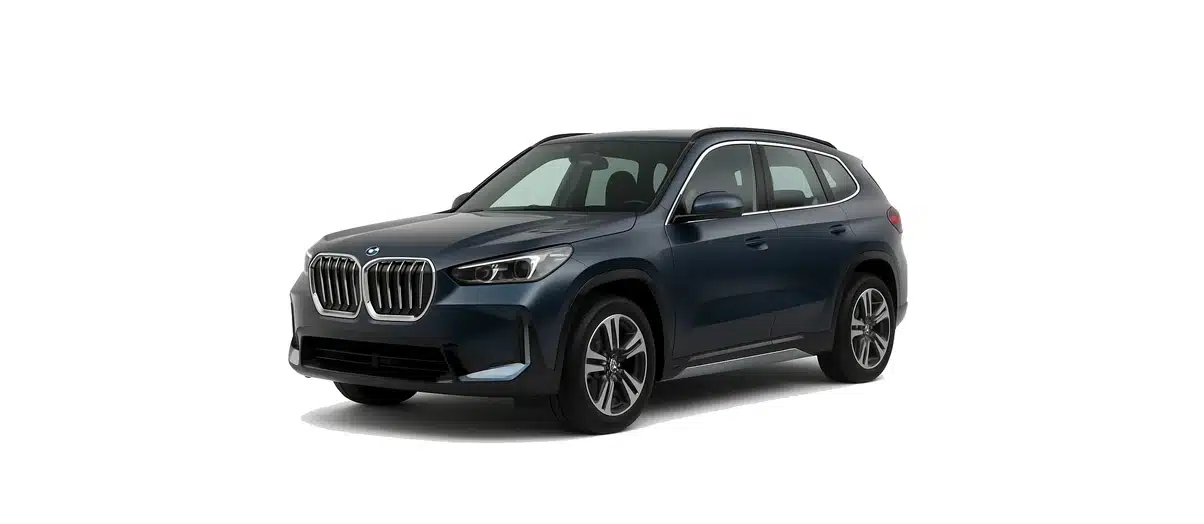
The BMW iX1 is the fully electric version of the BMW X1 compact SUV, sold in the UK as a battery-electric vehicle rather than a plug-in hybrid. Current UK models include the front-wheel-drive iX1 eDrive20 and the all-wheel-drive iX1 xDrive30, with range and performance varying by variant, trim, wheels and model year.
For charging, the key point is that the iX1 uses the UK and European standard Type 2 connection for AC charging and CCS Combo 2 for DC rapid charging. That means it can use a home wallbox, most public destination chargers, and motorway rapid chargers without any unusual adaptor requirements. In practice, most UK owners will charge at up to 7.4 kW at home on a single-phase wallbox, even though the car can accept 11 kW AC as standard and, where specified, up to 22 kW AC on a suitable three-phase supply.
BMW iX1 Battery and Charging Specifications
The BMW iX1 is built around a battery of around 66.5 kWh gross capacity in current UK data, with EV Database UK listing a usable capacity of 65.2 kWh for MY26 eDrive20 and xDrive30 versions. Earlier MY23-25 versions are commonly listed with a slightly lower usable figure, so owners of used cars should check their exact model year if comparing specifications.
| Vehicle | BMW iX1 |
|---|---|
| Body style | Compact SUV / SAV |
| Powertrain | Battery-electric vehicle |
| Current UK variants | eDrive20 front-wheel drive and xDrive30 all-wheel drive |
| Battery capacity | 66.5 kWh gross; around 65.2 kWh usable in current MY26 EV Database UK data |
| AC charging connection | Type 2 |
| DC rapid charging connection | CCS Combo 2 |
| Charge port location | Right rear side |
| Standard AC charging | Up to 11 kW, subject to charger and electrical supply |
| Optional AC charging | Up to 22 kW where the car is fitted with the optional 22 kW on-board charger and connected to a suitable three-phase charge point |
| DC rapid charging | Up to around 130 kW |
Battery Options
For current UK-market iX1 models, the main decision is less about battery size and more about drivetrain. EV Database UK lists both the MY26 iX1 eDrive20 and MY26 iX1 xDrive30 with a 66.5 kWh nominal battery and 65.2 kWh usable capacity. BMW UK technical data rounds this to about 65 kWh.
The eDrive20 is the front-wheel-drive model and is generally the range-focused option. The xDrive30 uses all-wheel drive and offers stronger performance, but its WLTP range is typically slightly lower. This means charging equipment requirements are broadly the same across the two versions, but trip planning and expected miles added per charge can differ.
AC Charging Speed
AC charging is what you will use at home, at many workplace chargers, and at public destination chargers in places such as car parks, hotels and town centres. The BMW iX1 has a Type 2 AC inlet and current data lists 11 kW AC charging as standard.
However, most UK homes have a single-phase electricity supply. With a typical dedicated home wallbox, the practical maximum is usually 7.4 kW. At that rate, a near-empty to full charge is likely to take overnight rather than a short stop, which suits the way most EV owners charge: plug in when parked and leave with a full or nearly full battery the next morning.
BMW and EV Database UK also refer to 22 kW AC capability for current models, but this should not be treated as universal. To achieve 22 kW AC charging, the specific iX1 must have the optional 22 kW on-board charger and the driver must connect to a suitable three-phase 22 kW AC charge point. Without both of those conditions, charging will be limited by the car, the charger or the electrical supply.
DC Rapid Charging Speed
For longer journeys, the BMW iX1 uses CCS Combo 2 rapid charging. The peak DC charging rate is around 130 kW, so a 150 kW or faster public rapid charger is a good match for the car. Connecting to a 350 kW ultra-rapid charger is safe where compatible, but it will not make the iX1 charge above its own vehicle limit.
BMW quotes a 10-80% rapid charging time of around 29 minutes, while EV Database UK gives a typical estimate of about 30 minutes for current MY26 cars. Real charging times depend on battery temperature, state of charge, charger performance and how busy the charging site is.
As with most EVs, charging speed is fastest in the middle of the battery and slows as the battery fills. On a road trip, it is usually quicker to plan rapid-charging stops from roughly 10% to 80% rather than charging all the way to 100% on DC. Charging to 100% can still be useful before a long journey or when you need the extra range, but it is not normally the fastest way to travel between rapid chargers.
Range and Efficiency
There is no single WLTP range figure that applies to every BMW iX1. Current UK figures vary by drivetrain, trim, wheel size and model year. As a broad guide, recent UK data places the iX1 at roughly 265-321 miles WLTP, with the eDrive20 generally offering the longest official range and the xDrive30 trading some range for all-wheel-drive performance.
Real-world range will usually be lower than WLTP, especially in winter, at motorway speeds, or with a heavily loaded car. EV Database UK estimates combined real-world range at around the mid-240-mile mark for current versions, with cold motorway conditions potentially reducing this. Gentle driving, warmer weather and urban routes can produce better results.
The iX1 is confirmed in current data as having a standard heat pump. A heat pump can help reduce the energy used for cabin heating compared with less efficient heating systems, although actual winter efficiency still depends on temperature, route and driving style.
Charging at Home
For most BMW iX1 drivers, home charging will be the cheapest and most convenient way to run the car. A dedicated Type 2 home wallbox on a typical UK single-phase supply will usually charge at up to 7.4 kW. That is below the iX1’s standard 11 kW AC capability, but it is the normal limit for many domestic installations.
A tethered home charger has a cable permanently attached, so you simply plug the car in. An untethered wallbox has a Type 2 socket and requires a separate Type 2 charging cable. Many owners prefer keeping a separate cable in the boot for public AC posts, even if they have a tethered unit at home.
If you are considering three-phase charging at home, you will need the right electrical supply, a suitable charger and, for 22 kW charging, an iX1 fitted with the optional 22 kW on-board charger. This is not the norm for most UK homes, so it is best treated as a specialist setup rather than an assumption.
A 3-pin charger is generally best suited as a backup or occasional charging solution, but can be used regularly if a qualified electrician has confirmed the socket and electrical installation are suitable for sustained EV charging. A dedicated wallbox is normally the better long-term option because it is faster, safer and designed for repeated EV charging loads.
Public Charging
Public charging falls into two main categories: AC destination charging and DC rapid charging. For AC posts, the BMW iX1 uses a Type 2 cable. Many public AC charge points are untethered, so you will need to bring your own cable. Depending on the charger and the car’s on-board charger, you may see anything from 7 kW to 11 kW, or up to 22 kW only where the car and supply support it.
For rapid charging, you use the tethered CCS cable attached to the rapid charger. You do not need to bring your own DC cable. On motorways and major A-roads, look for 150 kW or faster CCS units if you want to give the iX1 the opportunity to reach its peak rate. A lower-powered 50 kW rapid charger will still work, but it will take longer.
The iX1 also supports Plug & Charge or Autocharge functionality according to current EV Database UK entries, though availability depends on the charging network, account setup and vehicle compatibility. It is still sensible to carry a contactless payment card and have key charging apps available when travelling beyond your usual area.
Vehicle-Specific Features
The BMW iX1 has several charging-related features worth knowing about. Battery preconditioning is listed as standard in current data, and BMW navigation can route to rapid chargers so the car can prepare the battery where supported. This is particularly useful in cold weather, when a cold battery may charge more slowly.
The car’s Type 2 and CCS charging inlet is located on the right rear side. That position is worth remembering when choosing a bay at public chargers, especially where cable reach is limited or bays are arranged for different port locations.
Vehicle-to-load, vehicle-to-home and vehicle-to-grid functions are not supported according to current EV Database UK data. In practical terms, the iX1 should be viewed as a conventional EV for charging: it can take energy from AC and DC chargers, but it is not designed to power appliances, a home or the grid through V2L, V2H or V2G.
Charging Tips
- Choose the right cable: For public AC charging, use a Type 2 to Type 2 cable suitable for the charge points you expect to use.
- Understand your home limit: Most UK single-phase home wallboxes charge at up to 7.4 kW, even though the iX1 can accept 11 kW AC as standard.
- Do not assume 22 kW AC: It requires the optional 22 kW on-board charger and a suitable three-phase AC supply.
- Use CCS for long trips: A 150 kW or faster CCS charger is a good match for the iX1’s 130 kW peak DC capability.
- Plan rapid stops around 10-80%: Charging above 80% on DC is usually slower, so shorter stops can be more efficient on long journeys.
- Use the car’s navigation: Routing to rapid chargers can help the iX1 precondition the battery when supported.
- Expect range variation: Cold weather, motorway speed, roof loads and heavy use of heating can reduce miles per charge.
Frequently Asked Questions
What charging cable does the BMW iX1 use?
The BMW iX1 uses a Type 2 connection for AC charging. For public AC charge points that are untethered, you will need a Type 2 to Type 2 charging cable. DC rapid chargers use CCS Combo 2 and have their own tethered cable attached to the charger.
Is the BMW iX1 a plug-in hybrid?
No. The BMW iX1 is a battery-electric vehicle. The wider BMW X1 range includes other powertrains, including plug-in hybrid versions in some markets and model lines, but those charging specifications do not apply to the iX1.
How fast can the BMW iX1 charge at home?
On a typical UK single-phase home wallbox, expect up to 7.4 kW. The car’s standard AC capability is listed at 11 kW, but that generally requires a suitable three-phase supply. Optional 22 kW AC charging is only relevant where the car is fitted with the optional on-board charger and connected to a compatible three-phase charge point.
How fast can the BMW iX1 rapid charge?
The BMW iX1 can rapid charge at up to around 130 kW on a CCS charger. A 10-80% rapid charge is typically around 30 minutes in favourable conditions, though actual times vary.
What is the BMW iX1 range?
Current UK WLTP figures vary by version and specification, broadly from around 265 to 321 miles. The eDrive20 is generally the longer-range version, while the xDrive30 offers all-wheel drive and stronger performance with a slightly lower official range. Real-world range is likely to vary with weather, speed and driving conditions.
What This Means for Drivers
The BMW iX1 is straightforward to charge in the UK because it uses the standard Type 2 and CCS connections. For most owners, the practical routine will be simple: charge at home overnight at up to 7.4 kW, carry a Type 2 cable for public AC posts, and use CCS rapid chargers for longer journeys.
The main detail to watch is the difference between the car’s technical capability and the charging speed you will actually see. The iX1 can accept 11 kW AC as standard, and some cars may support 22 kW AC, but most domestic charging will still be limited by the UK home supply. On rapid chargers, the useful target is a 150 kW or faster CCS unit, because the car’s peak is around 130 kW rather than the 200 kW-plus speeds seen on some newer high-voltage EVs.
Looking for a Charging Cable for BMW iX1?
If you need a suitable Type 2 charging cable for your BMW iX1, We offer BMW iX1 charging cables for home, workplace and public AC charging use.
Please note that this information is intended as a guide. Charging specifications may change due to model and year of manufacture. For precise information, always refer to your vehicle user manual.

