
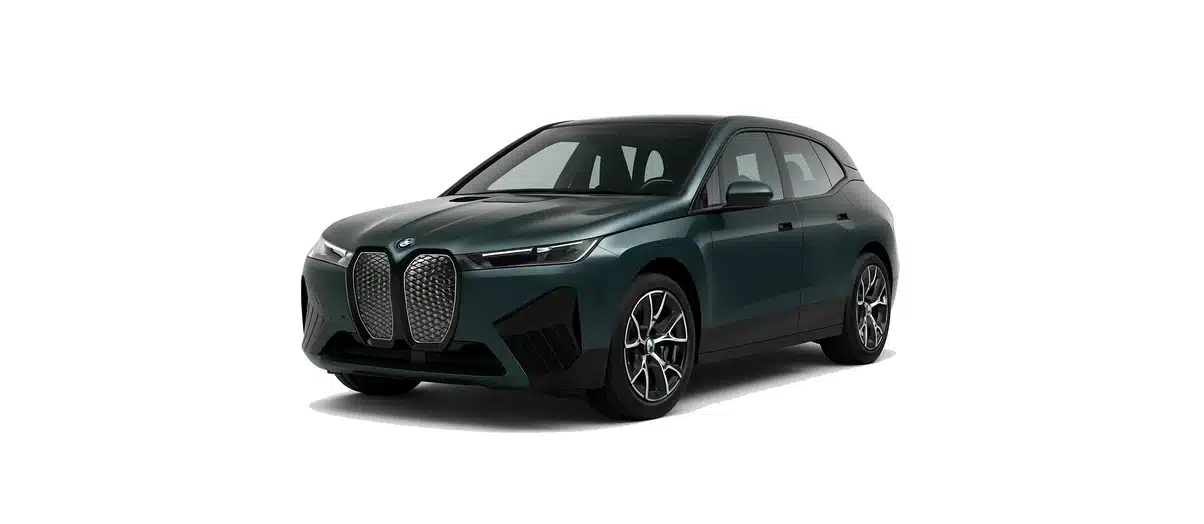
The BMW iX is a large luxury electric SUV, or Sports Activity Vehicle in BMW terminology, designed as a battery electric vehicle rather than a plug-in hybrid. For UK drivers, the key point is that the current facelifted iX range looks like one model family, but it has several battery and charging configurations depending on variant.
BMW’s current UK iX line-up, introduced for customer deliveries from May 2025, includes the iX xDrive45, iX xDrive60 M Sport and iX M70 xDrive. Earlier UK iX xDrive40, xDrive50 and M60 models were sold before this update and use different battery and charging figures, so it is important to check the exact version before comparing charge times or range.
This guide explains how the BMW iX charges in real UK use, including Type 2 home and public AC charging, CCS rapid charging, battery sizes, realistic range expectations and cable selection.
BMW iX Battery and Charging Specifications
The current UK BMW iX is a BEV-only model with dual-motor all-wheel drive across the range. It uses a Type 2 connector for AC charging and a CCS Combo 2 connector for DC rapid charging. EV Database lists the charge port at the right-side rear of the vehicle.
Charging capability varies by variant. The xDrive45 has a lower peak DC charging rate than the larger-battery xDrive60 and M70, while AC charging also depends on whether the car has the standard 11 kW onboard charger or the 22 kW AC Charging Professional setup.
| Current UK variant | Usable battery capacity | AC charging | Peak DC charging | BMW 10-80% DC time |
|---|---|---|---|---|
| BMW iX xDrive45 | 94.8 kWh | 11 kW standard; 22 kW optional | 175 kW | 34 minutes |
| BMW iX xDrive60 M Sport | 109.1 kWh | 11 kW standard; 22 kW optional | 195 kW | 35 minutes |
| BMW iX M70 xDrive | 108.9 kWh | 22 kW standard | 195 kW | 35 minutes |
Battery Options
BMW quotes net, or usable, battery capacities for the current iX range. The iX xDrive45 uses a 94.8 kWh usable battery, while the iX xDrive60 M Sport uses a 109.1 kWh usable battery. The performance-focused iX M70 xDrive has a very similar usable capacity at 108.9 kWh.
EV Database estimates the nominal, or gross, battery capacity at around 100 kWh for the xDrive45 and around 115 kWh for the xDrive60 and M70. For owners, the usable capacity is usually the more relevant figure because it is the energy available for driving after the vehicle’s battery management buffers are taken into account.
These large battery packs are one reason the iX can cover long distances between charges, but they also mean that charging from a low state of charge on a domestic wallbox takes longer than it would in a smaller electric car. In day-to-day use, most owners will not need to charge from empty to full; regular top-ups from a lower daily mileage are usually far more convenient.
AC Charging Speed
AC charging is used for home wallboxes, many workplace chargers and slower public charge points. In the UK and Europe, the BMW iX uses a Type 2 connection for AC charging.
BMW lists the current iX xDrive45 and xDrive60 with 11 kW AC charging as standard, with 22 kW AC Charging Professional available as an option as part of the Technology Pack. The iX M70 xDrive is listed by BMW UK with 22 kW AC charging as standard.
However, those 11 kW and 22 kW figures do not automatically translate to the same speed at home. Most UK homes have single-phase electricity, and a typical dedicated home wallbox provides up to 7.4 kW. On that kind of charger, the iX will usually charge at around the wallbox limit rather than at its full 11 kW or 22 kW AC capability.
To make use of 11 kW or 22 kW AC charging, the property or charging location normally needs a suitable three-phase supply and a compatible charger. Some workplaces, destination chargers and commercial sites can offer this, but it is less common in ordinary domestic settings.
DC Rapid Charging Speed
DC rapid charging is used for motorway services and high-power public charging hubs. The BMW iX uses its CCS Combo 2 connector for DC charging, and this is the connection you will use when plugging into a rapid or ultra-rapid charger.
For the current facelifted UK range, the iX xDrive45 has a peak DC charging rate of 175 kW. The iX xDrive60 M Sport and iX M70 xDrive have a higher peak DC rate of 195 kW. BMW quotes a 10-80% rapid charging time of 34 minutes for the xDrive45 and 35 minutes for the xDrive60 and M70.
Peak charging power is not held for an entire charging session. The actual speed depends on the charger, the vehicle’s state of charge, battery temperature, outside temperature and how busy the charging site is. The fastest part of a rapid charge is normally in the lower and middle part of the battery, which is why long-distance EV charging plans often focus on arriving with a lower state of charge and charging to around 80% rather than waiting for 100%.
The current iX also has battery preconditioning for DC fast charging. Using the BMW navigation or route planning to set a rapid charger as your destination helps the car prepare the battery temperature before arrival, which can improve charging performance, especially in colder conditions.
Range and Efficiency
The headline WLTP range for the current BMW iX range reaches up to 426 miles in the iX xDrive60 M Sport, depending on specification. The xDrive45 and M70 have lower official WLTP figures, with range affected by battery size, performance level, wheels, equipment and driving conditions.
WLTP figures are useful for comparing cars, but real-world range will vary. EV Database estimates real-world range for the current iX at around the low-to-mid 300-mile region depending on variant and conditions, with approximately 325 miles a useful broad reference point rather than an official BMW figure.
In everyday UK driving, motorway speed, cold weather, roof loads, tyre choice and cabin heating can all reduce range. Urban and mixed driving in mild weather is usually more efficient. The iX includes a heat pump as standard, and BMW states that heating of the high-voltage battery at low outside temperatures uses the vehicle heat pump, helping the car manage energy and temperature more effectively.
BMW recommends charging to 80% for battery health in normal use, while official WLTP range figures are based on a full 100% charge. For daily driving, an 80% limit is often sufficient, with 100% best reserved for longer journeys where the extra range is genuinely useful.
Charging at Home
For most BMW iX owners, home charging will be the most convenient and predictable way to keep the vehicle topped up. A dedicated 7.4 kW home wallbox on a suitable single-phase supply is the normal UK setup, and it allows the car to charge overnight or during cheaper off-peak electricity periods if your tariff supports that.
Because the iX has a large battery, a very low-to-full charge on a 7.4 kW charger can take many hours. In practice, owners usually charge little and often. For example, replacing the energy used in a normal commute or a few days of local driving is much quicker than charging the whole battery from near empty.
If you have access to three-phase power at home or at a workplace, an 11 kW or 22 kW compatible charge point may allow faster AC charging, provided your specific iX variant has the matching onboard capability. The xDrive45 and xDrive60 require the optional 22 kW AC Charging Professional equipment to use 22 kW AC, while the M70 has 22 kW as standard in current UK specification.
A 3-pin charger is generally best suited as a backup or occasional charging solution, but can be used regularly if a qualified electrician has confirmed the socket and electrical installation are suitable for sustained EV charging. Given the BMW iX’s large battery capacity, a domestic 3-pin socket will be slow compared with a dedicated wallbox.
Public Charging
Public charging for the BMW iX falls into two main categories: AC destination charging and DC rapid charging. For AC posts, such as those found in town centres, hotels, leisure facilities and some car parks, you will generally use a Type 2 cable. Some posts are tethered, but many UK AC charge points are untethered, meaning you need to bring your own cable.
For rapid and ultra-rapid charging, you use the tethered CCS cable attached to the charger. You do not need your own separate cable for CCS rapid charging. The car and charger communicate automatically to manage the session, power level and safety checks.
BMW supports Plug & Charge Multi Contract on the iX, and EV Database lists Plug & Charge support using ISO 15118-2 and ISO 15118-20, as well as Autocharge support on current variants. Availability can depend on the charging network and account setup, so it is still sensible to carry the relevant charging apps, RFID cards or contactless payment method for backup.
Vehicle-Specific Features
The current BMW iX includes several features that matter for charging and EV ownership. The heat pump is standard, and battery preconditioning is confirmed, including optimised high-voltage battery preconditioning for DC fast charging. These features can help with charging consistency and cold-weather usability.
The iX does not currently offer V2L, V2H or V2G support in the UK data reviewed. BMW UK discusses discharging features for the new BMW iX3 and future BMW models, but they should not be assumed for the current iX.
The iX is also a model where variant and model year are especially important. A used pre-facelift xDrive40, xDrive50 or M60 will not necessarily match the battery sizes, charging speeds or range figures listed for the latest xDrive45, xDrive60 M Sport and M70 xDrive.
Charging Tips
- Check your variant: The current xDrive45, xDrive60 and M70 have different usable battery capacities and charging limits.
- Do not assume 22 kW AC at home: Most UK home chargers are 7.4 kW single-phase, even if the car can accept 11 kW or 22 kW elsewhere.
- Use a Type 2 cable for AC charging: This is needed for many untethered home, workplace and public AC charge points.
- Use CCS for rapid charging: Rapid chargers have their own tethered CCS cables, so you simply plug in at the charger.
- Plan rapid stops around 10-80%: This is usually the most time-efficient charging window on long trips.
- Use navigation preconditioning: Set your rapid charger as the destination so the car can prepare the battery when conditions allow.
- Use 80% for routine charging: BMW recommends an 80% charge target for battery health in normal use.
Frequently Asked Questions
What charging cable does the BMW iX use?
The BMW iX uses a Type 2 connection for AC charging and a CCS Combo 2 connection for DC rapid charging. For many UK AC public charge points, you will need a Type 2 charging cable. DC rapid chargers use tethered CCS cables attached to the charger.
Can the BMW iX charge at 22 kW AC?
Some current BMW iX variants can charge at 22 kW AC, but it depends on specification. The current xDrive45 and xDrive60 have 11 kW AC charging as standard, with 22 kW optional. The M70 xDrive has 22 kW AC as standard in UK data. You also need a suitable three-phase charge point to achieve 22 kW.
How fast does the BMW iX rapid charge?
The current iX xDrive45 peaks at 175 kW DC, while the xDrive60 M Sport and M70 xDrive peak at 195 kW DC. BMW quotes 10-80% rapid charging times of 34 minutes for the xDrive45 and 35 minutes for the xDrive60 and M70, subject to conditions.
Is the BMW iX a plug-in hybrid?
No. The BMW iX is a battery electric vehicle. It does not have a petrol or diesel engine and must be charged from mains electricity or public EV chargers.
Should I charge my BMW iX to 100%?
For everyday use, BMW recommends charging to 80% for battery health. Charging to 100% is useful before a longer journey, but it is not normally necessary for routine local driving.
What This Means for Drivers
The BMW iX is a capable long-distance electric SUV, but the best charging experience comes from understanding your exact variant. The xDrive45, xDrive60 M Sport and M70 xDrive all use the same Type 2 and CCS charging standards, yet their battery capacities, AC equipment and DC peak charging speeds are not identical.
For most UK owners, a 7.4 kW home wallbox will be the everyday charging solution, with public CCS rapid chargers used for longer trips. If you regularly use destination chargers or have access to three-phase charging, the 11 kW or 22 kW AC capability may become more relevant. For road trips, precondition the battery through the navigation system and plan around the 10-80% charging window for more efficient stops.
Looking for a Charging Cable for BMW iX?
If you need a suitable Type 2 cable for home, workplace or public AC charging, choose a cable that matches your BMW iX, your charger and how you plan to use the vehicle. We offer BMW iX charging cables for UK drivers.
Please note that this information is intended as a guide. Charging specifications may change due to model and year of manufacture. For precise information, always refer to your vehicle user manual.

