
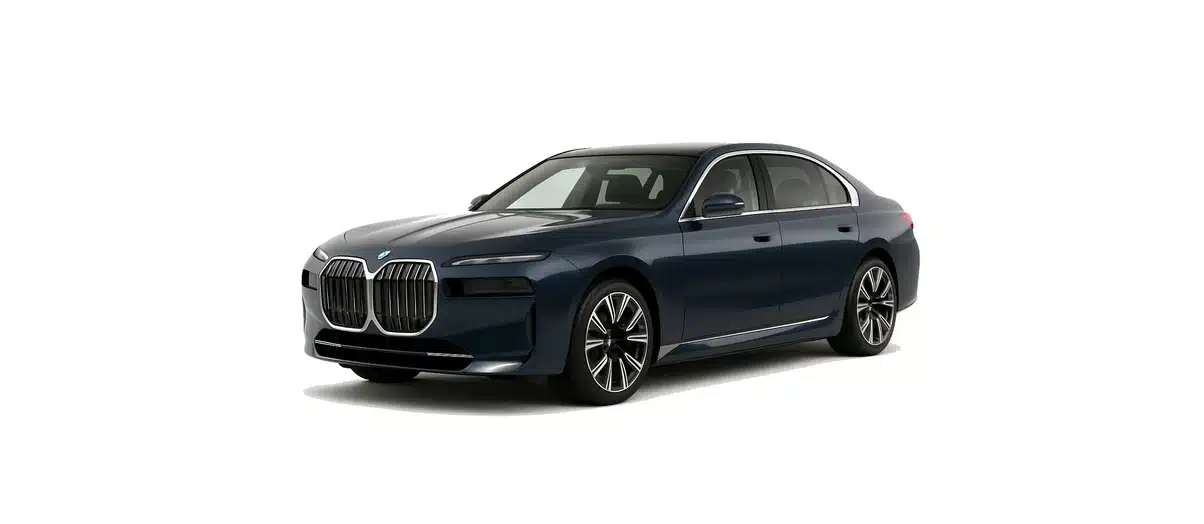
The BMW i7 is the fully electric version of the BMW 7 Series luxury saloon. For UK drivers, it uses a Type 2 connection for AC charging at home and on public destination chargers, and a CCS Combo 2 connection for DC rapid charging on longer journeys. It should not be confused with BMW 7 Series plug-in hybrid models such as the 750e xDrive or M760e xDrive, which have different battery sizes and charging needs.
This guide is particularly important because there are two key generations of BMW i7 charging figures in circulation. Earlier MY23-26 i7 models, including the i7 xDrive60, used a smaller usable battery and had lower peak rapid charging capability. The updated 2026/MY27 i7 line-up, including the i7 50 xDrive, i7 60 xDrive and i7 M70 xDrive, is quoted with a larger usable battery and faster DC charging. If you are buying used, ordering new, or comparing online specifications, checking the model year and exact variant matters.
BMW i7 Battery and Charging Specifications
UK and European BMW i7 models use the Type 2 charging standard for AC charging and CCS Combo 2 for rapid DC charging. That means the same charging port area can be used for home wallboxes, public AC posts and high-power motorway chargers, although the connector and charging method differ depending on the charger type.
For current 2026/MY27 i7 models, BMW UK states a WLTP electric range across the range of 352-452 miles, depending on variant and specification. BMW material and EV data sources indicate a usable battery capacity of around 112.5 kWh for the updated i7 50 xDrive and i7 60 xDrive, with the i7 M70 xDrive listed at a very similar usable figure. Earlier MY23-26 i7 models, such as the i7 xDrive60, are commonly listed with around 101.7 kWh usable capacity.
Rapid charging also differs by generation. The updated 2026/MY27 i7 is quoted at up to 250 kW DC, with a 10-80% charge time of around 28 minutes in suitable conditions. Earlier i7 models are typically listed around 195-200 kW peak DC charging, so owners should not assume that every BMW i7 will match the latest 250 kW figure.
Battery Options
The current BMW i7 range is expected to include i7 50 xDrive, i7 60 xDrive and i7 M70 xDrive versions. These are fully electric, all-wheel-drive luxury saloons in BMW’s current official material. The updated models use BMW’s newer battery technology, with current data indicating a gross capacity of about 117 kWh and a usable capacity of roughly 112.4-112.5 kWh, depending on variant.
Earlier MY23-26 BMW i7 models are still highly relevant in the used market. These cars, including the i7 xDrive60, are usually listed with a 105.7 kWh gross battery and approximately 101.7 kWh usable capacity. That difference is large enough to affect charging time estimates, range expectations and road-trip planning.
If you are looking at a used i7 or comparing a dealer listing against charging data online, check the model year, exact derivative and build specification. A 2023 i7 xDrive60 and a 2026/MY27 i7 60 xDrive may look closely related, but their quoted battery and rapid charging figures are not the same.
AC Charging Speed
AC charging is the type of charging most owners use at home and at many workplace or destination chargers. For the BMW i7, AC charging uses a Type 2 cable or a tethered Type 2 connector. The car’s onboard charger converts AC power into DC power for the battery.
There is some variation in published information for the current MY27 i7. BMW press material refers to AC charging at up to 22 kW, with an empty-to-full charge taking about 6 hours at 22 kW or about 12 hours at 11 kW. However, EV Database UK lists 11 kW as standard and 22 kW as optional on some MY27 i7 pages. For that reason, it is best to verify the exact onboard AC charger fitted to your car before relying on a 22 kW charging time.
For most UK homes, the practical charging rate will be up to 7.4 kW from a single-phase dedicated home wallbox. Even if the car can accept 11 kW or 22 kW AC, those higher AC speeds normally require a three-phase electrical supply and a compatible charger. Many domestic properties do not have three-phase power, so a typical overnight home charge will be slower than the car’s maximum AC capability.
As a rough guide, a current i7 with around 112.5 kWh usable capacity may take in the region of 16 hours or more from a low state of charge to full on a 7.4 kW home charger, allowing for charging losses and tapering. In everyday use, most owners will not charge from empty to 100%; topping up from, for example, 40% to 80% overnight is much more realistic.
DC Rapid Charging Speed
DC rapid charging is used for long journeys and shorter high-power stops. With DC charging, the charger supplies direct current to the car’s battery through the CCS Combo 2 connector, bypassing the car’s AC onboard charger.
The updated 2026/MY27 BMW i7 is quoted at up to 250 kW DC, with a 10-80% charge taking around 28 minutes where charger capability, battery temperature and state of charge are favourable. This is a notable improvement over earlier MY23-26 i7 models, which are generally listed around 195-200 kW peak DC charging.
Peak charging speed is not maintained for the whole session. Like other electric cars, the i7 charges fastest at lower to mid battery percentages and slows as the battery fills. On a road trip, charging from around 10% to 70% or 80% is usually more time-efficient than waiting for 100% at a rapid charger. Charging beyond 80% can be useful when you genuinely need the range, but it will usually take disproportionately longer.
Range and Efficiency
BMW UK states that the current i7 range spans 352-452 miles WLTP, depending on model and specification. Current BMW press information gives figures of up to 452 miles for the i7 50 xDrive, up to 451 miles for the i7 60 xDrive and up to 426 miles for the i7 M70 xDrive, although some figures may be provisional depending on market timing and final specification.
Real-world range will usually be lower than WLTP in mixed UK use. Factors such as motorway speed, winter temperature, wheel size, cabin heating, passenger load and driving style can make a noticeable difference. EV Database UK lists a real-world estimate of around 348 miles for at least one current i7 configuration, which gives a more practical indication for planning than the headline WLTP figure alone.
The i7 is a large luxury saloon with a sizeable battery, so it is well suited to long-distance use when paired with reliable rapid charging. However, its energy use will be higher at sustained motorway speeds than in gentle urban or A-road driving, especially in cold weather.
Charging at Home
For most BMW i7 owners, a dedicated Type 2 home wallbox will be the most convenient charging solution. A 7.4 kW single-phase charger is typical for UK homes and can add a substantial amount of range overnight. You can choose either a tethered charger, which has the Type 2 cable permanently attached, or an untethered charger, where you use your own Type 2 cable.
An untethered charger can be neater on the wall and allows you to replace or change cable length more easily. A tethered charger is more convenient for daily use because the cable is always ready. Either option is suitable for the i7 as long as the charger is correctly installed and configured for your property.
A 3-pin charger is generally best suited as a backup or occasional charging solution, but can be used regularly if a qualified electrician has confirmed the socket and electrical installation are suitable for sustained EV charging. Because the BMW i7 has a large battery, charging from a domestic 3-pin socket will be very slow compared with a dedicated wallbox, so it is not the most practical choice for regular high-mileage use.
Public Charging
Public AC chargers are useful at hotels, offices, car parks and destinations where the car will be parked for several hours. These chargers usually require your own Type 2 cable unless the unit is tethered. A high-quality Type 2 cable rated for the charging setup you use is therefore important for i7 ownership.
For motorway and long-distance driving, use CCS rapid or ultra-rapid chargers. The updated i7’s quoted 250 kW peak DC capability means it can benefit from high-power chargers when conditions allow. Earlier i7 owners should expect lower peak figures, but a 150 kW or 200 kW charger can still provide useful charging performance depending on the car’s state of charge and battery temperature.
Where possible, route to a rapid charger using the BMW navigation system. The i7 supports battery preparation for high-power charging, and this is especially helpful in cold weather. Arriving with the battery at an appropriate temperature can make a significant difference to the speed you see at the charger.
Vehicle-Specific Features
The BMW i7 includes heat pump technology, which helps manage cabin heating more efficiently than a simple resistive heater. This is particularly useful in colder UK conditions, where heating demand can otherwise reduce driving range.
Battery preconditioning is also part of the i7 charging experience. Using the vehicle’s navigation to plan a stop at a compatible high-power charger can help the car prepare the battery for faster DC charging. This does not guarantee peak speed every time, but it improves the chances of achieving strong charging performance.
Current data does not support claiming V2L, V2G or V2H capability for UK BMW i7 models. Plug & Charge support may be available on current versions depending on service and network compatibility, but Plug & Charge is a payment and authentication feature, not vehicle-to-load or vehicle-to-grid power export.
Charging Tips
- Check your model year: MY23-26 i7 cars and updated 2026/MY27 cars have different battery and rapid charging figures.
- Use Type 2 for AC charging: Home wallboxes and many public destination chargers use Type 2 in the UK and Europe.
- Use CCS for rapid charging: DC rapid chargers use the CCS Combo 2 connector.
- Plan around 10-80%: Rapid charging is usually most efficient within this window.
- Verify 11 kW vs 22 kW AC: Do not assume every current i7 has 22 kW AC unless the car’s specification confirms it.
- Precondition before rapid charging: Use BMW navigation to help prepare the battery for high-power charging where supported.
- Choose cable length carefully: A 5m cable suits many parking layouts, while a longer cable may help on driveways or awkward public bays.
Frequently Asked Questions
What charging cable does the BMW i7 use?
The BMW i7 uses a Type 2 connection for AC charging. For public rapid charging, it uses the CCS Combo 2 connector, which is the UK and European rapid charging standard.
Can the BMW i7 charge at 22 kW AC?
Some current information states AC charging up to 22 kW, but other UK data lists 11 kW as standard and 22 kW as optional on MY27 models. Check the specification of your exact car before assuming 22 kW AC capability.
How fast can the BMW i7 rapid charge?
The updated 2026/MY27 BMW i7 is quoted at up to 250 kW DC and around 28 minutes for a 10-80% charge under suitable conditions. Earlier MY23-26 models are typically around 195-200 kW peak DC charging.
Is the BMW i7 a plug-in hybrid?
No. The BMW i7 is a fully electric vehicle. BMW 7 Series plug-in hybrid models exist, but they are separate from the i7 range and have different charging requirements.
Should I charge my BMW i7 to 100% every day?
For daily use, many EV owners set a lower charge limit, such as around 80%, and only charge to 100% before a longer journey. Follow BMW’s in-car guidance and owner manual for battery care recommendations.
What This Means for Drivers
The BMW i7 is a capable long-distance electric saloon, but charging expectations should be based on the correct generation. If you own or are considering an earlier MY23-26 i7, use the approximately 101.7 kWh usable battery and around 195-200 kW rapid charging figures as your reference. If you are looking at the updated 2026/MY27 i7, the relevant figures are around 112.5 kWh usable capacity and up to 250 kW DC charging where conditions allow.
At home, most UK owners will charge at up to 7.4 kW from a single-phase wallbox, regardless of the car’s higher possible AC capability. For public charging, carrying a suitable Type 2 cable covers destination chargers, while rapid charging will use the tethered CCS cable attached to the charging unit.
Looking for a Charging Cable for BMW i7?
If you need a suitable Type 2 cable for home or public AC charging, We offer BMW i7 charging cables for UK owners, including options for different cable lengths and charging setups.
Please note that this information is intended as a guide. Charging specifications may change due to model and year of manufacture. For precise information, always refer to your vehicle user manual.

