
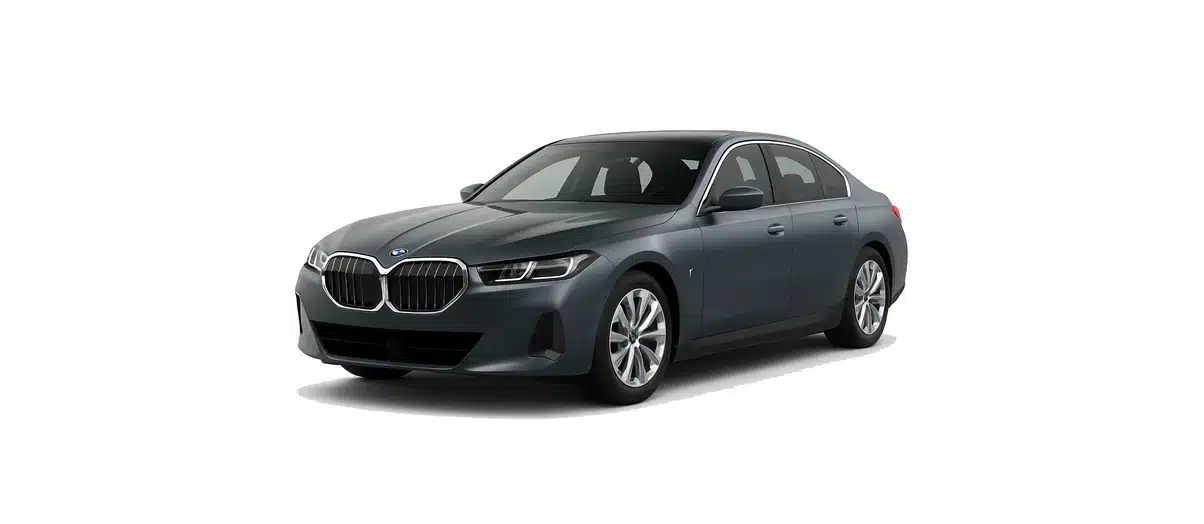
The BMW i5 is the fully electric version of the current 5 Series, available in the UK as both a Saloon and Touring estate. It is a battery-electric vehicle, not a plug-in hybrid, and should not be confused with 5 Series PHEV models such as the 530e or 550e. For drivers moving into an i5 from a petrol, diesel or hybrid executive car, the main charging questions are straightforward: which cable do you need, how quickly will it charge at home, and what should you expect on longer journeys?
In the UK, the BMW i5 uses a Type 2 connection for AC charging and a CCS Combo 2 connection for DC rapid charging. That means a Type 2 cable is the key item for untethered home wallboxes and many destination chargers, while motorway and rapid charging hubs use the tethered CCS cable attached to the charger. The i5 is capable of high-power DC charging, but most day-to-day charging will still be governed by the limits of a UK home electricity supply.
BMW i5 Battery and Charging Specifications
Current UK-market BMW i5 models use an 81.2 kWh battery capacity figure in BMW technical data. EV Database lists the MY25 i5 eDrive40 Saloon with an 84.4 kWh nominal battery and 81.2 kWh usable capacity, so 81.2 kWh is the safest practical figure to use when estimating charging time and usable driving range.
The charge port is located at the right rear of the car. For AC charging, the i5 uses a Type 2 inlet. For DC rapid charging, the lower CCS pins are used as part of the same charging port. This is the standard arrangement for modern UK and European electric cars, so the i5 is compatible with typical UK home wallboxes, workplace chargers, destination chargers and CCS rapid chargers.
- Vehicle type: Battery-electric BMW 5 Series
- Body styles: Saloon and Touring estate
- Battery guide figure: 81.2 kWh usable
- AC charging: Type 2, typically 11 kW on-board charging, with 22 kW availability dependent on variant or option
- DC rapid charging: CCS Combo 2, up to around 205 kW peak
- Typical rapid charge: approximately 10-80% in around 30 minutes on a suitable high-power charger
Battery Options
The current i5 range, including eDrive40, xDrive40 and M60 xDrive versions, is best treated as using the same 81.2 kWh usable battery capacity for general charging guidance. Some older or third-party references may quote a slightly different gross battery capacity, but usable capacity is the more helpful figure for owners because it relates more closely to available driving energy.
There are important differences between versions, however. The Saloon is generally more efficient than the Touring estate, and the high-performance M60 xDrive models typically have lower range than the most efficient eDrive40 configurations. Wheel size, trim, weather and driving style can also make a noticeable difference, so it is better to think in terms of a range band rather than one fixed number that applies to every BMW i5.
AC Charging Speed
BMW UK data for the i5 includes 11 kW and 22 kW AC charging references, while EV Database lists 11 kW AC as standard for the MY25 eDrive40 Saloon with 22 kW available as an optional on-board charger. Because availability appears to vary by variant, trim or option, owners should check their exact build, VIN or BMW specification sheet before assuming their car has 22 kW AC capability.
For most UK homes, the more important limit is the property supply rather than the car. A typical single-phase home wallbox charges at up to 7.4 kW. Even if an i5 has an 11 kW or 22 kW on-board charger, it will not charge faster than the wallbox and the electrical supply can provide. On a 7.4 kW home charger, a large battery such as the i5’s will commonly be an overnight charging proposition, with EV Database giving around 13 hours from empty to full as a typical single-phase home charging estimate.
Three-phase charging is more common at workplaces, commercial premises and some public AC sites. If your BMW i5 has the relevant on-board charger and the charging point supports it, 11 kW or 22 kW AC charging can reduce waiting time. However, a 22 kW public AC post will only deliver 22 kW to the car if the car itself is equipped to accept that rate.
DC Rapid Charging Speed
For longer journeys, the BMW i5’s CCS rapid charging capability is one of its key strengths. BMW quotes up to around 205 kW DC charging and a 10-80% charge time of about 30 minutes under suitable conditions. EV Database gives a similar typical 10-80% result for the MY25 i5 eDrive40 Saloon on a high-power CCS charger.
It is important not to treat 205 kW as a constant charging speed. Rapid charging follows a curve: the car may accept a high peak rate when the battery is warm and at a lower state of charge, then gradually reduce power as the battery fills. Charging from 10-80% is usually much faster than charging from 80-100%, which is why long-distance EV route planning often involves shorter, well-timed stops rather than waiting for a full battery at every charger.
Cold weather, charger congestion, battery temperature, charger output and the car’s state of charge can all affect charging speed. For the best results, use BMW’s navigation to route to a rapid charger where possible, as battery preconditioning is confirmed for the i5 when supported by the navigation route.
Range and Efficiency
The highest WLTP figure found for efficient BMW i5 Saloon configurations is up to 382 miles, but this should not be treated as a universal real-world figure. The i5 Touring estate, xDrive versions and M60 xDrive performance models have different official figures, and real driving range varies with speed, outside temperature, wheel and tyre specification, terrain and driving style.
As a practical guide, EV Database estimates around 295 miles of real-world range for the MY25 i5 eDrive40 Saloon. Some drivers may see more in mild weather and efficient mixed driving, while sustained motorway use in winter can reduce range. The standard heat pump should help efficiency in colder conditions compared with relying purely on resistive heating, but winter driving still affects all electric cars.
For daily use, many owners will not need to charge from empty to full. A routine such as charging to around 80% for normal driving and reserving 100% charges for longer trips is a sensible approach for battery care and convenience.
Charging at Home
Home charging is usually the cheapest and most convenient way to run a BMW i5. A dedicated 7.4 kW home wallbox allows the car to recover a significant amount of range overnight, especially when paired with an EV-friendly electricity tariff. For many drivers, plugging in a few times a week will be enough rather than charging every night.
If you have an untethered wallbox, you will need a Type 2 to Type 2 charging cable. The BMW i5’s on-board AC capability means it is sensible to choose a cable that suits your car, wallbox and future charging plans. A three-phase Type 2 cable can still be used on single-phase chargers, but the car will only receive the power that the charger and supply can deliver.
A 3-pin charger is generally best suited as a backup or occasional charging solution, but can be used regularly if a qualified electrician has confirmed the socket and electrical installation are suitable for sustained EV charging. Because the i5 has a large battery, a domestic 3-pin socket will be much slower than a dedicated wallbox and is not the most convenient option for regular high-mileage use.
Public Charging
Public charging for the BMW i5 falls into two main categories: AC destination charging and DC rapid charging. AC chargers are often found at hotels, car parks, workplaces, supermarkets and town centres. Many of these are untethered, so you use your own Type 2 cable. They are ideal when the car will be parked for several hours.
DC rapid and ultra-rapid chargers are used for faster top-ups on longer journeys. These chargers have tethered CCS connectors, so you do not use your own Type 2 cable for the rapid charging part. On a suitable high-power CCS unit, a 10-80% stop of roughly half an hour is a reasonable expectation, although real sessions can be slower if the battery is cold, the charger is limited or the car is already at a high state of charge.
EV Database lists Plug & Charge and Autocharge for the MY25 i5 eDrive40 Saloon. Availability can depend on charging network support, account setup and software, so it is still worth carrying the relevant charging apps or RFID cards for networks you use regularly.
Vehicle-Specific Features
The BMW i5 is built on BMW’s CLAR platform and uses a 400 V battery architecture according to EV Database. It also lists a heat pump as standard for the MY25 eDrive40 Saloon, along with navigation-based battery preconditioning. These features are useful for UK ownership because they help the car manage temperature and charging readiness, particularly in colder months.
Vehicle-to-load, vehicle-to-grid and vehicle-to-home capability should not be assumed for the BMW i5. EV Database lists V2L, V2G and V2H as not available for the MY25 eDrive40 Saloon, and there is no reliable UK model-specific evidence to suggest owners should buy equipment expecting those features.
Charging Tips
- Use a Type 2 cable for AC charging: This covers home wallboxes, workplace posts and many destination chargers.
- Use CCS for rapid charging: Rapid chargers have their own tethered CCS cable, so you do not need to supply one.
- Check your exact AC specification: Do not assume every i5 has 22 kW AC charging; confirm your variant, option list or VIN.
- Plan rapid stops around 10-80%: This is usually the most time-efficient charging window on long journeys.
- Use BMW navigation for rapid charging routes: This can support battery preconditioning before arrival.
- Charge to around 80% for normal use: Use 100% when you need maximum range before a longer trip.
Frequently Asked Questions
What charging cable does the BMW i5 need?
The BMW i5 needs a Type 2 charging cable for AC charging from an untethered home wallbox, workplace charger or public destination charger. For DC rapid charging, use the CCS connector attached to the rapid charger.
Can the BMW i5 charge at 22 kW AC?
Some UK data references 22 kW AC charging, but it appears to be variant or option dependent rather than something to assume on every i5. The safer standard figure is 11 kW AC, and owners should check their exact vehicle specification.
How long does the BMW i5 take to charge at home?
On a typical UK 7.4 kW single-phase wallbox, a full charge from very low to full is best thought of as an overnight charge, with around 13 hours from empty often quoted as a typical estimate. Smaller daily top-ups will take much less time.
How fast can the BMW i5 rapid charge?
The i5 can rapid charge at up to around 205 kW DC in ideal conditions. BMW quotes roughly 30 minutes for 10-80% on a suitable high-power charger, but real charging speed depends on battery temperature, charger capability and state of charge.
Is the BMW i5 a plug-in hybrid?
No. The BMW i5 is a fully electric 5 Series. BMW also sells plug-in hybrid 5 Series models, but those are not i5 models and have different charging requirements.
What This Means for Drivers
The BMW i5 is well suited to UK electric driving because it combines a large usable battery, strong CCS rapid charging and straightforward Type 2 AC compatibility. For most owners, the key point is that home charging will usually be limited by a 7.4 kW single-phase wallbox, not by the car’s maximum AC capability. Public rapid charging is much quicker, but the headline peak rate is only part of the story; the most efficient long-distance strategy is usually to arrive low, charge to around 80%, and continue your journey.
If you are choosing a cable, focus on quality, correct Type 2 compatibility and the charging environments you use most. A good Type 2 cable covers everyday AC charging, while rapid charging is handled by the CCS cable already attached to the public charger.
Looking for a Charging Cable for BMW i5?
We offer BMW i5 charging cables suitable for UK home, workplace and destination charging, including Type 2 options for everyday AC use.
Please note that this information is intended as a guide. Charging specifications may change due to model and year of manufacture. For precise information, always refer to your vehicle user manual.

