
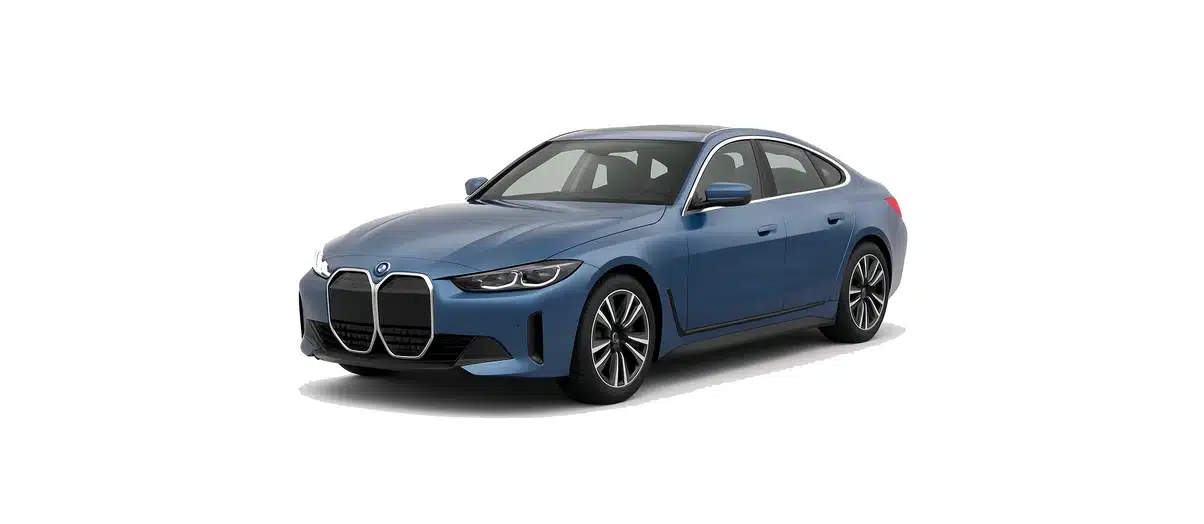
The BMW i4 is a fully electric 5-door Gran Coupé, combining the shape and driving style of a BMW 4 Series Gran Coupé with a battery-electric powertrain. For UK drivers, the important point is that the i4 is not a plug-in hybrid: it uses a Type 2 connection for AC charging and a CCS Combo 2 connection for rapid DC charging.
Charging figures vary by version, so it is worth treating the BMW i4 as a family of models rather than one single specification. The smaller-battery i4 eDrive35, long-range i4 eDrive40 and performance-focused i4 M60 xDrive have different battery sizes and DC rapid charging limits, although researched current variants share an 11 kW maximum AC charging capability.
BMW i4 Battery and Charging Specifications
UK-market BMW i4 specifications can differ by variant, model year, wheel size and trim. As a guide, current research shows the i4 using a Type 2 AC inlet and CCS Combo 2 DC rapid charging connection, with the charge flap positioned on the right rear side of the car. This is similar in location to a conventional fuel filler flap, which makes it easy to access at many home and public charge points.
All researched battery-electric i4 variants use an 11 kW onboard AC charger. That does not mean every home charger will deliver 11 kW, because most UK homes are single-phase and typically charge at up to 7.4 kW. To use the full 11 kW AC capability, the property or site normally needs a three-phase electricity supply and a compatible three-phase charge point.
For rapid charging, the i4 uses tethered CCS DC chargers. Depending on variant, maximum DC charging is listed at up to 180 kW for the eDrive35 and up to 205 kW for larger-battery eDrive40 and M60 versions.
Battery Options
The BMW i4 battery you have will affect charging time and range. The following table summarises the researched UK-relevant variants, but always check your vehicle documentation or the live BMW UK specification for your exact model year.
| BMW i4 version | Battery information | AC charging | DC rapid charging | Notes |
|---|---|---|---|---|
| i4 eDrive35 | About 70.3 kWh gross / 67.1 kWh usable | Up to 11 kW | Up to 180 kW | Smaller-battery rear-wheel-drive version |
| i4 eDrive40 | About 83.9 kWh gross / 81.3 kWh usable | Up to 11 kW | Up to 205 kW | Long-range rear-wheel-drive version |
| i4 M60 xDrive | About 83.9 kWh gross / around 81.1 kWh usable in BMW UK data | Up to 11 kW | Up to 205 kW | Current high-performance all-wheel-drive version |
Older or market-specific i4 versions may differ, and the previous M50 should not automatically be assumed to match the current M60 in every detail.
AC Charging Speed
AC charging is the type of charging you will normally use at home, at work and on many destination chargers. The BMW i4’s onboard AC charger is rated at up to 11 kW across the researched variants, but the actual speed depends on the charge point and electrical supply.
On a typical UK single-phase 7.4 kW home wallbox, an i4 eDrive35 may take roughly 10 to 11 hours for a large charge, while the larger-battery eDrive40 may take around 13 hours from very low to full. These are broad guide figures because temperature, starting charge level and charger output all affect the result.
On a three-phase 11 kW AC charger, charging is quicker. EV Database examples suggest roughly 7 hours 15 minutes for the eDrive35 and around 8 hours 45 minutes for the eDrive40 at 11 kW. A 22 kW public AC post will not charge the i4 at 22 kW, because the car’s onboard AC charger is the limiting factor at 11 kW.
DC Rapid Charging Speed
DC rapid charging is used for longer journeys and motorway stops. Instead of using your own Type 2 cable, rapid chargers have their own tethered CCS plug. You connect the CCS plug directly to the i4’s charging port, and the charger supplies DC power straight to the battery.
The i4 eDrive35 is listed with up to 180 kW DC charging, while the eDrive40 and M60 xDrive are listed with up to 205 kW DC charging. BMW UK data and EV Database examples indicate that larger-battery versions can charge from 10% to 80% in around 30 minutes in suitable conditions. The eDrive35 is also generally quoted at around 30 to 32 minutes for a 10% to 80% rapid charge, depending on source and model-year display.
These peak speeds are not held for the entire session. Rapid charging is usually fastest when the battery is at a lower state of charge and warm enough, then slows as the battery approaches 80% and beyond. For this reason, short rapid stops from around 10% to 80% are often more time-efficient than charging to 100% on a DC charger.
Range and Efficiency
Range depends heavily on which BMW i4 you drive. The eDrive35 has the smaller battery and is typically suited to drivers who want the i4 experience without needing the maximum possible range. The eDrive40 offers the longest-range positioning in the line-up, while the M60 xDrive prioritises performance as well as everyday usability.
BMW UK WLTP figures vary by trim and wheels. Research indicates WLTP values of roughly 258 to 306 miles for the eDrive35, around 319 to 380 miles across displayed eDrive40 rows, and about 311 to 338 miles for the M60 xDrive. EV Database estimates are usually more conservative for real-world use, with examples such as around 265 miles for the eDrive35, around 325 miles for the eDrive40 and around 285 miles for the M60 xDrive.
As with any EV, motorway speed, cold weather, tyres, wheel size, cabin heating and driving style can make a significant difference. The i4 is fitted with a heat pump according to the reviewed data, which can help heating efficiency in cooler conditions, but it does not remove the normal winter range reduction that EV drivers may notice.
Charging at Home
For most BMW i4 owners, home charging will be the cheapest and most convenient way to run the car. A dedicated 7.4 kW wallbox is a good match for a typical UK single-phase home supply. It will not use the i4’s full 11 kW AC capability, but it is usually fast enough to recharge overnight, especially if you are topping up from a partial state of charge rather than charging from empty.
If your property has three-phase electricity and a suitable charger, the i4 can make use of up to 11 kW AC. This can be useful for higher-mileage drivers or households with more than one EV, but it is not something most UK homes have by default.
For an untethered home charger, you will need a Type 2 to Type 2 charging cable. The same cable is also used on many workplace and public AC charging posts. If your wallbox is tethered, it already has the cable attached, so you may still want a separate Type 2 cable for public AC charging.
A 3-pin portable charger is generally best suited as a backup or occasional charging solution, but can be used regularly if a qualified electrician has confirmed the socket and electrical installation are suitable for sustained EV charging. Standard domestic sockets were not originally designed around repeated high-load EV charging for many hours, so professional electrical advice is important.
Public Charging
Public charging falls into two main categories: AC destination charging and DC rapid charging. AC destination chargers are common in car parks, hotels, workplaces and town centres. Many are untethered, so you plug in using your own Type 2 to Type 2 cable. The i4 will charge at up to its 11 kW AC limit if the post and supply support it.
DC rapid and ultra-rapid chargers are different. They have a tethered CCS connector, so you do not use your own charging cable. These are the chargers to use on longer journeys when you need to add range quickly.
For best rapid-charging performance, plan longer trips through the BMW navigation system where possible. Battery preconditioning is listed for current i4 variants, including automatic preconditioning when navigating to a suitable rapid charger. This can help bring the battery closer to the right temperature before arrival, improving charging consistency in suitable conditions.
Vehicle-Specific Features
The BMW i4 has several charging-related features worth knowing about. Reviewed data lists Plug & Charge / ISO 15118 support on current variants, which can simplify payment and authentication on compatible charging networks. Availability and network support can vary, so it is sensible to check the charging provider before relying on it.
Battery preconditioning is also listed, including navigation-linked preconditioning for rapid charging. This is particularly useful in winter or before high-power charging stops, when a cold battery may otherwise accept power more slowly.
The i4 does not have a front storage compartment, so keep your Type 2 cable in the boot or underfloor storage area if available. The charging inlet is on the right rear flank. The reviewed data does not list vehicle-to-load, vehicle-to-home or vehicle-to-grid support for the BMW i4, so it should not be treated as a mobile power source for external appliances or home backup.
Charging Tips
- Set a daily charge limit of around 80% for regular use unless you need the extra range for a specific journey.
- Charge to 100% shortly before departure when maximum range is useful, rather than leaving the car sitting full for long periods.
- Use a Type 2 to Type 2 cable for untethered home, workplace and public AC charging.
- Do not expect 22 kW from a 22 kW AC post; the i4’s onboard AC limit is 11 kW.
- On long trips, navigate to the rapid charger through the car’s route planning so battery preconditioning can operate where supported.
- For rapid charging, aim for efficient 10% to 80% stops rather than waiting for the final 20% unless you genuinely need it.
- Check whether your i4 is an eDrive35, eDrive40, M60 or an older variant before comparing charging figures.
Frequently Asked Questions
What charging cable does the BMW i4 use?
The BMW i4 uses a Type 2 connection for AC charging. For untethered AC charge points, choose a Type 2 to Type 2 cable. For DC rapid charging, use the tethered CCS plug attached to the rapid charger.
Can the BMW i4 charge at 11 kW at home?
Only if your home has a suitable three-phase supply and compatible 11 kW charger. Most UK homes are single-phase and will typically charge the i4 at up to 7.4 kW on a dedicated wallbox.
Can the BMW i4 use a 22 kW public charger?
Yes, if it is a Type 2 AC post, but the car will not take 22 kW. The onboard AC charger is limited to 11 kW, so that is the maximum AC rate under suitable conditions.
How fast can the BMW i4 rapid charge?
The eDrive35 is listed at up to 180 kW DC, while the eDrive40 and M60 xDrive are listed at up to 205 kW DC. In good conditions, a 10% to 80% charge is generally around the 30-minute mark, depending on variant and charger performance.
Should I charge my BMW i4 to 100%?
For everyday use, BMW recommends regular charging to around 80% to help optimise battery health. Charging to 100% is useful before a longer journey, ideally finishing close to departure time.
What This Means for Drivers
The BMW i4 is straightforward to charge once you separate AC charging from rapid DC charging. At home and on most destination chargers, you will use Type 2 AC charging, usually at up to 7.4 kW on a typical UK home wallbox or up to 11 kW where three-phase AC is available. On longer journeys, CCS rapid charging provides much faster stops, with the exact peak rate depending on whether you have the eDrive35 or a larger-battery variant.
The most practical setup for many UK i4 owners is a dedicated home wallbox, a good-quality Type 2 to Type 2 cable for untethered AC posts, and sensible use of BMW route planning for rapid charging stops. Because the i4 range includes several versions and has seen recent model-year changes, check your exact variant before relying on a single battery size, range figure or peak charging speed.
Looking for a Charging Cable for BMW i4?
We offer BMW i4 charging cables for Type 2 AC charging at home, work and public charging posts; choose the cable length and rating that best suits your charger and how you park.
Please note that this information is intended as a guide. Charging specifications may change due to model and year of manufacture. For precise information, always refer to your vehicle user manual.

