
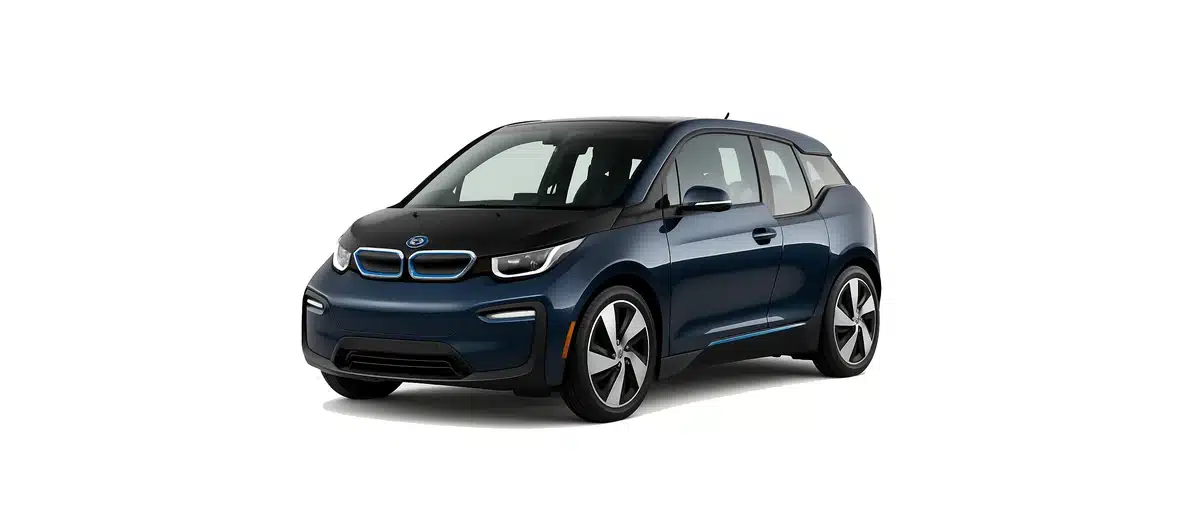
The BMW i3 is one of the most distinctive used electric cars on UK roads. This guide covers the original BMW i3 I01 hatchback sold in the UK from 2013 until production ended in 2022, not the newer BMW i3 Saloon nameplate due later in the decade. That distinction matters because the original i3 hatchback has its own battery sizes, charging limits and connector details.
For used buyers and current owners, the most important charging checks are simple: identify whether the car is a 60 Ah, 94 Ah or 120 Ah model, confirm the AC charging capability, and on early cars check whether CCS rapid charging is fitted. Most UK owners will charge at home using a Type 2 connection, while public rapid charging uses a tethered CCS connector where the vehicle is equipped for it.
BMW i3 Battery and Charging Specifications
The original BMW i3 hatchback uses a Type 2 inlet for AC charging in the UK and Europe. Later cars with rapid charging use the CCS Combo 2 arrangement, which adds two larger DC pins below the Type 2 section. The charge port is positioned at the rear off-side/right rear quarter, which is useful to remember when parking at public chargers.
Charging performance depends strongly on the age and battery version of the car. Early 60 Ah cars are typically listed with up to 7.4 kW AC charging, while later 120 Ah models can accept up to 11 kW AC on a suitable three-phase supply. In practice, most UK home installations are single-phase and will usually charge the i3 at up to 7.4 kW.
For DC rapid charging, the later i3 hatchback is commonly associated with CCS charging at around 47-50 kW, with EV Database listing 49 kW for the 120 Ah model. However, early 60 Ah owners should not assume rapid charging is fitted, as CCS was optional on some early cars. A visual check of the socket is the easiest first step: if the lower DC pins are not present, the car cannot use CCS rapid chargers.
Battery Options
The BMW i3 hatchback was sold with several battery versions over its life. The early 60 Ah i3 BEV, sold from around 2013 to 2017, has a 21.6 kWh gross battery capacity and about 18.8 kWh usable capacity. EV Database lists this version at around 70 miles of real-world range, although age, weather, tyres and battery condition can affect what a used example achieves today.
The 94 Ah i3, introduced later in the first generation’s life, increased capacity to 33.2 kWh gross and around 27.2 kWh usable. It is often a good compromise for drivers who like the original lightweight i3 concept but want more range than the earliest cars. Charging specification can vary, so it is sensible to check the individual car rather than relying only on the model year.
The final and most capable UK hatchback version is the 120 Ah i3, sold from 2018 until the end of production. It has a 42.2 kWh gross battery and around 37.9 kWh usable capacity. The i3s 120 Ah uses the same battery capacity but has a sportier setup and slightly lower efficiency and range. If you are buying used and want the simplest modern charging experience, the 120 Ah model is usually the easiest version to understand because it combines the largest battery with Type 2 AC and CCS DC charging.
AC Charging Speed
AC charging is what you will use at home, at many workplace chargers and at untethered public destination chargers. For the BMW i3, this uses a Type 2 connection. If the charging point is untethered, you will need a Type 2 to Type 2 cable.
On a 120 Ah i3 or i3s, AC charging can be up to 11 kW where the car and charging supply support it. That generally requires a three-phase AC supply, which is more common in some commercial locations than in typical UK homes. EV Database lists a 0-100% AC charge for the 120 Ah i3 at around 4 hours 15 minutes on 11 kW.
At home in the UK, a single-phase 7.4 kW charger is the more typical setup. On a 120 Ah i3, this is likely to mean a full 0-100% charge in roughly 6 hours 15 minutes according to EV Database figures. In day-to-day use, you will rarely be charging from completely empty, so overnight charging is usually straightforward.
For earlier cars, do not assume 11 kW AC charging. The 60 Ah i3 is listed at up to 7.4 kW AC. Some 94 Ah cars may also be limited to 7.4 kW depending on specification and market, while others may have higher AC capability. If you need a definite answer, check the vehicle documentation, build specification or observe charging behaviour on a suitable post.
DC Rapid Charging Speed
DC rapid charging is used on longer journeys and uses a tethered cable attached to the rapid charger. You do not need to carry a portable DC cable for the BMW i3. Where fitted, the car uses a CCS Combo 2 connector.
For the 120 Ah i3, DC charging is listed at about 49 kW, with a typical 10-80% rapid charge time of around 36 minutes in favourable conditions. Some sources and real-world scenarios may put the practical 0/10-80% stop nearer 36-42 minutes depending on battery temperature, charger output, state of charge and other conditions.
As with most EVs, the fastest part of a rapid charge is usually below 80%. Once the battery reaches a higher state of charge, charging power tapers to protect the battery, so it is often quicker to stop at around 80% and continue your journey rather than waiting for a full charge.
The key caution is with early 60 Ah cars. Some were supplied without CCS rapid charging. If you are looking at a used i3 and rapid charging matters to you, check the vehicle inlet for the two lower DC pins below the Type 2 socket. Without them, the car can still AC charge, but it cannot use CCS rapid chargers.
Range and Efficiency
The BMW i3 was designed as a compact urban EV with a lightweight LifeDrive architecture, including an aluminium drive module and carbon-fibre reinforced plastic passenger cell. Its small footprint, low weight and efficient packaging make it well suited to city and suburban use.
Range depends on battery version. The 60 Ah i3 is listed by EV Database at about 70 miles real-world range. The 94 Ah version is listed at around 100 miles real-world range. The 120 Ah i3 is the strongest performer, with EV Database UK listing up to 191 miles WLTP and around 145 miles real-world range for the standard i3 120 Ah. BMW Group material also quotes up to 307 km WLTP for the 120 Ah hatchback, which is broadly consistent with the UK WLTP figure.
The i3s 120 Ah uses the same 42.2 kWh gross battery but has a sportier setup and lower efficiency. EV Database lists the i3s at around 176 miles WLTP and about 143 miles real-world range. In winter, at motorway speeds or on wet roads, it is sensible to plan more conservatively.
Charging at Home
For most UK BMW i3 owners, a dedicated home charge point is the most convenient option. A 7.4 kW single-phase home charger suits the majority of UK installations and matches the practical home-charging limit of many i3 models. Even where a later i3 can accept 11 kW AC, it will normally only reach that level on a three-phase supply.
If you have a tethered home charger with a Type 2 plug, you can connect directly to the car. If you have an untethered home charger, you will need a Type 2 to Type 2 cable. A 32 amp cable is a common choice because it supports 7.4 kW single-phase charging and is also suitable for many public AC posts. Drivers who regularly use three-phase AC posts may wish to consider a cable capable of three-phase charging, particularly for later 11 kW-capable cars.
A 3-pin charger is generally best suited as a backup or occasional charging solution, but can be used regularly if a qualified electrician has confirmed the socket and electrical installation are suitable for sustained EV charging. Because EV charging places a continuous load on a socket for many hours, it should not be treated like ordinary short-duration household use.
Public Charging
Public charging for the BMW i3 falls into two main categories: AC destination charging and DC rapid charging. AC chargers are often found in town centres, supermarkets, hotels, car parks and workplaces. Many of these units are untethered, so you need to bring your own Type 2 to Type 2 cable.
A 22 kW public AC post will not necessarily charge the BMW i3 at 22 kW. The car’s onboard charger is the limiting factor. A 120 Ah i3 may take up to 11 kW on compatible three-phase AC, while many earlier or single-phase-limited examples will charge at up to 7.4 kW. This is normal and does not mean the charger or cable is faulty.
For rapid charging, use the tethered CCS connector attached to the charger. This is most useful for journeys beyond the car’s comfortable range. Remember that the i3’s DC charging rate is modest by the standards of newer long-range EVs, but the battery is also relatively small, so charging stops can still be manageable when planned around the 10-80% window.
Vehicle-Specific Features
The BMW i3 has a few features and variations that are worth noting before choosing charging equipment. First, the original i3 hatchback is not the same vehicle as the new BMW i3 Saloon nameplate. Do not use future saloon range or ultra-rapid charging figures when assessing an original used i3 hatchback.
Second, some earlier i3 Range Extender, or REx, versions existed. These are not conventional plug-in hybrids with petrol driving the wheels. They use a small petrol generator to help maintain battery charge. Later 120 Ah UK and European models were sold as pure-electric only.
Third, a heat pump was optional rather than universal, so used buyers should check the exact specification of the car. Battery preconditioning for rapid charging is not listed for the 120 Ah i3, and the original i3 hatchback should not be assumed to support vehicle-to-load, vehicle-to-home or vehicle-to-grid functions.
Charging Tips
- Check the exact battery version: 60 Ah, 94 Ah or 120 Ah.
- On early cars, visually confirm whether CCS rapid charging is fitted by looking for the lower DC pins.
- Use a Type 2 to Type 2 cable for untethered home and public AC charging.
- Remember that most UK homes are single-phase, so 7.4 kW is usually the realistic home charging ceiling.
- Do not expect a 22 kW AC post to override the car’s onboard charging limit.
- For long journeys, plan rapid charging around roughly 10-80% to avoid slower charging above 80%.
- If buying used, check the car’s specification rather than relying only on the registration year.
Frequently Asked Questions
What charging cable does the BMW i3 use?
The original UK BMW i3 hatchback uses Type 2 for AC charging. For untethered home or public AC chargers, you need a Type 2 to Type 2 cable. DC rapid charging, where fitted, uses a tethered CCS connector at the charger.
Does every BMW i3 have CCS rapid charging?
No. Later cars commonly have CCS, but some early 60 Ah cars may not. Check the charging inlet for the two lower DC pins below the Type 2 socket.
Can the BMW i3 charge at 11 kW?
Some later models, particularly the 120 Ah i3 and i3s, can charge at up to 11 kW AC on a suitable three-phase supply. Early 60 Ah cars are generally listed at 7.4 kW, and some 94 Ah cars may vary by specification.
How long does a BMW i3 take to charge at home?
A 120 Ah i3 is listed at around 6 hours 15 minutes from 0-100% on a typical 7.4 kW single-phase home charger. Smaller-battery versions may take less time, although actual charging time depends on starting charge, battery condition and charger output.
Is the BMW i3 still a good used EV?
For drivers who want a compact, characterful EV for local and medium-distance driving, the i3 can still make a lot of sense. The key is choosing the battery size and charging specification that match your journeys.
What This Means for Drivers
The BMW i3 is straightforward to charge once you know which version you own. For most UK drivers, the practical setup is a 7.4 kW home charger and a Type 2 to Type 2 cable for untethered AC posts. If you have a later 120 Ah model and access to three-phase AC, you may see up to 11 kW, but that is not the normal home-charging expectation for many UK properties.
The biggest used-car check is CCS. If rapid charging matters, do not assume every early i3 has it. Confirm the socket layout before buying or planning long journeys. Once that is established, the i3 remains an efficient and distinctive compact EV with charging needs that are easy to manage.
Looking for a Charging Cable for BMW i3?
If you need a compatible cable for an original BMW i3 hatchback, We offer BMW i3 charging cables for home and public AC charging, including Type 2 options suited to common UK charging setups.
Please note that this information is intended as a guide. Charging specifications may change due to model and year of manufacture. For precise information, always refer to your vehicle user manual.

