
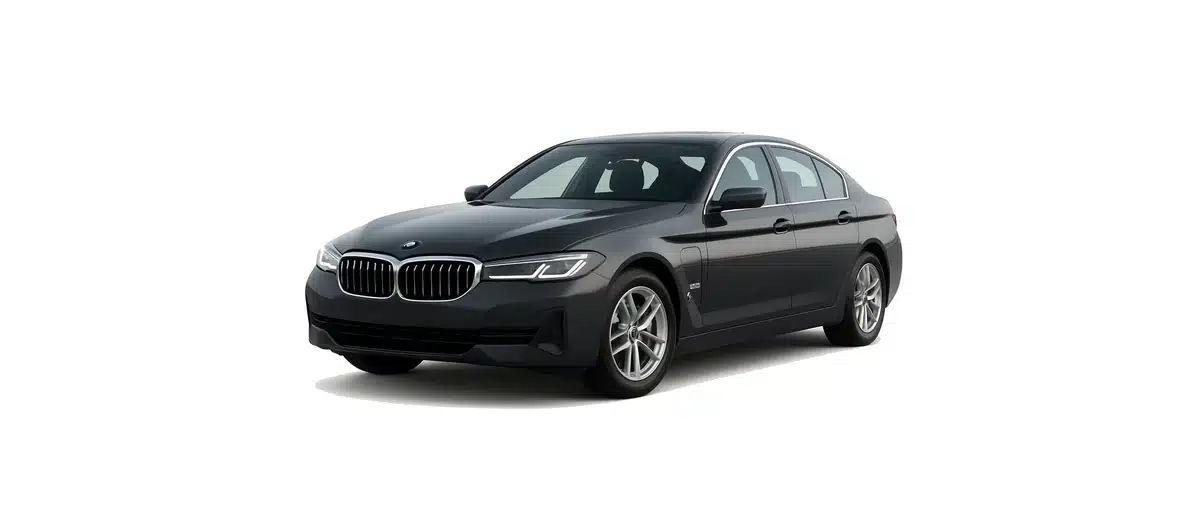
The BMW 530e is a plug-in hybrid version of the 5 Series, available in saloon and Touring estate forms depending on generation. It is important to treat it as a petrol plug-in hybrid rather than a fully electric vehicle: it can drive on electric power for local journeys, but it also has a petrol engine for longer trips. The fully electric 5 Series is the BMW i5, not the 530e.
For charging cable selection, the most important point is that BMW 530e specifications vary significantly by generation. The current UK G60 saloon and G61 Touring models have a much larger plug-in hybrid battery and BMW UK currently lists up to 11 kW AC charging. Older G30/G31 models, which are common on the UK used market, are typically quoted with a smaller 12 kWh battery and 3.7 kW AC charging. Before buying a cable or comparing charging times, check which version you own.
BMW 530e Battery and Charging Specifications
The current UK BMW 530e is part of the latest 5 Series generation, known as G60 for the saloon and G61 for the Touring. BMW UK technical information lists a battery capacity of 19.4 kWh for current 530e plug-in hybrid models, while BMW Group vehicle footprint data gives the current battery as 22.1 kWh gross and 19.4 kWh net. BMW UK also lists 11 kW AC charging and a minimum 0-100% AC charging time of around 2 hours 15 minutes for current models, where the charging supply can support it.
Older outgoing BMW 530e models are different. Many 2020-2023-era G30/G31 facelift cars are quoted by UK review and specification sources with a 12 kWh battery and a 3.7 kW onboard AC charger. That means their charging behaviour is much closer to a traditional plug-in hybrid: easy to top up overnight, but unable to take advantage of faster AC posts beyond the car’s onboard limit.
For UK and European AC charging, the relevant connection is Type 2. If you have an older imported or used car, it is still sensible to check the vehicle socket and handbook before ordering accessories.
Battery Options
There is no single battery size that applies to every BMW 530e. The current BMW 530e saloon and Touring use the larger plug-in hybrid battery, with BMW Group data stating 22.1 kWh gross and 19.4 kWh usable capacity. This is relatively large for a PHEV and is a major reason the latest 530e has a much stronger electric-only range than older cars.
For the current saloon, BMW UK data gives a WLTP electric range that typically sits around 59-64 miles depending on specification. For the current Touring, the figure is generally lower, broadly around 54-60 miles depending on trim and equipment. As with all official WLTP figures, the exact number can vary with wheels, options, temperature, route and driving style.
Older G30/G31 BMW 530e models commonly found used in the UK are often quoted with a 12 kWh battery. Their official electric range is much lower, with sources such as DrivingElectric quoting around 36-37 miles WLTP for some saloon versions and around 32-34 miles for 530e xDrive versions. These older figures should not be applied to the latest G60/G61 cars, and the current figures should not be assumed for an older used 530e.
AC Charging Speed
AC charging is the main charging method for the BMW 530e. For the current UK G60/G61 models, BMW UK currently lists a maximum AC charging power of 11 kW and a minimum 0-100% charging time of around 2 hours 15 minutes. To reach that best-case figure, the charge point and cable setup need to support the required AC supply, and in practice 11 kW AC generally means a suitable three-phase supply.
Many UK homes have single-phase electricity. A typical single-phase home wallbox is rated up to 7.4 kW, so a current 11 kW-capable BMW 530e will usually charge more slowly at home than BMW’s fastest published AC time. That is not a fault with the car or the charger; it is simply the limit of the electrical supply. For many owners, a home wallbox will still be more than adequate because the 530e battery is much smaller than a fully electric car battery and can normally be replenished during an overnight parking period.
For older 3.7 kW BMW 530e models, a higher-rated public AC post or cable will not make the car charge faster than the onboard charger allows. A 7.4 kW, 11 kW or 22 kW AC charge point can only deliver what the car is able to accept. This is why identifying the generation and model year matters before making assumptions about charging speed.
DC Rapid Charging Speed
The BMW 530e should be approached as an AC-charging plug-in hybrid for day-to-day cable guidance. Current BMW UK technical pages provide AC charging information for the 530e, but a reliable current UK DC rapid-charging figure was not identified in the research data. For that reason, it would not be sensible to plan ownership around CCS rapid charging or to assume a 10-80% rapid-charge time for this model.
In practical terms, this is rarely a major issue for a PHEV. The most useful charging pattern for a BMW 530e is usually to charge at home, at work or at longer-stay public AC locations, then use the petrol engine when journeys exceed the available electric range. If you regularly need long-distance zero-emission motorway charging, a fully electric model may be more appropriate.
Range and Efficiency
The latest BMW 530e has a strong electric-only range for a plug-in hybrid. The current saloon is generally listed by BMW UK in the region of 59-64 miles WLTP, while the current Touring is typically around 54-60 miles WLTP depending on specification. This can be enough for many commutes and local journeys if the car is plugged in regularly.
Real-world range will usually vary. Cold weather, high speeds, short winter journeys, heavy use of cabin heating, roof bars, larger wheels and a fully loaded estate body can all reduce electric range. Older G30/G31 cars have a smaller battery and lower official electric range; DrivingElectric has also observed around 25 miles in colder weather for the outgoing model, which gives useful context for used-car buyers but should not be treated as a current-generation figure.
For best efficiency, the BMW 530e works well when treated as a car that is charged little and often. If it is rarely plugged in, it behaves more like a petrol hybrid carrying additional plug-in hardware. If it is charged at home and at suitable destinations, more local miles can be completed using stored electricity.
Charging at Home
Home charging is usually the most convenient way to run a BMW 530e. An untethered home wallbox will typically require a Type 2-to-Type 2 charging cable. If the wallbox is tethered, the cable is already attached to the unit, so you only need to connect it to the car.
For current 11 kW-capable models, owners with access to a suitable three-phase charger may benefit from the car’s higher AC capability. However, most domestic UK installations are single-phase, where 7.4 kW is a common wallbox rating. On that type of charger, the current 530e will still charge conveniently, but not at the fastest published 11 kW rate.
For older 3.7 kW models, a standard home wallbox is still useful, but the car’s onboard charger will limit the charging rate. This means a 3.7 kW 530e may take roughly the sort of time associated with older PHEV charging rather than the 2 hour 15 minute figure quoted for current models.
A 3-pin charger is generally best suited as a backup or occasional charging solution, but can be used regularly if a qualified electrician has confirmed the socket and electrical installation are suitable for sustained EV charging. Avoid using damaged sockets, extension leads or outdoor sockets that are not suitable for the load and conditions.
Public Charging
For public charging, the most relevant locations for the BMW 530e are AC destination chargers: workplace car parks, hotels, leisure centres, supermarkets, railway stations and town-centre car parks. These are places where the car can sit for a few hours while you do something else.
Many public AC posts in the UK are untethered, so you will usually need to bring your own Type 2-to-Type 2 cable. A current 11 kW BMW 530e can make better use of three-phase AC posts where available, while an older 3.7 kW model will charge at its own lower maximum even if the post is rated higher.
Because the 530e has a petrol engine, it is normally less important to seek out high-turnover rapid-charging hubs on long journeys. Instead, think of public charging as a way to increase electric mileage when you are already parked for a useful length of time.
Vehicle-Specific Features
The key vehicle-specific feature for charging is the difference between generations. The latest G60/G61 530e has a 19.4 kWh usable battery and BMW UK currently lists 11 kW AC charging. That combination makes it unusually capable for a plug-in hybrid when connected to a suitable AC supply.
The older G30/G31 530e is still a practical plug-in hybrid, but it should be judged by its own limits: smaller battery, shorter electric range and commonly quoted 3.7 kW AC charging. If you are buying used, check the registration year, body style, handbook and vehicle specification rather than relying only on the 530e badge.
Saloon and Touring models also differ slightly in range because of body shape, weight and specification. The Touring estate is more versatile for luggage, but its official electric range is generally a little lower than the saloon in current BMW UK data.
Charging Tips
- Check your generation first: current G60/G61 cars and older G30/G31 cars have materially different charging limits.
- Use Type 2 for AC charging: for untethered home and public AC posts, a Type 2-to-Type 2 cable is the relevant cable type.
- Match expectations to the onboard charger: a high-powered post cannot force an older 3.7 kW car to charge at 7.4 kW or 11 kW.
- Charge regularly: a PHEV delivers its best running-cost and emissions benefits when the battery is kept topped up for local trips.
- Consider three-phase access: current 11 kW models can benefit from suitable three-phase AC charging at workplaces or some public posts.
- Do not rely on rapid charging: treat the 530e as an AC-charging PHEV unless the exact vehicle documentation confirms otherwise.
Frequently Asked Questions
Is the BMW 530e fully electric?
No. The BMW 530e is a petrol plug-in hybrid. It can drive on electric power when the battery has charge, but it also has a petrol engine. The fully electric 5 Series model is the BMW i5.
What charging cable does the BMW 530e use?
For UK and European AC charging, the BMW 530e uses Type 2 charging. For an untethered home wallbox or public AC post, you will normally need a Type 2-to-Type 2 cable. Check the exact vehicle if it is an older import or if the charging socket history is unclear.
How long does the BMW 530e take to charge?
For the current UK G60/G61 BMW 530e, BMW UK lists 11 kW AC charging and a minimum 0-100% AC time of about 2 hours 15 minutes on a suitable supply. Older G30/G31 models are commonly quoted at 3.7 kW AC and around 3.5 hours for a full charge.
Will a 22 kW public charger charge my BMW 530e faster?
Only up to the car’s onboard AC charging limit. A current 11 kW-capable 530e may benefit from a suitable three-phase AC post, but it will not exceed the car’s maximum. An older 3.7 kW 530e will remain limited to around 3.7 kW even on a higher-rated post.
Can I use a 3-pin plug charger with a BMW 530e?
Yes, but it should be treated carefully. A 3-pin charger is generally best suited as a backup or occasional charging solution, but can be used regularly if a qualified electrician has confirmed the socket and electrical installation are suitable for sustained EV charging.
What This Means for Drivers
The BMW 530e can be a very effective company car, commuter car or family car when it is charged often. The latest version offers a useful electric range and much faster AC charging than many older plug-in hybrids, particularly where 11 kW three-phase AC is available. For many drivers, that means local electric driving during the week and petrol flexibility for longer journeys.
The main caution is to avoid treating every 530e as the same. A current G60/G61 model and an older G30/G31 model can have very different battery sizes, charging speeds and electric ranges. Before selecting a cable or comparing charging times, confirm the model year, generation and charging specification of your exact car.
Looking for a Charging Cable for BMW 530e?
We offer BMW 530e charging cables for UK home and public AC charging, including Type 2 options suitable for untethered charge points. Check your exact model year and onboard charging capability before choosing the cable rating.
Please note that this information is intended as a guide. Charging specifications may change due to model and year of manufacture. For precise information, always refer to your vehicle user manual.

