
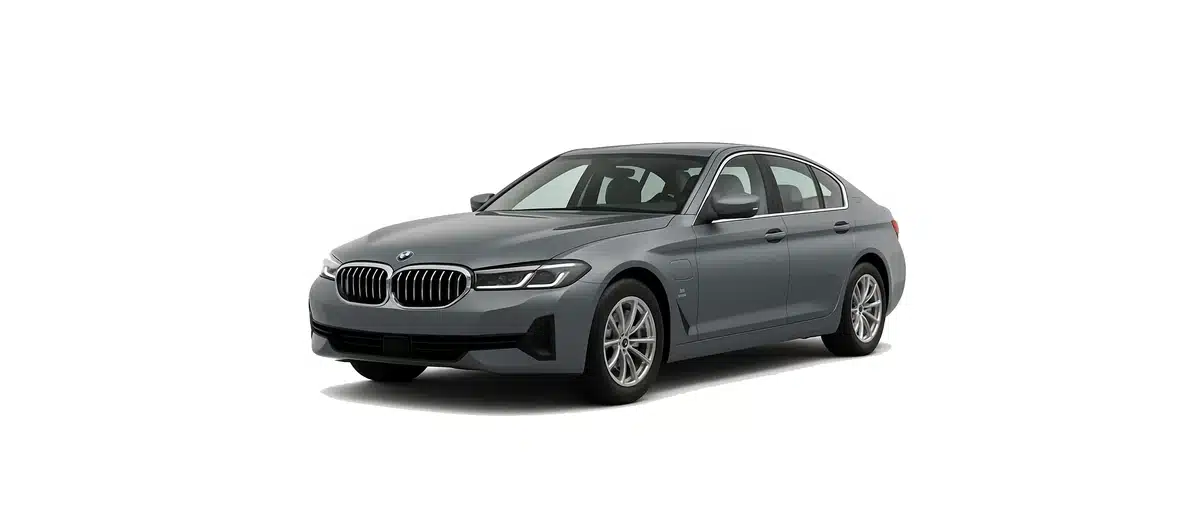
The BMW 520e is a plug-in hybrid version of the 5 Series, not a fully electric BMW. It combines a 2.0-litre petrol engine with an electric motor integrated into the 8-speed Steptronic transmission, giving drivers the option of short electric journeys with petrol backup for longer trips.
For UK drivers, the 520e needs a little context. BMW announced the model in 2021 for European markets in both Saloon and Touring estate forms, but UK availability as a new model was not clearly confirmed, and UK 5 Series plug-in hybrid information has generally focused on other variants such as 530e and 550e models. Treat the BMW 520e as a legacy, imported or grey-area listing rather than a clearly current UK new-car model.
From a charging point of view, the key detail is simple: available BMW Group launch data lists the 520e with a 12.0 kWh gross battery and AC charging at up to 3.7 kW. That means cable choice and regular top-ups matter more than chasing high-power charging claims.
BMW 520e Battery and Charging Specifications
The BMW 520e uses a relatively small plug-in hybrid battery intended for daily local electric driving, commuting and low-speed urban trips. It is not designed to behave like a long-range battery-electric vehicle, and the charging specification reflects that.
| Vehicle type | Plug-in hybrid electric vehicle (PHEV) |
|---|---|
| Battery capacity | 12.0 kWh gross, based on BMW Group 2021 European launch data |
| Charging connector | Type 2 for AC charging |
| Maximum AC charging power | Up to 3.7 kW |
| AC charging time | Approximately 3.6 hours from 0-100%; around 2.6 hours from 0-80% in launch information |
| DC rapid charging | No reliable confirmation found for DC rapid charging on the 520e |
| WLTP electric range | Saloon approximately 33-38 miles; Touring approximately 32-35 miles |
Because this is a PHEV with a modest onboard AC charger, a more powerful wallbox or cable will not make the car charge beyond its onboard limit. A 7 kW or 22 kW Type 2 cable can still be compatible when correctly rated, but the BMW 520e itself is expected to charge at up to about 3.7 kW.
Battery Options
The available European launch information identifies one main battery specification for the BMW 520e Saloon and Touring: a 12.0 kWh gross high-voltage lithium-ion battery. BMW’s published data gives gross capacity, but a reliable official usable-capacity figure was not found in the research data, so it is best not to compare it directly with the usable battery figures often quoted for newer electric vehicles.
In practical terms, this battery is large enough to cover many short local journeys electrically when charged frequently. It is not intended for long electric-only motorway trips. Owners will get the most benefit by plugging in regularly at home, at work or at destination chargers rather than treating the battery as something to charge only occasionally.
AC Charging Speed
BMW Group data lists the BMW 520e with AC charging at up to 3.7 kW. This is typical of many plug-in hybrids of the period and is slower than the 7 kW or 11 kW charging often seen on newer fully electric vehicles.
BMW’s launch information gives an approximate 0-100% AC charging time of 3.6 hours, with 0-80% quoted at around 2.6 hours. Real-world times can vary depending on temperature, state of charge, cable condition, charge point behaviour and the vehicle’s own charging management.
For an untethered UK home wallbox or public AC post, you would normally use a Type 2 charging cable. A 7 kW Type 2 cable is usually a sensible match for this kind of PHEV because it comfortably covers the car’s 3.7 kW maximum and remains useful with many other UK AC charge points. A 22 kW three-phase cable may also work where the vehicle and charge point accept it, but it will not increase the BMW 520e’s charging speed beyond the onboard charger limit.
DC Rapid Charging Speed
No reliable source in the supplied research confirms DC rapid charging or CCS rapid charging for the BMW 520e. For that reason, it should not be treated like a battery-electric vehicle that can stop at motorway rapid chargers for a 10-80% top-up.
This matters when planning journeys. The 520e’s electric capability is best viewed as a daily-use efficiency feature rather than a long-distance rapid-charging system. On longer trips, the petrol engine provides the range flexibility, while AC charging can be used when the car is parked for a longer period.
If you are buying an imported or used BMW 520e, check the actual charging inlet on the vehicle and the owner’s manual before relying on public charging assumptions. The research-backed position is to plan around Type 2 AC charging rather than DC rapid charging.
Range and Efficiency
BMW’s 2021 European launch figures gave different WLTP electric range bands for the two body styles. The 520e Saloon was listed at 53-61 km, roughly 33-38 miles. The 520e Touring estate was listed at 52-57 km, roughly 32-35 miles.
As with any PHEV, real-world electric range may be lower than the official WLTP figure. Cold weather, motorway speeds, heavy use of cabin heating, larger wheels, roof loads and a fully laden car can all reduce electric range. Stop-start town driving and gentle suburban routes are generally where a PHEV battery is most useful.
The practical advantage of the 520e is that even a short electric range can be valuable if your daily driving pattern suits it. For example, commuting, school runs, local errands and low-emission urban driving can often be completed with little or no petrol use if the car is charged frequently.
Charging at Home
Home charging is likely to be the most convenient way to run a BMW 520e efficiently. With a 3.7 kW onboard AC charging limit and a relatively small PHEV battery, the car can be replenished during a normal evening or overnight parking session.
A dedicated home wallbox is usually the most convenient long-term setup. It provides a safer and more robust charging arrangement than relying on a domestic socket, can be positioned where you park, and may allow scheduling to take advantage of off-peak electricity tariffs if your charger and energy plan support it.
A 3-pin charger is generally best suited as a backup or occasional charging solution, but can be used regularly if a qualified electrician has confirmed the socket and electrical installation are suitable for sustained EV charging. Avoid extension leads, damaged sockets or charging from unknown electrical installations.
Because the BMW 520e cannot use more than about 3.7 kW in the available specification, there is no need to choose a cable on the basis that it will make this car charge faster than that. Instead, choose a good-quality Type 2 cable with a suitable current rating, length and build quality for your parking situation.
Public Charging
Public charging for the BMW 520e is mainly about AC destination charging. Think supermarkets, hotels, workplaces, town-centre car parks, leisure facilities and long-stay parking rather than high-power motorway chargers.
Many UK public AC posts are untethered, which means you need to bring your own Type 2 cable. If you own or use a BMW 520e, keeping a Type 2 cable in the car makes public AC charging much easier. A 5-metre cable suits many spaces, while a longer cable can be helpful where the charge point is offset from the bay or where the car’s charging port position makes parking awkward.
At public AC chargers rated above 3.7 kW, the BMW 520e should still only draw what its onboard charger allows. In other words, plugging into a 7 kW or 22 kW AC post does not necessarily mean the car will charge at that speed. The car, the cable and the post all have to support a speed, and the lowest limit applies.
Vehicle-Specific Features
The BMW 520e was positioned as an entry-level plug-in hybrid within the European 5 Series range. BMW Group technical data listed a system output of 150 kW, or 204 hp, with rear-wheel drive in the 520e Saloon and Touring launch specification.
The electric motor is integrated into the 8-speed Steptronic transmission, helping the car operate in electric mode for shorter journeys and blend petrol and electric power when required. BMW also highlighted digital services such as BMW eDrive Zone and BMW Points in the European launch information, aimed at encouraging electric driving in suitable areas.
The most important ownership point is that the 520e’s charging setup is modest. It is a premium executive PHEV, but that does not mean it has the same charging hardware as a modern high-capacity electric car. Avoid applying specifications from later or different BMW 5 Series plug-in hybrid models to the 520e unless they are confirmed for your exact vehicle.
Charging Tips
- Charge little and often: PHEVs work best when the battery is topped up regularly rather than left empty.
- Use the right Type 2 cable: A correctly rated Type 2 cable is the key accessory for untethered UK and European AC charging posts.
- Do not overpay for speed the car cannot use: A higher-rated wallbox or cable will not push the 520e beyond its onboard AC charging limit.
- Plan public charging around parking time: The 520e suits locations where you will be stopped for a few hours.
- Check imported vehicles carefully: Because UK status is unclear, confirm the charging inlet, handbook details and charging behaviour on the individual car.
- Keep the cable accessible: Storing the cable under luggage can make quick public top-ups inconvenient, especially in an estate model loaded for travel.
Frequently Asked Questions
Is the BMW 520e fully electric?
No. The BMW 520e is a plug-in hybrid. It has a petrol engine and an electric motor, so it can drive on electric power for shorter trips but is not a battery-electric vehicle.
What charging cable does the BMW 520e use?
The BMW 520e is associated with Type 2 AC charging. For untethered UK home and public AC charge points, a Type 2 cable is the appropriate cable type to check for this vehicle.
How fast can the BMW 520e charge?
Available BMW Group data lists AC charging at up to 3.7 kW, with a full charge taking approximately 3.6 hours under the stated test conditions.
Will a 7 kW wallbox charge the BMW 520e faster?
A 7 kW wallbox can be compatible, but it will not make the BMW 520e charge faster than the car’s onboard limit of about 3.7 kW.
Can the BMW 520e use rapid chargers?
No reliable confirmation was found for DC rapid charging on the BMW 520e. Owners should plan around AC charging rather than motorway rapid charging.
What is the electric range of the BMW 520e?
BMW’s European WLTP figures list around 33-38 miles for the Saloon and around 32-35 miles for the Touring. Real-world range can vary with weather, speed, driving style and vehicle load.
What This Means for Drivers
The BMW 520e is best understood as a short-range electric commuting and local-driving PHEV with petrol support, not as a rapid-charging electric car. Its 12.0 kWh gross battery and 3.7 kW AC charging limit make it well suited to overnight home charging, workplace charging and destination charging during longer stops.
For owners, the practical priorities are straightforward: use a Type 2 cable, charge frequently, and set expectations around the car’s actual onboard charging capability. A more powerful AC charge point may be useful for other vehicles or future-proofing, but it will not transform the 520e into a fast-charging car.
Looking for a Charging Cable for BMW 520e?
If you need a suitable Type 2 cable for a BMW 520e, We offer BMW 520e charging cables for home, workplace and public AC charging use.
Please note that this information is intended as a guide. Charging specifications may change due to model and year of manufacture. For precise information, always refer to your vehicle user manual.

