
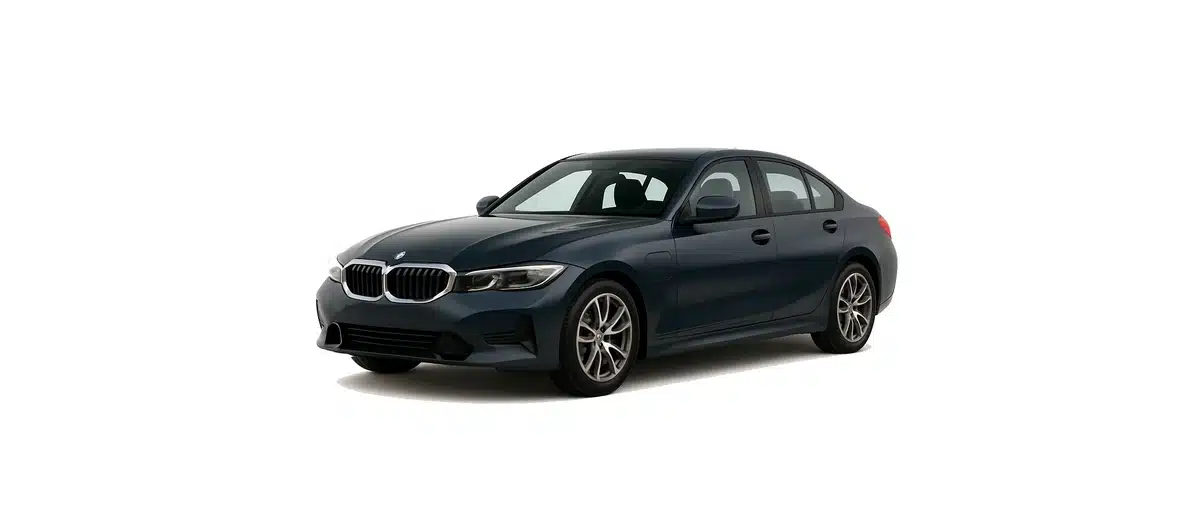
The BMW 330e is a plug-in hybrid version of the 3 Series, available in Saloon and Touring estate forms. It is not a fully electric car: it combines a petrol engine with an electric motor and a rechargeable high-voltage battery. That makes charging habits slightly different from a battery-electric vehicle. You do not need to plan every long journey around rapid chargers, but regular charging is still important if you want to make the most of the car’s electric driving capability.
The key point for UK owners is that not all BMW 330e models charge at the same speed or have the same battery size. Current 2024-on models use a larger plug-in hybrid battery and support faster AC charging than many earlier cars. Older G20/G21 models and the original F30 330e are typically more limited. Before choosing a cable or estimating charge times, it is worth identifying which generation of 330e you own.
BMW 330e Battery and Charging Specifications
Current UK-market BMW 330e Saloon and Touring models from the 2024 update use BMW’s newer plug-in hybrid system with a 19.5 kWh usable battery capacity, according to BMW technical data. Independent UK review information also refers to a 22.3 kWh total battery capacity for the latest version. BMW quotes up to 11 kW AC charging for these newer cars where a suitable three-phase AC supply is available.
Earlier BMW 330e models are different. The pre-2024 G20/G21 330e used a smaller 12.0 kWh gross battery, with BMW data listing 10.79 kWh net capacity, and was commonly limited to 3.7 kW AC charging. The original F30 330e had a smaller battery again, listed at 7.6 kWh gross and 5.7 kWh net in BMW press material. This is why a single charging figure should not be applied to every 330e on the road.
Battery Options
The main BMW 330e battery groups to be aware of are:
- Current 2024-on BMW 330e and 330e xDrive Saloon/Touring: around 19.5 kWh usable capacity, with BMW quoting substantially improved electric range compared with previous versions.
- Earlier G20/G21 BMW 330e, broadly 2019 to 2024: 12.0 kWh gross and 10.79 kWh net capacity in BMW UK technical data, with slower AC charging.
- Original F30 BMW 330e: 7.6 kWh gross and 5.7 kWh net capacity, with a smaller electric-only range and 3.7 kW wallbox charging in BMW’s launch data.
If you are buying a charging cable for a used BMW 330e, do not rely only on the badge. Check the registration year, vehicle documentation, charging specification, or the charging information shown in the car’s menu.
AC Charging Speed
The BMW 330e uses Type 2 AC charging. For the current 2024-on model, BMW quotes up to 11 kW AC charging and a 0-100% charging time of around 2 hours 15 minutes when connected to a suitable three-phase AC charger. This is relatively fast for a plug-in hybrid and is one of the most important changes introduced with the latest version.
However, many UK homes have a single-phase electricity supply. On a typical 7 kW home wallbox, the latest 330e will not charge at the full 11 kW three-phase rate, so a full charge is likely to take longer. UK review estimates suggest roughly 3.5 hours on a 7 kW home charger, although the exact time depends on the charger, supply, starting battery level and vehicle conditions.
Older BMW 330e models are commonly limited to 3.7 kW AC charging. For those cars, plugging into a faster 7 kW, 11 kW or 22 kW AC charge point will not make the vehicle charge beyond its onboard charger limit. The charger provides the supply; the car decides how much AC power it can accept.
DC Rapid Charging Speed
No DC rapid-charging speed should be assumed for the BMW 330e. The 330e is a plug-in hybrid with Type 2 AC charging, not a battery-electric vehicle with a confirmed CCS rapid-charging inlet. Public rapid and ultra-rapid DC chargers are therefore not the right focus for this car.
For longer journeys, the petrol engine removes the need to stop for rapid charging in the way a pure EV might. The best charging approach is to use home, workplace, destination and public AC charging to keep the battery topped up for local electric driving.
Range and Efficiency
BMW’s official electric range figures for the current 330e vary by body style, drivetrain, trim and wheel choice. BMW press material gives figures of up to around 63 miles WLTP for some Saloon versions, with Touring and xDrive versions generally showing slightly different figures. Current UK pages show similar specification-dependent variation.
WLTP figures are useful for comparing vehicles, but they are not a guarantee of what every owner will see every day. Real-world electric range will depend on temperature, speed, route, tyre choice, climate control use, load, driving style and battery age. Winter use, motorway speeds and short cold journeys can reduce electric range noticeably. Conversely, regular urban and suburban trips at moderate speeds are where the 330e is most likely to deliver useful electric-only mileage.
Charging at Home
Home charging is the most convenient way to run a BMW 330e efficiently. Because the battery is much smaller than a full battery-electric car’s battery, it is well suited to regular top-ups. Many owners will get the best results by charging most nights or whenever the car is parked for several hours, rather than waiting until the battery is empty.
A dedicated home wallbox is generally the preferred solution. For most UK homes, this will be a single-phase charger, commonly rated up to 7 kW. A tethered wallbox has a cable attached, while an untethered wallbox requires your own Type 2 to Type 2 charging cable. If your home has three-phase supply, a current 2024-on 330e may be able to benefit from up to 11 kW AC charging, subject to the charger and installation.
A 3-pin charger is generally best suited as a backup or occasional charging solution, but can be used regularly if a qualified electrician has confirmed the socket and electrical installation are suitable for sustained EV charging. Avoid using damaged sockets, extension leads or unknown outdoor electrical supplies for routine charging.
Public Charging
For public charging, the BMW 330e should be treated as an AC Type 2 vehicle. Many destination chargers at supermarkets, hotels, workplaces, town centres and car parks use untethered Type 2 sockets, so you will usually need to carry a Type 2 to Type 2 cable.
The right cable depends on your specific 330e. A current 2024-on car can make use of up to 11 kW AC where three-phase AC charging is available, so a suitable three-phase Type 2 cable may be useful. A UK home wallbox on single-phase supply may call for a different priority, such as a 32 A single-phase Type 2 cable. Older 3.7 kW 330e models will not charge faster simply because a higher-rated cable or charge point is used, but a good-quality compatible cable is still important.
If you regularly use public AC chargers, check whether the posts are tethered or untethered and whether they are single-phase or three-phase. The car and charge point will negotiate the safe charging rate automatically, but the cable must still be suitable for the intended use.
Vehicle-Specific Features
The main vehicle-specific charging feature of the latest BMW 330e is the move to the larger Gen5 plug-in hybrid battery and up to 11 kW three-phase AC charging. This makes the current model more practical to top up during shorter stops than earlier 330e versions, provided the right AC charging infrastructure is available.
The 330e’s electric motor is integrated into the automatic transmission, and the petrol engine remains available for longer trips or when the battery is depleted. This means charging is not about avoiding being stranded; it is about reducing fuel use, increasing electric driving and getting the best from the plug-in hybrid system.
Charging Tips
- Identify your generation first: 2024-on, earlier G20/G21 and original F30 cars have different battery and charging specifications.
- Use regular top-ups: a plug-in hybrid is most efficient when the battery is charged frequently for local driving.
- Carry the right Type 2 cable: this is especially useful for untethered public AC chargers and untethered home wallboxes.
- Do not chase DC rapid chargers: the 330e is best matched to AC charging at home, work or destinations.
- Expect seasonal variation: cold weather and faster roads can reduce electric range compared with official figures.
- Check cable rating carefully: an older 3.7 kW car and a latest 11 kW-capable car may not need the same cable specification.
Frequently Asked Questions
Is the BMW 330e fully electric?
No. The BMW 330e is a plug-in hybrid. It has a petrol engine, an electric motor and a rechargeable battery, allowing electric driving for shorter trips and petrol operation when needed.
What charging cable does the BMW 330e use?
The BMW 330e uses Type 2 AC charging. For untethered home wallboxes and many public AC charge points, you will need a Type 2 to Type 2 cable.
Do all BMW 330e models charge at 11 kW?
No. The 11 kW AC charging figure applies to current 2024-on models where suitable three-phase AC charging is available. Many older BMW 330e models are limited to around 3.7 kW AC charging.
Can the BMW 330e use rapid chargers?
Public DC rapid charging should not be assumed for the BMW 330e. It is best viewed as an AC-charging plug-in hybrid rather than a CCS rapid-charging electric car.
How long does it take to charge a BMW 330e?
It depends on the model year and charger. Current 2024-on cars are quoted at around 2 hours 15 minutes from 0-100% on suitable 11 kW three-phase AC charging. On a typical UK 7 kW home wallbox, expect longer. Older 330e models with 3.7 kW AC charging will also take longer relative to their onboard charger limits.
What This Means for Drivers
The BMW 330e is at its best when treated as a plug-in hybrid that is charged little and often. For local journeys, commuting and urban driving, keeping the battery topped up can significantly increase electric mileage. For longer trips, the petrol engine provides flexibility, so you do not need to plan around rapid chargers.
The most important practical step is to match your cable and charging expectations to your exact car. A current 2024-on 330e with 11 kW AC capability is quite different from an earlier 3.7 kW model. Once you know which version you own, choosing between a single-phase or three-phase Type 2 cable becomes much clearer.
Looking for a Charging Cable for BMW 330e?
You can browse BMW 330e charging cables and choose a Type 2 cable that suits your vehicle generation, home charger and public charging needs.
Please note that this information is intended as a guide. Charging specifications may change due to model and year of manufacture. For precise information, always refer to your vehicle user manual.

