
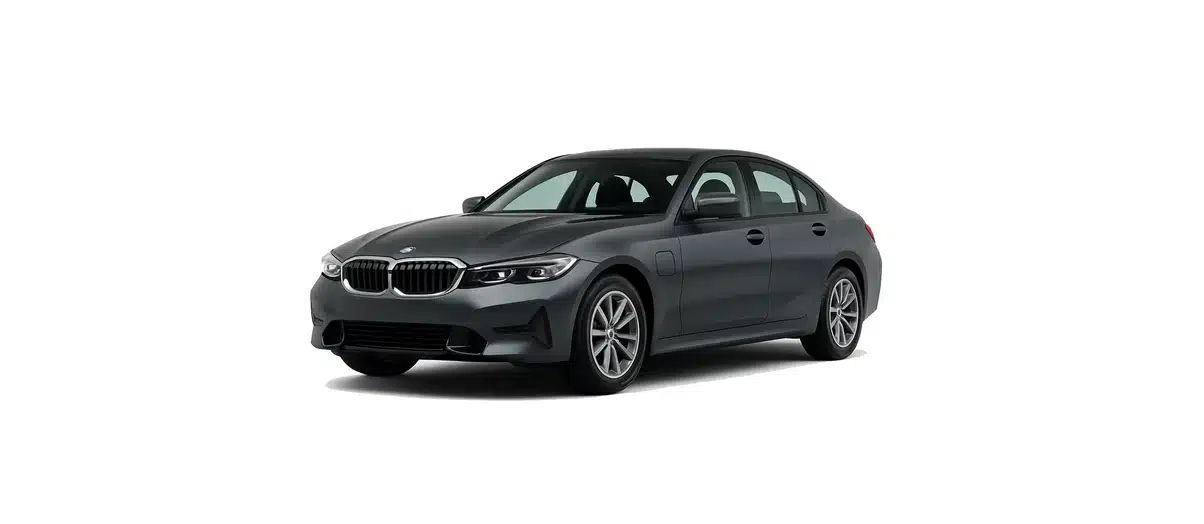
The BMW 320e is a plug-in hybrid version of the BMW 3 Series, introduced in European material from 2021 as an entry-level PHEV below the more widely known 330e. It combines a 2.0-litre petrol engine with an electric motor, giving drivers the option of short electric journeys while keeping petrol range available for longer trips.
For UK drivers, the 320e needs a little context. Contemporary UK reports indicated that the 320e was not sold new in the UK, and current BMW UK 3 Series plug-in hybrid information focuses on the 330e rather than the 320e. That means UK examples may be used imports, specialist listings or vehicles that should be checked carefully against their VIN and handbook. This guide treats the BMW 320e as a used/import plug-in hybrid charging case rather than a confirmed current UK new-car model.
In charging terms, the BMW 320e is very different from a full battery-electric vehicle. It has a relatively small plug-in hybrid battery, uses a Type 2 AC charging connection, and is designed around regular home, workplace or destination top-ups rather than motorway rapid charging. The key is choosing the right charging cable and building a routine that keeps the battery topped up for local driving.
BMW 320e Battery and Charging Specifications
BMW’s European launch information describes the 320e as a petrol plug-in hybrid using fourth-generation BMW eDrive technology. The combined system output is quoted at up to 150 kW, or 204 hp, depending on specification. Unlike a battery-electric vehicle, the 320e does not rely solely on charging infrastructure: when the plug-in battery is depleted, the petrol engine remains available.
The charging specification most relevant to owners is the car’s AC charging limit. BMW stated a maximum charging power of 3.7 kW for the 320e, with a 0–80% charge taking about 2.6 hours and a 0–100% charge taking about 3.6 hours. This is modest compared with many modern EVs and some newer plug-in hybrids, but it is well matched to the 320e’s battery size.
The charging port used for normal UK and European AC charging is Type 2. If buying a used or imported BMW 320e, it is sensible to check the charge flap, the vehicle handbook and any VIN-specific BMW documentation before ordering accessories, because the model’s UK-market status is not as straightforward as mainstream UK BMW PHEV models.
Battery Options
The 2021-era European BMW 320e specification is associated with a lithium-ion plug-in hybrid battery with a gross capacity of 12.0 kWh. A European BMW 3 Series technical brochure lists a net battery capacity of 11.15 kWh for 320e and 330e variants of that period. As with any used or imported PHEV, individual vehicles should be checked by VIN, especially if the car has changed market, trim or model-year context.
This battery size is typical of a plug-in hybrid designed for commuting, urban driving and short daily trips. It is not intended to provide the long electric-only range of a full EV. The advantage is that the smaller battery can be recharged relatively quickly at AC speeds, making frequent top-ups practical if you have access to home, workplace or regular destination charging.
AC Charging Speed
The BMW 320e’s maximum AC charging rate is about 3.7 kW. This limit is set by the vehicle, not by the charging cable or the public charge point alone. If you connect the car to a 7 kW home wallbox, the 320e will still draw only up to its own AC charging limit. The same applies at many 11 kW or 22 kW public AC posts: the car will not charge faster simply because the post can supply more power.
BMW’s quoted charging times are around 2.6 hours from 0–80% and around 3.6 hours from 0–100%. In day-to-day use, many drivers will not arrive home with the battery completely empty, so a top-up after commuting or local errands may take less time. For a plug-in hybrid like this, charging little and often is usually more useful than waiting until the battery is fully depleted.
For UK public AC charging, a Type 2 to Type 2 cable is typically the most useful cable to keep in the boot. Many untethered public charge points require drivers to provide their own cable. A suitable Type 2 cable allows the 320e to use public AC posts, workplace chargers and many destination chargers where a tethered lead is not provided.
DC Rapid Charging Speed
BMW 320e sources found for the European 2021-era model give AC charging information only. No DC rapid-charging power or 10–80% rapid-charge time should be assumed for this car. In practical terms, owners should plan around AC charging at home, at work or at public AC posts, rather than treating the 320e like a rapid-charging battery-electric vehicle.
This is not usually a problem for a PHEV. If the battery is low during a long journey, the petrol engine is available, so the charging strategy is different from a full EV. The best use of the plug-in battery is to charge before local journeys, commute on electric power where possible, and use the combustion engine for longer trips when charging is not convenient.
Range and Efficiency
BMW’s European WLTP figures vary by body style and drivetrain. The 320e Saloon was quoted at approximately 52–61 km of electric range, which is about 32–38 miles. The 320e Touring was quoted at around 50–59 km, or about 31–37 miles. The 320e xDrive Touring, where offered in European material, was quoted at around 46–57 km, or about 29–35 miles.
Those are laboratory figures, so real-world electric range will depend on temperature, speed, route, tyre condition, use of heating and air conditioning, and how gently the car is driven. In colder weather or at higher road speeds, electric range may be lower. Around town, with regular charging and smooth driving, the 320e is better placed to make use of its plug-in hybrid battery.
Because the 320e is a petrol plug-in hybrid, overall efficiency depends heavily on driver behaviour. An owner who charges every night and mostly does short journeys may use very little petrol. An owner who rarely plugs in will be carrying hybrid hardware without getting the full benefit of it. The car makes most sense when it is treated as a chargeable vehicle, not simply as a conventional petrol 3 Series.
Charging at Home
Home charging is usually the most convenient way to run a BMW 320e efficiently. A dedicated home wallbox gives a safer and more convenient charging routine than relying on public posts for day-to-day use. Even though the car is limited to around 3.7 kW, a professionally installed 7 kW wallbox can still be a sensible choice because it is standard for UK home EV charging and may also suit a future EV.
With the 320e’s quoted 0–100% AC charging time of about 3.6 hours, many owners can fully recharge the battery during the evening or overnight. If your electricity tariff offers cheaper off-peak rates, scheduling charging during those hours may reduce running costs. The exact savings depend on your tariff and how often you drive on electric power.
A 3-pin charger is generally best suited as a backup or occasional charging solution, but can be used regularly if a qualified electrician has confirmed the socket and electrical installation are suitable for sustained EV charging. For regular ownership, a dedicated wallbox is usually the neater, safer and more practical long-term arrangement.
Public Charging
Public charging for the BMW 320e is mainly about AC destination charging. Look for Type 2 AC charge points in car parks, supermarkets, workplaces, hotels, leisure centres and town-centre locations. Because the car’s charging power is limited to around 3.7 kW, there is little benefit in seeking out higher-powered AC posts unless they are simply the most convenient option available.
It is worth thinking carefully about cost. Some public chargers price by kWh, while others may include connection fees, parking fees or overstay charges. Because the BMW 320e has a small PHEV battery, expensive public charging may not always make financial sense compared with charging at home. Public charging is most useful when it fits naturally into a stop you were already making.
For untethered public chargers, carry a Type 2 cable. A higher-rated cable can be used, but it will not increase the car’s charging speed beyond the onboard limit. The practical priority is compatibility, cable length, build quality and ease of storage in the boot.
Vehicle-Specific Features
The BMW 320e looks much like a regular 3 Series, which is part of its appeal. It offers the familiar Saloon and Touring body styles in European material, with xDrive also referenced for Touring in that context. The plug-in hybrid system gives the car a useful electric-driving element without removing the petrol engine backup that many drivers value for longer journeys.
BMW launch material also referred to digital services such as BMW eDrive Zone and BMW Points in supported European city zones. These services were intended to encourage and support electric driving in appropriate areas. Availability can depend on market, software, connected services and the individual vehicle, so used buyers should confirm what is active on the specific car they are considering.
It is also important not to confuse the 320e with later or different 3 Series PHEV specifications. Current UK information and newer 330e data may quote different battery sizes, electric ranges and charging capabilities. Those figures should not be automatically applied to a BMW 320e.
Charging Tips
- Charge frequently: A PHEV works best when it is plugged in after short journeys rather than used like a normal petrol car.
- Use a Type 2 cable: The BMW 320e is associated with Type 2 AC charging for UK and European public AC posts.
- Do not chase rapid chargers: Plan around home, workplace and destination AC charging rather than DC rapid charging.
- Remember the 3.7 kW limit: A faster public post or wallbox will not make the car charge beyond its onboard AC capability.
- Check used imports carefully: Confirm the car’s handbook, charge port and VIN-specific details before buying cables or making assumptions.
- Make short trips electric: The 320e’s plug-in battery is best used for commuting, school runs, local errands and urban driving.
Frequently Asked Questions
Is the BMW 320e a fully electric car?
No. The BMW 320e is a petrol plug-in hybrid, not a battery-electric vehicle. It can drive using electric power for shorter journeys when charged, but it also has a petrol engine.
What charging cable does the BMW 320e use?
The BMW 320e uses Type 2 AC charging. For UK public AC charging, a Type 2 to Type 2 cable is typically the most useful option.
How fast can the BMW 320e charge?
BMW’s European launch data gives a maximum AC charging power of about 3.7 kW, with a 0–100% charge taking around 3.6 hours under suitable conditions.
Can the BMW 320e use a 7 kW home charger?
Yes, it can be connected to a compatible 7 kW home wallbox, but the car will only draw up to its own limit of around 3.7 kW.
Does the BMW 320e support DC rapid charging?
Available BMW 320e sources give AC charging information only, so DC rapid charging should not be assumed. Owners should plan around AC charging.
Was the BMW 320e sold new in the UK?
The UK position is unclear. Contemporary UK reporting suggested the 320e was announced for Europe and not sold new in the UK, while current BMW UK PHEV information focuses on the 330e. UK buyers should treat 320e examples as used/import vehicles unless documentation proves otherwise.
What This Means for Drivers
The BMW 320e is best understood as a short-range plug-in hybrid 3 Series. Its charging requirements are simple: a Type 2 cable, access to regular AC charging, and a routine that encourages frequent top-ups. It is not a car where rapid-charging performance is the focus, and it should not be compared directly with full EVs or later 330e specifications.
For the right driver, the 320e can make sense: electric running for regular local journeys, petrol flexibility for longer trips, and a familiar 3 Series driving experience. The main ownership habit is plugging in consistently. If you do that, the car’s modest battery and 3.7 kW charging limit are not necessarily drawbacks; they are simply part of how this particular PHEV is designed to be used.
Looking for a Charging Cable for BMW 320e?
If you need a suitable Type 2 charging cable for a BMW 320e, choose one that matches how you plan to charge at home, work and public AC posts, and always check your individual vehicle’s handbook or VIN-specific details if it is a used or imported example.
Please note that this information is intended as a guide. Charging specifications may change due to model and year of manufacture. For precise information, always refer to your vehicle user manual.

