
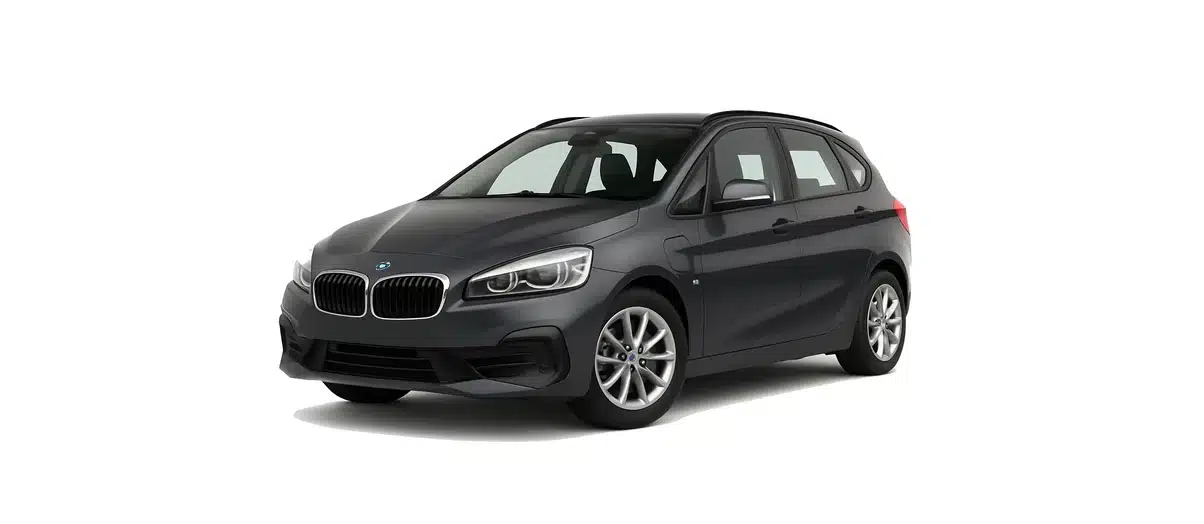
The BMW 225xe is a plug-in hybrid version of the previous-generation F45 2 Series Active Tourer. It is not a fully electric car, and that distinction is important when planning how to charge it. The 225xe combines a petrol engine with an electric motor and a relatively small traction battery, allowing short electric journeys when charged while still giving the flexibility of petrol for longer trips.
For UK used-car buyers, the key thing to understand is that not every BMW 225xe has the same battery. Earlier cars used a smaller battery pack, while BMW updated the model in 2019 with a larger 10.0 kWh gross battery. Charging speed, however, remained centred around AC charging at up to 3.7 kW, so a faster public post or higher-rated cable will not make the car charge beyond its onboard limit.
This guide explains what you need to know about charging the BMW 225xe at home and in public, how the battery versions differ, and which Type 2 charging cable is typically suitable.
View BMW 225xe Charging Cables
BMW 225xe Battery and Charging Specifications
The BMW 225xe should be treated as an AC-only plug-in hybrid. BMW technical information for the 225xe lists AC charging at up to 3.7 kW. The car uses a Type 2 AC charging inlet, with the charging flap described by BMW as being on the front-left side of the vehicle.
Unlike many newer battery-electric cars, the 225xe is not intended for DC rapid charging. There is no useful 10–80% rapid-charging figure to quote for this model, because it is designed for home, workplace and destination AC charging rather than motorway rapid charging.
| Item | BMW 225xe charging information |
|---|---|
| Vehicle type | Plug-in hybrid electric vehicle, not a full battery-electric car |
| Charging inlet | Type 2 AC inlet |
| Maximum AC charging rate | Up to 3.7 kW |
| DC rapid charging | Not supported / no CCS rapid-charging inlet confirmed for the 225xe |
| Typical cable for UK public AC posts | Type 2 to Type 2 charging cable |
Battery Options
Because the BMW 225xe is now a used-market vehicle, battery capacity depends on age and build specification. This is one of the most common areas of confusion, especially because the newer BMW 225e xDrive and 230e xDrive Active Tourer models use different battery and charging specifications.
Launch-era and earlier F45 225xe models were listed by BMW with a 7.6 kWh gross battery and 5.8 kWh net capacity. BMW’s later material also refers to the earlier pack as 7.7 kWh gross, so small differences in published figures are likely due to rounding and source presentation.
For the 2019 battery-updated BMW 225xe Active Tourer, BMW listed a 10.0 kWh gross battery with 8.8 kWh net capacity. This later pack increased the official electric range compared with earlier cars, but it did not turn the 225xe into a rapid-charging vehicle.
| Version | Battery capacity | BMW-listed full charge time at 3.7 kW |
|---|---|---|
| Early BMW 225xe | Approximately 7.6/7.7 kWh gross, 5.8 kWh usable | About 2.2 hours |
| 2019-updated BMW 225xe | 10.0 kWh gross, 8.8 kWh usable | About 3.2 hours |
If you are buying a used 225xe, it is worth checking the registration date, build year, vehicle paperwork and, where possible, the vehicle handbook or VIN-specific information. Do not assume every 225xe has the later 10.0 kWh battery.
AC Charging Speed
The BMW 225xe’s AC charging capability is modest by modern EV standards, but it is well matched to the size of the battery. BMW lists the car at up to 3.7 kW AC. In practical terms, this means the car can be fully recharged in a few hours rather than overnight, depending on the battery version and starting state of charge.
On the earlier 7.6/7.7 kWh gross battery cars, BMW listed a full charge time of around 2.2 hours at 3.7 kW. On the 2019-updated 10.0 kWh gross battery cars, BMW listed around 3.2 hours to full at the same charging rate.
A 7 kW home wallbox, 11 kW public AC charger or 22 kW public AC post will not make the BMW 225xe charge faster than its onboard AC limit. The charge point can offer more power, but the car will only draw what it can accept.
For cable choice, a 16A single-phase Type 2 cable is generally sufficient for the 225xe’s 3.7 kW onboard charger. However, some owners prefer a 32A Type 2 cable because it can be useful for future vehicles with faster AC charging, while still working with the 225xe.
DC Rapid Charging Speed
The BMW 225xe is not a DC rapid-charging car. It should not be planned around CCS rapid chargers, motorway high-power chargers or 10–80% rapid-charging stops. Instead, it is best charged where the car is parked for a while: at home, at work, at a hotel, at a leisure destination or at a public AC charging post.
This is normal for many plug-in hybrids of this era. The battery is small compared with a full EV battery, and the car also has a petrol engine for longer journeys. For most owners, the charging strategy is to plug in regularly for local electric driving rather than use the public rapid-charging network.
Range and Efficiency
Official electric range depends on the battery version and test cycle. Earlier BMW 225xe models were listed with an electric range of up to around 41 km, which is approximately 25 miles, on the older European test cycle. The 2019-updated model was listed by BMW with an electric range of 55–57 km, or approximately 34–35 miles, using WLTP-derived figures for comparison.
Real-world electric range will vary. Temperature, driving speed, use of heating or air conditioning, tyre condition, terrain and how often the petrol engine is called on can all affect the distance covered on electric power. For many owners, the 225xe makes the most sense when daily journeys are short enough to be covered largely on battery power, with the petrol engine available for longer routes.
It is also important not to confuse the older 225xe with the current-generation BMW 225e xDrive or 230e xDrive Active Tourer. Those newer models use a larger battery and different charging hardware, so their figures should not be applied to the discontinued 225xe.
Charging at Home
Home charging is usually the most convenient way to run a plug-in hybrid such as the BMW 225xe. Because the battery is relatively small, even a full recharge can be completed comfortably during an evening or while the car is parked overnight.
If you have a tethered home wallbox with a Type 2 connector, you can plug straight into the car. If your home charger is untethered, you will need a Type 2 to Type 2 charging cable. A 7 kW home charge point is common in the UK and is suitable for the 225xe, although the car will draw up to its own 3.7 kW limit rather than the full output of the charger.
A 3-pin portable charger is generally best suited as a backup or occasional charging solution, but can be used regularly if a qualified electrician has confirmed the socket and electrical installation are suitable for sustained EV charging. Avoid using damaged sockets, extension leads or any arrangement that feels warm in use, and follow the safety guidance in the vehicle handbook and charging equipment instructions.
For the lowest running costs, many owners charge overnight on an off-peak electricity tariff where available. Smart scheduling through the charge point or the vehicle can help, although exact functions depend on the equipment and vehicle specification.
Public Charging
For UK and European public AC charging posts, the BMW 225xe typically requires a Type 2 to Type 2 cable. Many public AC posts are untethered, meaning you must bring your own cable. Tethered rapid chargers often have fixed connectors, but these are generally not useful for the 225xe if they are DC-only or CCS-based.
When using public charging, look for AC destination chargers rather than rapid chargers. These may be found at supermarkets, car parks, hotels, workplaces, gyms and town-centre charging hubs. A public AC charger rated at 7 kW, 11 kW or 22 kW can still be used, but the BMW 225xe will charge at up to its 3.7 kW AC capability.
Because the battery is small, it may not be worth stopping specifically to charge unless the car will be parked for long enough. The biggest benefit usually comes from plugging in during time that would be spent parked anyway.
Vehicle-Specific Features
The BMW 225xe uses BMW’s plug-in hybrid layout for the F45 2 Series Active Tourer generation. In BMW’s technical description, the petrol engine drives the front wheels, while the electric motor drives the rear wheels, creating an electrified xDrive arrangement.
From a charging perspective, the most important vehicle-specific details are straightforward: it is a Type 2 AC plug-in hybrid with no practical DC rapid-charging use. The charging inlet is positioned on the front-left side wall of the car, which can influence how you park beside a home wallbox or public charging post.
Used buyers should also check what charging equipment comes with the car. Some cars may include a public charging cable, a portable charger, both, or neither. Inspect the charge port for damage, make sure the flap opens and closes correctly, and test charging before purchase where possible.
Charging Tips
- Confirm the battery version. Earlier 225xe models and 2019-updated cars have different battery capacities and different full-charge times.
- Use the right cable. A Type 2 to Type 2 cable is the usual choice for untethered home wallboxes and public AC posts.
- Do not expect faster charging from higher-rated posts. The car’s onboard charger limits AC charging to around 3.7 kW.
- Charge little and often. Plug-in hybrids are most efficient when the battery is topped up regularly for short journeys.
- Check used-car accessories. Replacement cables add cost, so confirm what is included before buying.
- Plan public charging around parking time. Destination AC charging is more useful than stopping solely to charge.
Frequently Asked Questions
Is the BMW 225xe fully electric?
No. The BMW 225xe is a plug-in hybrid. It can drive on electric power for short journeys when charged, but it also has a petrol engine for longer journeys or when the battery is depleted.
What charging cable does the BMW 225xe use?
The BMW 225xe uses a Type 2 AC charging inlet. For most UK public AC posts and untethered home wallboxes, you will need a Type 2 to Type 2 charging cable.
Does the BMW 225xe support rapid charging?
No. The 225xe should be treated as an AC-only plug-in hybrid. It does not have a useful DC rapid-charging capability, so there is no 10–80% rapid-charge time to plan around.
How long does the BMW 225xe take to charge?
BMW listed around 2.2 hours to fully charge the earlier 7.6/7.7 kWh gross battery version at 3.7 kW, and around 3.2 hours for the 2019-updated 10.0 kWh gross battery version at the same charging rate.
Will a 7 kW or 22 kW charger charge the BMW 225xe faster?
No. A higher-rated AC charge point can be used if it has the correct Type 2 connection, but the car will still be limited by its onboard charging capability of up to 3.7 kW.
Is a 16A or 32A Type 2 cable better for the BMW 225xe?
A 16A single-phase Type 2 cable is sufficient for the 225xe’s 3.7 kW charging rate. A 32A cable is also compatible and may be a better long-term choice if you expect to use the cable with a future EV that can charge faster on AC.
What This Means for Drivers
The BMW 225xe is best understood as a practical used plug-in hybrid for drivers who can charge at home or at regular destinations. Its charging speed is not especially fast by modern EV standards, but it does not need to be: the battery is small enough to recharge in a few hours, and the petrol engine provides backup for longer journeys.
The main ownership point is to buy and charge with the correct expectations. Check whether you are looking at an early smaller-battery car or a later 2019-updated version, use a Type 2 cable for AC charging, and do not confuse the 225xe with the newer 225e xDrive and 230e xDrive models.
Looking for a Charging Cable for BMW 225xe?
We offer BMW 225xe charging cables suitable for Type 2 AC charging, including options for public charging posts and untethered home wallboxes.
View BMW 225xe Charging Cables
Please note that this information is intended as a guide. Charging specifications may change due to model and year of manufacture. For precise information, always refer to your vehicle user manual.

