
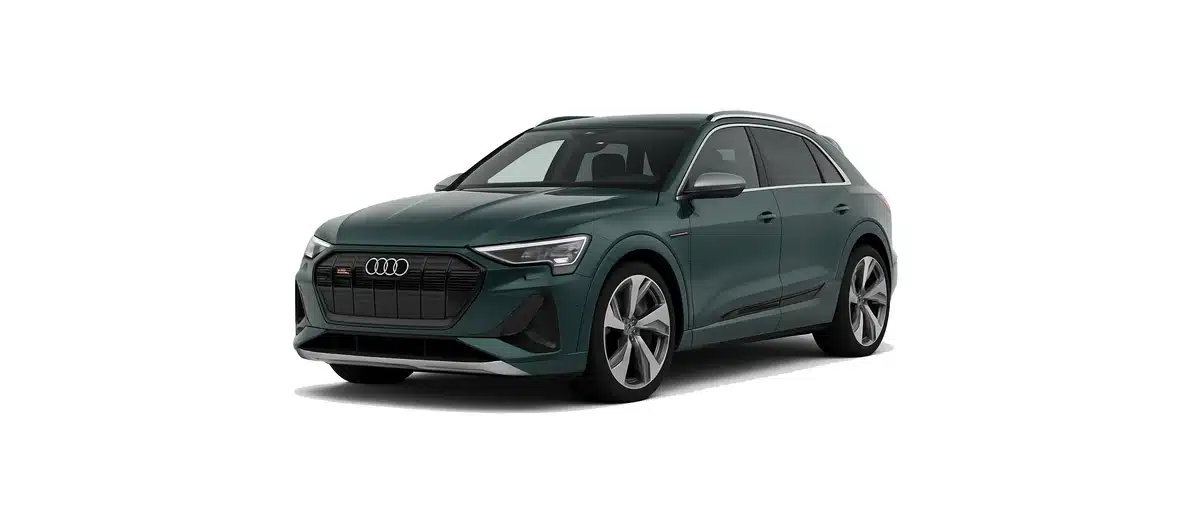
The Audi SQ8 e-tron is a high-performance, fully electric large SUV that sits at the top of the Q8 e-tron family. Sold in the UK from 2023 and now no longer generally available as a new factory-order model, it is an important used electric SUV for drivers who want quattro traction, strong performance and long-distance comfort without choosing a plug-in hybrid or petrol SQ8.
For charging, the key points are its large 106 kWh usable battery, Type 2 AC charging, CCS rapid charging and a standard UK AC charging figure of 11 kW. Some examples may have 22 kW AC capability or an additional AC charge port, but this is specification-dependent and should be checked on the individual vehicle before purchase. In normal UK home use, most drivers will be charging from a 7.4 kW single-phase wallbox, which is slower than the car’s maximum AC capability but still practical for regular overnight top-ups.
View Audi SQ8 e-tron Charging Cables
Audi SQ8 e-tron Battery and Charging Specifications
The Audi SQ8 e-tron is a battery electric vehicle, not a plug-in hybrid. It uses a tri-motor quattro layout, with one electric motor at the front and two at the rear. UK and European models use the Type 2 connector for AC charging and the CCS Combo 2 connector for DC rapid charging, which is the standard arrangement for most modern electric cars in the UK and Europe.
| Vehicle type | Fully electric BEV |
| Battery | 114 kWh gross / 106 kWh usable |
| AC charging | 11 kW standard; 22 kW may be optional or equipment-dependent |
| DC rapid charging | Up to around 170 kW |
| Rapid charge time | Approximately 31 minutes from 10-80% in suitable conditions |
| AC connector | Type 2 |
| DC connector | CCS Combo 2 |
| UK home charging reality | Typically up to 7.4 kW on a single-phase wallbox |
Battery Options
The SQ8 e-tron was offered with the larger Q8 e-tron battery pack. Audi quotes 114 kWh gross capacity and 106 kWh net usable capacity for SQ8 e-tron models. This applies to both the regular SUV and the SQ8 Sportback e-tron, although real-world range can differ slightly between body styles, wheel sizes, tyres and equipment.
A usable capacity of 106 kWh is very large by EV standards. The benefit is strong long-distance capability and less need to charge to 100% every day. The trade-off is that a full charge takes time, especially on a typical UK home wallbox. In practice, many owners will charge little and often rather than regularly running the battery very low and refilling it completely.
AC Charging Speed
For UK buyers and used-car shoppers, AC charging is the area that needs the most care. Audi UK data quotes 11 kW AC as the standard maximum for the SQ8 e-tron, with a 0-100% charge taking around 11 hours 30 minutes on suitable three-phase 11 kW hardware. Some technical sources and specification listings refer to 22 kW three-phase AC capability, but this appears to be optional or equipment-dependent rather than something to assume on every UK car.
This matters because many used electric cars are advertised simply as having “fast AC charging”, without stating whether the vehicle has the 11 kW or 22 kW onboard charger. If 22 kW AC charging is important to you, check the original build specification, options list or VIN with Audi or a knowledgeable dealer.
For most UK homes, the more important figure is 7.4 kW. A standard single-phase home wallbox will usually provide up to 7.4 kW, even if the vehicle itself can accept more on three-phase AC. With such a large battery, a full charge from empty on a 7.4 kW wallbox can take roughly 17 hours, but typical daily charging sessions will be much shorter because you are usually replacing the miles used that day rather than filling the battery from 0-100%.
DC Rapid Charging Speed
The Audi SQ8 e-tron supports CCS rapid charging at up to around 170 kW. Under suitable conditions, Audi quotes a 10-80% rapid charge time of about 31 minutes. This is the charging window most drivers use on long journeys because charging is generally fastest when the battery is at a lower state of charge and slows as it approaches a high percentage.
To get close to the best rapid-charging performance, use a capable CCS ultra-rapid charger, arrive with a reasonably low battery level and, where possible, make sure the battery is warm. The SQ8 e-tron has battery preconditioning capability, although available data suggests it should not be assumed to work automatically through navigation in the same way as some newer EV platforms. In cold weather, charging speeds may be lower until the battery reaches an appropriate temperature.
Range and Efficiency
Range varies depending on body style and specification. EV Database UK lists the SQ8 SUV e-tron with a WLTP range band of around 258-285 miles and the SQ8 Sportback e-tron slightly higher at around 265-293 miles. The Sportback’s more aerodynamic shape can help, although wheel size, tyres, temperature and driving style all make a noticeable difference.
As a broad real-world guide, the SUV version is often estimated at around 280 miles in mixed use, with the Sportback potentially a little higher. These figures should be treated as realistic planning estimates rather than fixed promises. Motorway driving at higher speeds, winter temperatures, heavy rain, roof boxes and full loads will reduce range, while gentle driving in mild weather may improve it.
Because the SQ8 e-tron is a large, powerful SUV, it will not be as efficient as a smaller electric hatchback or saloon. The large battery helps compensate, but for long-distance motorway use it is sensible to plan charging stops around reliable CCS chargers rather than relying on the maximum possible range.
Charging at Home
Home charging is likely to be the most convenient and cost-effective way to run an Audi SQ8 e-tron. If you have off-street parking, a dedicated Type 2 wallbox is the best everyday solution. On most UK domestic supplies, this will be a single-phase 7.4 kW charger. It will not use the car’s full 11 kW AC capability, but it is well suited to overnight charging and regular top-ups.
For example, if you use 40-60 miles of range in a day, a 7.4 kW wallbox can usually replace that energy comfortably overnight. If you return home nearly empty and want to reach 100%, you may need a longer charging session or more than one night, especially if you are using timed off-peak tariffs.
If your property has a three-phase electrical supply, it may be possible to install an 11 kW or higher AC charger, subject to the installation and permissions. However, the vehicle must also support the relevant AC charging speed. Do not assume a used SQ8 e-tron has 22 kW AC charging unless the specification confirms it.
A 3-pin charger is generally best suited as a backup or occasional charging solution, but can be used regularly if a qualified electrician has confirmed the socket and electrical installation are suitable for sustained EV charging. With a battery this large, a domestic 3-pin plug will be very slow and is not the most convenient primary charging method for most owners.
Public Charging
For public AC charging, the Audi SQ8 e-tron uses a Type 2 connection. Many destination chargers at hotels, workplaces, town centres and supermarkets require you to bring your own Type 2 charging cable. A good-quality Type 2 cable is therefore useful even if you do most of your charging at home.
For rapid charging, use the CCS connector built into the rapid charger. You do not need your own cable for DC rapid charging, as CCS rapid and ultra-rapid units have tethered cables. The SQ8 e-tron’s maximum DC rate of around 170 kW means it is worth choosing high-power chargers when available, though the actual speed will depend on battery temperature, state of charge, charger output and site conditions.
The SQ8 e-tron also supports Plug & Charge on compatible CCS networks using ISO 15118. Where supported and correctly set up, this can allow the vehicle and charger to authenticate automatically, reducing the need to use an app or card at every session. Availability depends on the charging network and account setup.
Vehicle-Specific Features
The SQ8 e-tron’s tri-motor quattro system is one of its defining features. It is designed for performance and traction, with two rear motors helping provide precise torque distribution. For charging and ownership, however, the most important vehicle-specific points are the large battery, the AC charging specification and the body-style differences between SUV and Sportback.
A heat pump is listed as standard, which can help improve efficiency in colder conditions by reducing the energy needed for cabin heating. Battery preconditioning is also listed as possible, helping prepare the battery for faster charging when used appropriately, although drivers should not assume fully automatic navigation-based preconditioning on this model.
The SQ8 e-tron does not support V2L, V2G or V2H functionality according to available specification data. It should therefore not be treated as a vehicle that can power external appliances, export energy back to the grid or act as a home backup battery.
Charging Tips
- Check the AC charger specification before buying used. Treat 11 kW AC as the safe standard figure and verify any 22 kW claim through the build sheet or VIN.
- Use a Type 2 cable for public AC charging. Many destination chargers are untethered, so you will need your own cable.
- Plan long trips around CCS rapid chargers. The SQ8 e-tron is best suited to high-power CCS charging on motorway and trunk-road routes.
- Use the 10-80% window on journeys. It is usually quicker to rapid charge to around 80% and continue than to wait for the final 20%.
- Precondition or warm the battery where possible. A cold battery may charge more slowly, particularly in winter.
- Do not rely on 3-pin charging as the main solution unless professionally checked. The battery is large, and charging from a household plug is slow.
- Choose a suitable cable rating. A three-phase Type 2 cable can be useful if you regularly use 11 kW or 22 kW public AC charge points, but your vehicle’s onboard charger and the charge point both determine the actual speed.
Frequently Asked Questions
Is the Audi SQ8 e-tron a plug-in hybrid?
No. The Audi SQ8 e-tron is a fully electric battery electric vehicle. It should not be confused with the petrol Audi SQ8 or the Q8 TFSI e plug-in hybrid.
What charging connector does the Audi SQ8 e-tron use?
It uses a Type 2 connector for AC charging and a CCS Combo 2 connector for DC rapid charging in the UK and Europe.
Can every Audi SQ8 e-tron charge at 22 kW AC?
No. Audi UK data supports 11 kW AC as the standard maximum. Some sources list 22 kW capability, but this appears to be optional or equipment-dependent, so it should be verified on the specific vehicle.
How long does the Audi SQ8 e-tron take to charge at home?
On a typical UK 7.4 kW single-phase wallbox, a full charge from empty can take around 17 hours. Normal top-up charging is usually much shorter because most drivers do not arrive home with a completely empty battery.
How fast can the Audi SQ8 e-tron rapid charge?
It can rapid charge at up to around 170 kW on a suitable CCS charger. Audi quotes approximately 31 minutes for a 10-80% charge in ideal conditions.
Does the Audi SQ8 e-tron have vehicle-to-load or vehicle-to-grid?
No. Available data lists V2L, V2G and V2H as not supported on the SQ8 e-tron.
What This Means for Drivers
The Audi SQ8 e-tron is a capable used electric SUV with a very large battery and strong rapid-charging performance. For everyday ownership, the most important point is to match expectations to the charging hardware you actually have. At home, most UK owners will charge at up to 7.4 kW, which is excellent for routine top-ups but not fast enough to refill the 106 kWh usable battery from empty in a short overnight window.
For longer journeys, the CCS rapid-charging capability is more important. A well-planned 10-80% stop at a suitable ultra-rapid charger can make the SQ8 e-tron a comfortable long-distance EV, particularly if the battery is warm and the charger is delivering properly. If you are buying used, check the AC charging options carefully, especially if 22 kW AC charging or a second charge port is mentioned in an advert.
Looking for a Charging Cable for Audi SQ8 e-tron?
We offer charging cables for the Audi SQ8 e-tron, including Type 2 options for home wallboxes and public AC charge points; choose the cable that matches your charging setup and, if buying a used SQ8 e-tron, confirm the vehicle’s AC charging specification first.
View Audi SQ8 e-tron Charging Cables
Please note that this information is intended as a guide. Charging specifications may change due to model and year of manufacture. For precise information, always refer to your vehicle user manual.

