
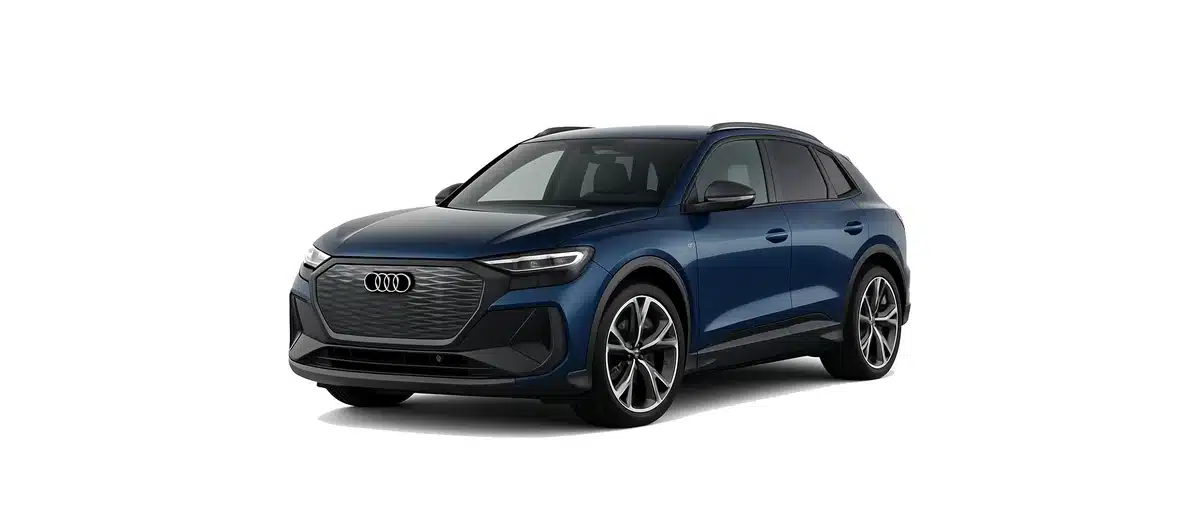
The Audi SQ6 e-tron is a fully electric performance SUV based on the Volkswagen Group PPE platform. In current UK SQ6 SUV e-tron form, it combines twin-motor quattro all-wheel drive with a large 94.9 kWh usable battery and an 800-volt electrical architecture designed for high-power rapid charging.
For owners, the key charging points are straightforward but important. The SQ6 e-tron uses Type 2 AC charging for home wallboxes and public AC posts, and CCS Combo 2 for DC rapid charging. Audi’s European layout is also slightly unusual because the car has a CCS Combo inlet on one rear side for AC and DC charging, plus an additional AC-only inlet on the opposite rear side. That can make everyday charging more flexible once you know which socket to use.
This guide focuses on the current UK Audi SQ6 SUV e-tron, not the SQ6 Sportback e-tron, which Audi lists separately. Figures can vary by derivative, equipment, temperature, charger capability and battery state of charge, so treat headline charging times as best-case conditions rather than guarantees.
View Audi SQ6 e-tron Charging Cables
Audi SQ6 e-tron Battery and Charging Specifications
| Specification | Audi SQ6 SUV e-tron |
|---|---|
| Vehicle type | Battery electric vehicle, twin-motor quattro SUV |
| Battery capacity | 100 kWh gross / 94.9 kWh usable |
| Official WLTP range | Up to 364 miles, depending on derivative and equipment |
| Estimated real-world range | Around 290 miles, depending on conditions and driving style |
| AC charging | Type 2, up to 11 kW as standard according to Audi UK data |
| Typical UK home charging | Up to 7.4 kW on a single-phase wallbox |
| DC rapid charging | CCS Combo 2, up to 270 kW under suitable conditions |
| Quoted DC charging time | 10-80% in about 21 minutes on a suitable ultra-rapid charger |
| Heat pump | Standard |
| Battery preconditioning | Supported via predictive thermal management when routing to a DC charger |
Battery Options
The current UK Audi SQ6 SUV e-tron is listed with a large battery pack. Audi UK states a net battery capacity of 94.9 kWh, while Audi technical material and independent specification data describe the pack as 100 kWh gross and 94.9 kWh usable. The usable figure is the more relevant number for estimating driving range and charging time.
It is worth distinguishing between gross and usable capacity. Gross capacity is the total physical size of the battery pack. Usable capacity is the portion made available to the driver, with buffers reserved by the vehicle’s battery management system to help protect long-term durability and performance.
As with many premium EVs, range and charging performance can also be affected by wheel size, equipment, weather and driving speed. The SQ6 SUV e-tron should not be confused with the SQ6 Sportback e-tron, because body style and equipment differences can change official range figures.
AC Charging Speed
For AC charging, the Audi SQ6 e-tron uses a Type 2 connection. Audi UK currently lists maximum AC charging at 11 kW. In practical UK home charging, however, most owners will charge at up to 7.4 kW because the majority of domestic wallboxes are single-phase.
A 7.4 kW home wallbox is therefore the realistic benchmark for many UK households. Audi quotes around 15 hours for a 0-100% charge using a 7.4 kW home wallbox. In normal ownership, you are unlikely to arrive home at 0% and charge to 100% every time, so overnight top-ups will usually be much shorter than a full empty-to-full session.
To use the car’s 11 kW AC capability, you generally need access to a three-phase supply and a compatible three-phase charging point. Some specification sources refer to an optional 22 kW onboard charger for the wider model line, but Audi UK’s current SQ6 SUV e-tron battery page lists 11 kW AC. If you are buying a used or factory-order car and three-phase AC charging matters to you, check the exact vehicle specification before relying on 22 kW compatibility.
DC Rapid Charging Speed
The SQ6 e-tron’s strongest charging feature is its 800-volt architecture, which supports up to 270 kW DC charging when connected to a suitable ultra-rapid charger. Audi quotes a 10-80% charging time of about 21 minutes in favourable conditions.
That headline figure depends on several factors. The charger must be capable of delivering the required power, the battery needs to be within the right temperature window, and the car must arrive at a low enough state of charge to accept peak power. A cold battery, a busy charging site, a lower-powered charger or starting at a high state of charge will all reduce charging speed.
The car can also use high-power 400-volt DC chargers. Audi states that its PPE charging system can split the 800-volt battery into two equal-voltage banks and charge them in parallel at up to 135 kW on suitable 400-volt infrastructure. In simple terms, you do not need to avoid 400-volt rapid chargers, but the fastest stops will normally require modern ultra-rapid hardware.
Range and Efficiency
Audi UK lists the SQ6 SUV e-tron with an official WLTP range of up to 364 miles, depending on derivative and equipment. Independent real-world estimates are closer to around 290 miles, which is often a more useful planning figure for mixed UK driving.
Your own range will vary. Motorway speeds, winter temperatures, wet roads, roof boxes, larger wheels and repeated hard acceleration can all increase consumption. Urban and suburban driving, milder weather and careful use of regenerative braking can improve efficiency.
For long journeys, range is only one part of the ownership experience. Because the SQ6 e-tron can rapid charge quickly when conditions are right, a practical motorway strategy is to plan shorter 10-80% charging stops rather than trying to run the battery down to 0% or charge to 100% at a rapid charger.
Charging at Home
Home charging is usually the cheapest and most convenient way to run the Audi SQ6 e-tron. For most UK owners, a dedicated 7.4 kW Type 2 wallbox will be the best everyday setup. It allows you to plug in overnight, schedule charging for off-peak electricity tariffs and start each day with the range you need.
If your wallbox is untethered, you will need a Type 2 charging cable. A tethered home charger has its own attached cable, so you simply plug the connector into the car. With the SQ6 e-tron’s dual-inlet layout, you can use either the CCS-side AC connection or the additional AC-only inlet, depending on which side is more convenient for your parking arrangement and cable reach.
A standard 3-pin domestic charger is generally best suited as a backup or occasional charging solution, but can be used regularly if a qualified electrician has confirmed the socket and electrical installation are suitable for sustained EV charging. Because the SQ6 e-tron has a large battery, 3-pin charging will be slow and is not the ideal primary charging method for most owners.
If you have or are considering a three-phase electrical supply, ask your installer to confirm the available charging power and whether your exact vehicle specification can make full use of it. The standard onboard AC charger is listed at 11 kW, and any higher AC capability should be verified against the specific car.
Public Charging
For public AC charging, the SQ6 e-tron uses a Type 2 cable. This applies to many destination chargers in car parks, hotels, workplaces, supermarkets and town centres. Public AC posts may be rated at 7 kW, 11 kW or 22 kW, but the car’s onboard charger and the electrical supply determine the power the vehicle can actually accept.
For rapid and ultra-rapid charging, you use the CCS Combo 2 inlet. The cable is attached to the DC charger, so you do not need to provide your own CCS cable. On a motorway or major A-road charging hub, look for high-power units rated at 150 kW, 250 kW, 270 kW or higher if you want the best chance of a fast stop.
Audi highlights Plug & Charge support for the Q6 e-tron series. Where supported by the charging network and your account setup, Plug & Charge can allow the car and charger to authenticate automatically after you plug in, reducing the need to use an app or RFID card. Availability depends on the charging provider and subscription setup.
Vehicle-Specific Features
The SQ6 e-tron has several charging-related features that are especially relevant to owners. The first is its dual-inlet European layout: a CCS Combo inlet on one rear side for AC and DC charging, plus a second AC-only inlet on the opposite side. This can be very useful at home, especially if your wallbox or driveway layout makes one side of the car easier to access.
The second major feature is the 800-volt PPE platform. This is what enables the car’s high peak DC charging rate of up to 270 kW on suitable chargers. It also supports Audi’s bank charging approach on certain 400-volt chargers, helping the car make better use of varied public charging infrastructure.
The SQ6 e-tron also has a standard heat pump, which can help reduce the energy needed for cabin heating in colder conditions compared with relying solely on resistive heating. It does not make winter driving immune to range loss, but it is a useful efficiency feature for UK weather.
Battery preconditioning is also supported. When you use the Audi navigation or e-tron route planner to set a compatible DC fast charger as your destination, the car can prepare the battery temperature before arrival. This helps the battery get closer to its optimal charging window, improving the chance of a strong rapid-charging session.
Vehicle-to-load, vehicle-to-home and vehicle-to-grid functionality should not be assumed for the UK SQ6 e-tron. Current specification data does not list V2L, V2H or V2G as available for this model in the UK.
Charging Tips
- Use 7.4 kW as your home-charging benchmark. Although the car is listed with 11 kW AC capability, most UK homes are single-phase and will charge at up to 7.4 kW with a suitable wallbox.
- Use the correct connection. Use a Type 2 cable for home and public AC charging. Use the tethered CCS cable attached to the charger for DC rapid charging.
- Plan motorway stops around 10-80%. The fastest part of the charging curve is usually in the middle of the battery, so repeated 10-80% stops are often quicker than charging to 100%.
- Precondition before rapid charging. Set the rapid charger as a destination in the Audi navigation or e-tron route planner so the car can prepare the battery.
- Do not expect 270 kW everywhere. You need a suitable high-power charger, a warm enough battery and a favourable state of charge.
- Check cable length. The dual-inlet layout is flexible, but driveway position and wallbox location still matter. Choose a Type 2 cable long enough for your regular parking setup.
- Verify three-phase needs. If you plan to use 11 kW AC charging at home or work, confirm that the site has three-phase power and that the installed charger is compatible.
Frequently Asked Questions
What charging cable does the Audi SQ6 e-tron use?
The Audi SQ6 e-tron uses a Type 2 cable for AC charging at home wallboxes and public AC posts. For DC rapid charging, it uses the CCS Combo 2 connection, and the cable is attached to the rapid charger.
Can the Audi SQ6 e-tron charge at 7.4 kW at home?
Yes. For most UK homes with a single-phase supply, a 7.4 kW wallbox is the practical home-charging option. Audi quotes around 15 hours for a full 0-100% charge using a 7.4 kW home wallbox.
Can the Audi SQ6 e-tron charge at 11 kW AC?
Audi UK lists maximum AC charging at 11 kW. To achieve this, you generally need a compatible three-phase charging supply. Most UK domestic installations are single-phase and will not provide 11 kW.
How fast can the Audi SQ6 e-tron rapid charge?
Under suitable conditions, the SQ6 e-tron can DC rapid charge at up to 270 kW. Audi quotes about 21 minutes for a 10-80% charge on a suitable ultra-rapid charger, but real sessions depend on charger output, battery temperature and starting charge level.
Does the Audi SQ6 e-tron have battery preconditioning?
Yes. The SQ6 e-tron supports predictive thermal management and battery preconditioning when a DC fast charger is used as a destination in the Audi route planner. This helps prepare the battery for faster charging.
Does the Audi SQ6 e-tron support V2L, V2H or V2G?
Current UK specification data does not list vehicle-to-load, vehicle-to-home or vehicle-to-grid capability as available for the SQ6 e-tron, so owners should not assume those functions are supported.
What This Means for Drivers
The Audi SQ6 e-tron is best understood as a high-performance electric SUV with very strong long-distance charging potential, but with normal UK home-charging limitations. Its 270 kW DC peak rate and 800-volt platform are impressive, yet most day-to-day charging will still happen at 7.4 kW on a home wallbox.
The dual-inlet layout is a genuine usability benefit. You can charge from either side when using AC, while the CCS inlet is used for rapid charging. For households with tight driveways or fixed wallbox positions, that extra flexibility may make the car easier to live with than many EVs that have only one charging inlet.
For the best ownership experience, install a proper Type 2 wallbox, keep a suitable Type 2 cable in the car for untethered public AC posts, and use the Audi navigation system before motorway rapid charging. That combination will help you make the most of the SQ6 e-tron’s large battery and fast-charging hardware.
Looking for a Charging Cable for Audi SQ6 e-tron?
If you need a Type 2 cable for home or public AC charging, We offer Audi SQ6 e-tron charging cables suitable for UK wallboxes and public charging posts. Choose a cable length and phase rating that matches your charging setup and the vehicle specification you intend to use.
View Audi SQ6 e-tron Charging Cables
Please note that this information is intended as a guide. Charging specifications may change due to model and year of manufacture. For precise information, always refer to your vehicle user manual.

