
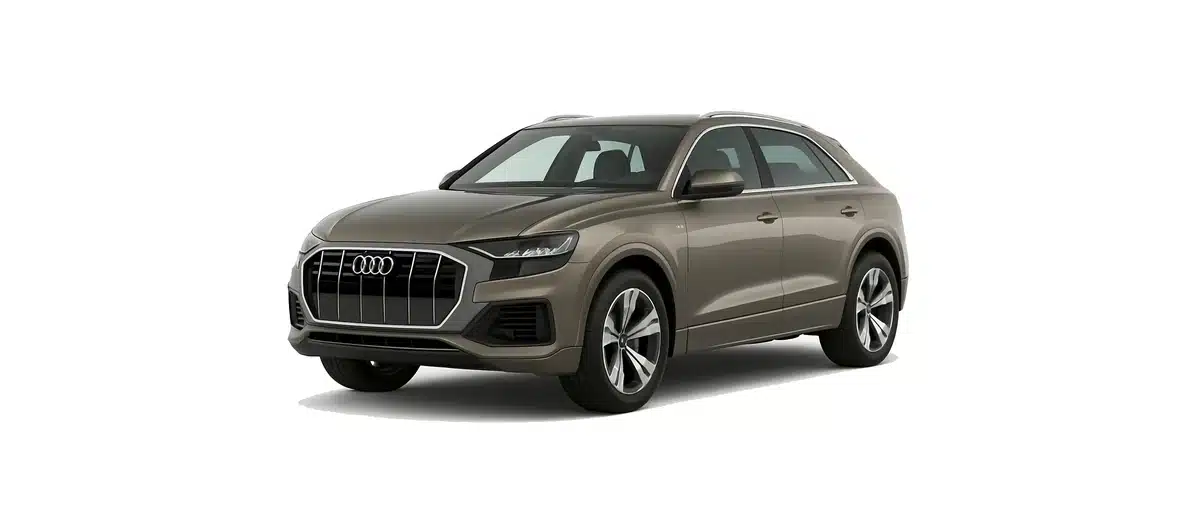
The Audi Q8 TFSIe is a large plug-in hybrid SUV that combines a petrol engine with an electric motor and quattro all-wheel drive. It is important to distinguish it from the fully electric Audi Q8 e-tron: the Q8 TFSIe is a PHEV, uses Type 2 AC charging, and is not a CCS rapid-charging electric car.
That distinction matters when choosing a charging cable. A Q8 TFSIe owner usually needs a suitable Type 2 cable for an untethered home wallbox or public AC post, rather than a DC rapid-charging setup. Current UK Q8 e-hybrid models also differ from earlier used Q8 55 TFSI e and 60 TFSI e models, so charging times and electric range should be checked against the age and version of the vehicle.
View Audi Q8 TFSIe Charging Cables
Audi Q8 TFSIe Battery and Charging Specifications
For the current UK Q8 SUV e-hybrid / Q8 TFSI e quattro 394 PS tiptronic, Audi lists a usable battery capacity of 22 kWh, an official WLTP electric range of 46–49 miles, and AC charging at up to 7.4 kW. Audi quotes a 0–100% charging time of around 3 hours 45 minutes from a 7 kW wallbox under suitable conditions.
Earlier UK Q8 55 TFSI e and 60 TFSI e models, introduced around 2020, used a smaller battery. Audi’s UK launch material stated a 17.8 kWh battery, up to 28 miles of WLTP electric range and up to 7.4 kW AC charging, with a full charge taking around 2.5 hours. Some used-car listings and third-party data may show the battery as 17.9 kWh, so owners of pre-facelift cars should check their vehicle documentation rather than relying on current model figures.
The key charging point is consistent across these versions: the Q8 TFSIe is an AC-charging plug-in hybrid with a Type 2 inlet for UK and European charging. It should not be treated as if it were the fully electric Q8 e-tron.
Battery Options
There are two broad battery contexts UK buyers are likely to encounter. The current UK Q8 e-hybrid is listed with a 22 kWh usable battery. This larger pack gives the car a higher official electric range than the earlier launch-era Q8 TFSI e models and is the version for which Audi quotes the 3 hour 45 minute 7 kW wallbox charge time.
Used examples of the Q8 55 TFSI e and Q8 60 TFSI e may instead have the earlier 17.8/17.9 kWh battery. These cars still use AC charging at up to 7.4 kW, but because the battery is smaller, the quoted full-charge time is shorter, at around 2.5 hours in Audi’s launch information.
This is why one universal battery or range figure can be misleading. If you are buying a used Audi Q8 TFSIe, check the exact model year, trim and vehicle documentation. For cable selection, however, the advice is simpler: a Type 2 AC charging cable is the relevant choice.
AC Charging Speed
The confirmed UK AC charging figure for the Audi Q8 TFSIe is up to 7.4 kW. In practical terms, this aligns well with a typical UK single-phase 7 kW home wallbox. On the current 22 kWh usable-battery model, Audi quotes a 0–100% charge in as little as 3 hours 45 minutes from a 7 kW wallbox. Earlier 17.8/17.9 kWh cars can be expected to take closer to Audi’s earlier quoted figure of around 2.5 hours for a full charge.
A higher-rated cable, such as an 11 kW or 22 kW Type 2 cable, may still be physically compatible if it is the correct Type 2-to-Type 2 cable and suitable for the charging point. However, it will not make the Q8 TFSIe charge faster than the car’s onboard AC charging limit. The limiting factor is the vehicle’s onboard charger, not simply the rating printed on the cable or post.
For most UK owners, the practical cable decision is therefore about quality, length, connector type and amperage suitability, rather than chasing a charging speed the car cannot use.
DC Rapid Charging Speed
The Audi Q8 TFSIe should not be described as a DC rapid-charging car. Audi UK explains that its plug-in hybrid models have an AC charging port, while DC rapid charging is associated with fully electric Audi models. No CCS/DC rapid-charging inlet is confirmed for the Q8 TFSIe, so there is no 10–80% rapid-charge time to quote.
This is one of the biggest areas of confusion because of the similar naming between Q8 TFSIe and Q8 e-tron. The Q8 e-tron is a fully electric vehicle with different battery sizes, charging hardware and rapid-charging capability. Those figures do not apply to the Q8 TFSIe plug-in hybrid.
At motorway service areas and rapid-charging hubs, the Q8 TFSIe may not be able to use the high-power CCS chargers intended for battery-electric vehicles. Instead, look for AC posts with Type 2 sockets if you want to charge away from home.
Range and Efficiency
The current UK Audi Q8 e-hybrid is listed with an official WLTP electric range of 46–49 miles. Earlier UK Q8 55 TFSI e and 60 TFSI e models were launched with an official electric range of up to 28 miles. These figures are laboratory-based WLTP values and should be used as a comparison guide rather than a guaranteed everyday result.
Real-world electric range can vary with temperature, route, speed, wheel and tyre specification, cabin heating or cooling use, driving style and how much of the battery’s usable capacity is available at the start of the journey. Short urban and suburban journeys are generally where a plug-in hybrid can make the best use of its electric capability, provided it is charged regularly.
The Q8 TFSIe’s efficiency also depends heavily on owner behaviour. If it is plugged in often, many local trips can be completed using electric power for a meaningful portion of the journey. If it is rarely charged, it becomes a heavy petrol hybrid carrying a battery that is not being used to its full advantage.
Charging at Home
Home charging is the most convenient setup for most Q8 TFSIe drivers. A 7 kW home wallbox suits the vehicle well because it matches the car’s confirmed AC charging capability. For the current 22 kWh usable-battery model, a full charge from empty is quoted at about 3 hours 45 minutes in suitable conditions. For earlier smaller-battery cars, the full-charge time is likely to be closer to the previously quoted 2.5-hour figure.
If your wallbox is untethered, you will need a Type 2 charging cable. A 5 metre cable is often enough for straightforward driveway parking, while a longer cable can be useful if the charging point and vehicle port do not always line up conveniently. Consider where the car is parked, whether you reverse in or drive in forwards, and whether you may also use public AC posts.
A 3-pin charger is generally best suited as a backup or occasional charging solution, but can be used regularly if a qualified electrician has confirmed the socket and electrical installation are suitable for sustained EV charging. A domestic socket will charge much more slowly than a dedicated wallbox and should not be treated as a like-for-like alternative to a properly installed EV charge point.
Public Charging
For public charging, the Audi Q8 TFSIe uses Type 2 AC charging points. Many supermarkets, hotels, car parks, workplaces and destination chargers provide Type 2 AC sockets. On untethered posts, you use your own Type 2 cable; on tethered AC units, the cable is already attached.
Because the car is limited to around 7.4 kW AC, plugging into an 11 kW or 22 kW AC post will not usually deliver those higher speeds to the vehicle. The post may be capable of more, but the car will draw only what its onboard charger and the electrical conditions allow.
For a plug-in hybrid, public charging is most useful when the car is parked for a while: at work, while shopping, during a meal or during a hotel stay. It is less about rapid turnarounds and more about recovering useful electric miles while the vehicle would be stationary anyway.
Vehicle-Specific Features
The defining feature of the Audi Q8 TFSIe from a charging perspective is its plug-in hybrid layout. It combines a V6 petrol engine with an electric motor and quattro all-wheel drive, allowing electric running for shorter journeys while retaining petrol capability for longer trips.
Unlike the fully electric Q8 e-tron, the Q8 TFSIe is not built around high-power DC charging. Audi’s own charging guidance separates plug-in hybrids, which use AC charging, from fully electric models, which can use AC and DC charging. This makes cable selection more straightforward: the main requirement is a Type 2 AC cable suitable for home and public AC charging.
Vehicle-to-load and vehicle-to-grid or vehicle-to-home capability are not available for this model in the supplied research data. Owners should therefore choose charging equipment for conventional AC charging rather than expecting the car to power external devices or export energy back to a home or grid system.
Charging Tips
- Charge little and often: a plug-in hybrid delivers its best electric-driving benefit when it is topped up regularly.
- Use a 7 kW wallbox where possible: this is the most relevant home setup for the Q8 TFSIe’s confirmed AC charging capability.
- Choose Type 2 for UK AC charging: this applies to untethered home wallboxes and many public AC posts.
- Do not pay for speed the car cannot use: an 11 kW or 22 kW cable will not overcome the vehicle’s onboard 7.4 kW AC charging limit.
- Check which battery your car has: current 22 kWh usable-battery models and earlier 17.8/17.9 kWh cars have different official range and charge-time figures.
- Do not use Q8 e-tron figures: the Q8 e-tron is a different, fully electric model with different charging hardware.
Frequently Asked Questions
Is the Audi Q8 TFSIe fully electric?
No. The Audi Q8 TFSIe is a plug-in hybrid. It has a petrol engine, an electric motor and a rechargeable battery. It is not the same vehicle as the fully electric Audi Q8 e-tron.
What charging cable does the Audi Q8 TFSIe use?
For UK and European AC charging, the Q8 TFSIe uses a Type 2 connection. A Type 2-to-Type 2 cable is the usual choice for untethered home wallboxes and public AC charging posts.
Can the Audi Q8 TFSIe use rapid chargers?
No CCS/DC rapid-charging capability is confirmed for the Q8 TFSIe. Audi UK describes plug-in hybrid models as having an AC charging port only, while DC charging applies to fully electric Audi models.
How long does the Audi Q8 TFSIe take to charge at home?
For the current UK 22 kWh usable-battery model, Audi quotes around 3 hours 45 minutes for a 0–100% charge from a 7 kW wallbox. Earlier 17.8/17.9 kWh Q8 TFSI e models were quoted at around 2.5 hours because they have a smaller battery.
Will a 22 kW cable charge the Q8 TFSIe faster?
Not beyond the car’s onboard charging limit. A higher-rated Type 2 cable may be compatible, but the Q8 TFSIe is confirmed at up to 7.4 kW AC charging, so a 22 kW cable should not be bought expecting faster charging from this vehicle.
What This Means for Drivers
For most Audi Q8 TFSIe owners, charging is simple once the car is understood as a plug-in hybrid rather than a fully electric Q8 e-tron. The right setup is typically a 7 kW home wallbox and a suitable Type 2 cable for untethered home and public AC charging. There is no need to plan around CCS rapid charging, because the car is AC-only.
Current UK Q8 e-hybrid models offer a larger usable battery and higher official electric range than earlier Q8 55 TFSI e and 60 TFSI e examples, but both depend on regular charging to deliver the best everyday benefit. If you can plug in at home or at work, the Q8 TFSIe is far more likely to complete local journeys with meaningful electric assistance.
Looking for a Charging Cable for Audi Q8 TFSIe?
We offer Audi Q8 TFSIe charging cables for Type 2 AC home and public charging, helping you choose a cable suited to the plug-in hybrid Q8 rather than the fully electric Q8 e-tron.
View Audi Q8 TFSIe Charging Cables
Please note that this information is intended as a guide. Charging specifications may change due to model and year of manufacture. For precise information, always refer to your vehicle user manual.

