
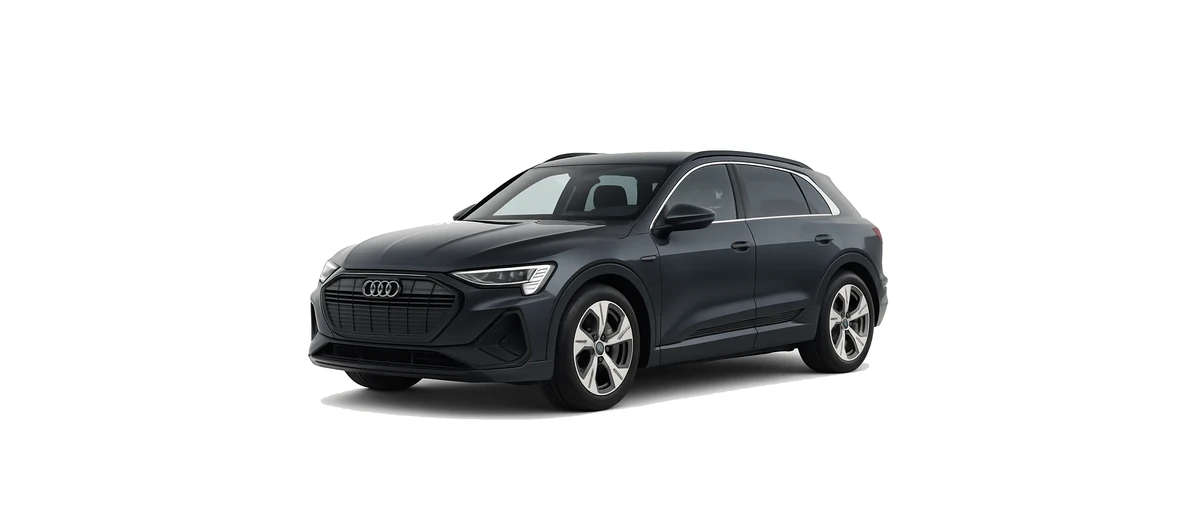
The Audi Q8 e-tron is a large, fully electric luxury SUV with quattro all-wheel drive and a choice of battery and performance variants. It replaced the earlier Audi e-tron name for the 2023 model year, so it is important not to mix the facelifted Q8 e-tron figures with older pre-facelift e-tron specifications. In the UK, the Q8 e-tron SUV was offered in versions including 50 quattro, 55 quattro and SQ8 e-tron, with the Sportback body style sold separately.
For buyers and owners, the main point is to identify the exact car before setting charging expectations. The 50 has a smaller battery and a slightly lower peak DC rapid-charging rate than the 55 and SQ8. Some cars may also have optional 22 kW AC charging or an additional AC charging port, but this should not be assumed. The Q8 e-tron is now best treated as a discontinued used or remaining-stock model rather than a new factory-order vehicle in the UK.
View Audi Q8 e-tron Charging Cables
Audi Q8 e-tron Battery and Charging Specifications
The UK Audi Q8 e-tron uses a Type 2 connector for AC charging and a CCS Combo 2 connector for DC rapid charging. That means it is compatible with typical UK home wallboxes, workplace AC chargers and the majority of motorway rapid and ultra-rapid charging infrastructure.
Standard AC charging is listed by Audi UK at up to 11 kW. This is useful where three-phase AC charging is available, but most UK homes are single-phase and are normally limited to a 7.4 kW wallbox. DC rapid charging depends on variant: the Q8 e-tron 50 is rated at up to around 150 kW, while the 55 and SQ8 are rated at up to around 170 kW under suitable conditions.
Battery Options
There are two main battery sizes for the facelifted Q8 e-tron SUV in the UK. The Q8 e-tron 50 quattro uses a 95 kWh gross battery with 89 kWh usable capacity. Audi UK range figures for this version vary by specification, with WLTP figures typically listed in the 261 to 281 mile band.
The Q8 e-tron 55 quattro uses the larger 114 kWh gross battery with 106 kWh usable capacity. Audi UK lists WLTP range figures of up to around 306 to 330 miles, again depending on specification, wheel size and trim. The SQ8 e-tron also uses the larger 114 kWh gross / 106 kWh usable battery, but its performance hardware and setup mean range is lower than the regular 55 quattro. UK review data commonly places the SQ8 at roughly the high-260s to mid-270s miles on WLTP, depending on version.
If you are buying used, checking whether the car is a 50, 55 or SQ8 is more useful than relying on the Q8 e-tron name alone. Battery capacity, official range and rapid-charging performance are not identical across the line-up.
AC Charging Speed
For everyday charging, the Audi Q8 e-tron charges via a Type 2 AC connection. Audi UK states 11 kW as the standard maximum AC charging capacity. On an 11 kW three-phase AC charger, Audi figures suggest a full 0 to 100% charge takes about 9 hours 15 minutes for the Q8 e-tron 50 and about 11 hours 30 minutes for the 55 and SQ8.
However, many UK homes do not have three-phase electricity. On a typical 7.4 kW single-phase home wallbox, a full charge from empty will take longer. EV Database estimates around 14 hours 15 minutes for the Q8 e-tron 50 and around 17 hours for the 55 or SQ8. In real ownership, most drivers do not charge from 0 to 100% every day, so overnight top-ups are usually more relevant than the full empty-to-full figure.
Some Q8 e-tron examples may have an optional 22 kW AC onboard charger, and some may have a second AC charging port. These features were not universal. A 22 kW AC setup also requires a compatible three-phase supply and charger, so it will not make a typical 7.4 kW single-phase home wallbox faster.
DC Rapid Charging Speed
For longer journeys, the Audi Q8 e-tron uses CCS rapid charging. The Q8 e-tron 50 can charge at up to around 150 kW, while the 55 and SQ8 can charge at up to around 170 kW when connected to a suitably powerful DC charger and when battery temperature and state of charge are favourable.
Audi UK quotes 10 to 80% rapid-charging times of about 28 minutes for the 50 and about 31 minutes for the 55 and SQ8 in suitable conditions. These figures are more useful for motorway planning than 0 to 100% times, because rapid charging usually slows significantly as the battery gets closer to full.
To make use of the car’s strongest rapid-charging performance, look for CCS ultra-rapid chargers capable of at least 150 kW for the 50 and at least 170 kW for the 55 or SQ8. A higher-rated charger will not force the car to take more than it can accept, but it can help the car reach its own peak where conditions allow.
Range and Efficiency
Official WLTP range varies considerably across the Q8 e-tron range. The 50 quattro is typically listed at 261 to 281 miles, while the 55 quattro is listed at 306 to 330 miles. The SQ8 e-tron has the larger battery but lower efficiency and shorter range than the 55 due to its performance-focused specification.
Real-world range will depend on speed, temperature, terrain, tyres, wheel size, load and driving style. As a large SUV, the Q8 e-tron can be more sensitive to motorway speed and winter conditions than a smaller, lighter EV. The standard heat pump can help efficiency in cold weather, but it cannot remove the normal winter range reduction entirely.
For daily use, many owners will charge to a comfortable limit and leave a reserve rather than trying to use the full WLTP range. For longer trips, planning around reliable rapid chargers and charging between roughly 10 and 80% is usually more efficient than stopping less often and charging to 100%.
Charging at Home
A dedicated home wallbox is the most practical charging option for most Q8 e-tron owners. A 7.4 kW Type 2 wallbox suits the majority of UK single-phase homes and is a good match for overnight charging, even though the car can accept up to 11 kW AC as standard when the electricity supply supports it.
You can choose either a tethered wallbox with a fixed Type 2 cable or an untethered wallbox that uses a separate Type 2 charging cable. A tethered unit is convenient because the cable is always attached. An untethered unit can look tidier and allows you to replace or change cable length more easily.
A 3-pin charger is generally best suited as a backup or occasional charging solution, but can be used regularly if a qualified electrician has confirmed the socket and electrical installation are suitable for sustained EV charging. Given the Q8 e-tron’s large battery, a 3-pin lead will be very slow compared with a proper wallbox and is not the preferred everyday solution for most owners.
Public Charging
At public AC chargers, the Q8 e-tron will normally use a Type 2 cable. Many public destination chargers are 7 kW, 11 kW or 22 kW. The car’s onboard charger and the site’s power supply determine the actual charging rate, so a standard 11 kW Q8 e-tron will not charge at 22 kW unless it has the optional 22 kW AC charger fitted.
At rapid and ultra-rapid locations, the cable is usually tethered to the charger and connects to the car’s CCS port. This is the best option for long-distance travel, especially for the 55 and SQ8 where the car can take up to around 170 kW in ideal conditions.
The charging port is generally listed as being at the front right side for the main charging connection, and some cars may have an optional second AC port at the front left. If you are purchasing a used Q8 e-tron, check the vehicle itself rather than assuming the second port is present.
Vehicle-Specific Features
The Audi Q8 e-tron is a battery-electric vehicle, not a plug-in hybrid. It does not use petrol or diesel power and should be charged as a full EV. It is based on the Volkswagen Group MLB Evo architecture, adapted from a combustion-platform family rather than a dedicated EV-only platform.
According to EV Database information, the Q8 e-tron has a heat pump and supports battery preconditioning. It also supports Plug & Charge / ISO 15118-2 functionality where the charging network and account setup are compatible. Battery preconditioning can help charging consistency, although available data suggests it should not be described as automatic navigation-triggered preconditioning in the same way as some newer EV platforms.
Vehicle-to-load, vehicle-to-grid and vehicle-to-home capability should not be assumed for this model. Available data lists V2L, V2G and V2H as not supported.
Charging Tips
- Confirm the exact variant: 50, 55 and SQ8 models differ in battery size, range and peak DC charging speed.
- Do not assume 22 kW AC: standard AC charging is 11 kW, while 22 kW AC was optional on some cars and needs three-phase charging infrastructure.
- Use the right public charger: choose CCS chargers capable of at least 150 kW for the 50 and at least 170 kW for the 55 or SQ8 when you want the fastest stop.
- Plan around 10 to 80%: this is usually the most time-efficient rapid-charging window on long journeys.
- Carry a suitable Type 2 cable: an untethered public AC charger will require your own cable.
- Check used-car options: look for evidence of the optional 22 kW AC charger or second AC port rather than relying on assumptions.
Frequently Asked Questions
What charging cable does the Audi Q8 e-tron use?
For AC charging, the Audi Q8 e-tron uses a Type 2 connection. For DC rapid charging, it uses CCS Combo 2. Public rapid chargers normally have their own tethered CCS cable, while many public AC chargers require you to bring a Type 2 cable.
Can the Audi Q8 e-tron charge at 22 kW AC?
Some cars may have been specified with optional 22 kW AC charging, but it is not standard across all UK Q8 e-tron vehicles. Standard Audi UK data lists 11 kW AC charging. Even with the option fitted, you need compatible three-phase AC infrastructure to see 22 kW charging.
How long does the Audi Q8 e-tron take to charge at home?
On a typical 7.4 kW UK home wallbox, estimates are around 14 hours 15 minutes for the Q8 e-tron 50 and around 17 hours for the 55 or SQ8 from empty to full. Everyday top-ups are usually much shorter because most drivers do not arrive home with an empty battery.
How fast can the Audi Q8 e-tron rapid charge?
The Q8 e-tron 50 can rapid charge at up to around 150 kW, while the 55 and SQ8 can charge at up to around 170 kW. Audi quotes 10 to 80% times of about 28 minutes for the 50 and about 31 minutes for the 55 and SQ8 in suitable conditions.
Is the Audi Q8 e-tron still available new in the UK?
The Q8 e-tron should now be treated as a discontinued model in the UK, with availability mainly depending on used cars or any remaining stock. Production of the Q8 e-tron ended in 2025, and UK availability data places the main Q8 SUV e-tron period from late 2022 to late 2024.
What This Means for Drivers
The Audi Q8 e-tron is straightforward to charge, but the best advice depends on the exact version. For most UK drivers, a 7.4 kW home wallbox and a good Type 2 cable will cover everyday charging, while CCS ultra-rapid charging is the right choice for longer journeys. The larger-battery 55 and SQ8 have more capacity and a higher peak DC charging rate than the 50, but they also take longer to fill on AC because the battery is bigger.
If you are buying used, check the badge, usable battery size, onboard AC charger specification and whether the car has a second AC port. Those details make a real difference to charging expectations, especially if you have access to three-phase charging at home or work.
Looking for a Charging Cable for Audi Q8 e-tron?
We offer charging cables suitable for the Audi Q8 e-tron, including Type 2 options for home, workplace and public AC charging.
View Audi Q8 e-tron Charging Cables
Please note that this information is intended as a guide. Charging specifications may change due to model and year of manufacture. For precise information, always refer to your vehicle user manual.

