
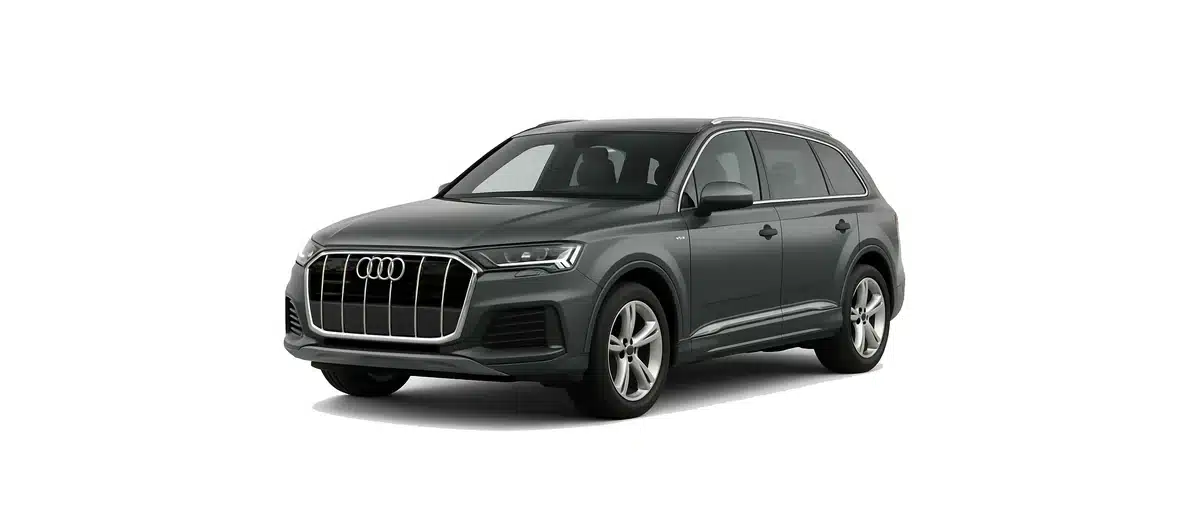
The Audi Q7 TFSIe is a large plug-in hybrid SUV, combining a petrol V6 engine with an electric motor and an externally rechargeable battery. That means it is not a pure electric vehicle, but it can still cover many local journeys on electric power when charged regularly. For UK drivers, the key charging point is straightforward: the Q7 TFSIe uses Type 2 AC charging and is limited by its onboard charger to a maximum of 7.4 kW.
Where the Q7 TFSIe needs a little more care is model-year identification. Earlier pre-facelift cars used a smaller battery, while current facelift technical data lists a larger 25.9 kWh gross battery with 22.0 kWh net capacity. This affects electric range and charging time, but it does not make cable selection complicated. A suitable Type 2 cable remains the practical choice for home wallboxes and untethered public AC charging points.
View Audi Q7 TFSIe Charging Cables
Audi Q7 TFSIe Battery and Charging Specifications
The current Audi Q7 TFSI e quattro is a plug-in hybrid large SUV with a five-seat layout in TFSI e form. It uses a 3.0-litre V6 TFSI petrol engine, an electric motor integrated with the automatic transmission and quattro all-wheel drive. The external charging system is AC-based, using a Type 2 connection in the UK and Europe.
For the current facelift model, Audi technical data lists a maximum AC charging capacity of 7.4 kW and a 0-100% AC charging time of 225 minutes, which is 3 hours 45 minutes. Audi UK also quotes 7.4 kW AC charging and a 3 hour 45 minute charging time. Public 11 kW or 22 kW AC posts can still be used if they have the right socket or tethered connector, but the car will not charge faster than its onboard charger allows.
| Charging item | Audi Q7 TFSIe guidance |
|---|---|
| Vehicle type | Plug-in hybrid petrol/electric SUV |
| Charging connector | Type 2 AC |
| Maximum AC charging rate | 7.4 kW |
| Current facelift battery | 25.9 kWh gross / 22.0 kWh net in Audi technical data |
| Current full AC charge time | About 3 hours 45 minutes at the maximum supported rate |
| DC rapid charging | No confirmed CCS/DC rapid-charging capability for the Q7 TFSIe PHEV |
Battery Options
The most important specification difference for Q7 TFSIe owners is whether the car is an earlier pre-facelift model or the newer facelift version. Older Q7 TFSI e models from around 2020 used a smaller battery, commonly listed at 17.9 kWh gross with around 14.4 kWh usable capacity. These cars generally have a shorter electric range and may take less time to charge because the battery is smaller.
For the current facelift Q7 SUV TFSI e quattro, Audi MediaCenter technical data lists a 25.9 kWh gross battery with 22.0 kWh net capacity. This is a substantial increase compared with the earlier version and is the figure that best aligns with the newer quoted electric range and the 3 hour 45 minute 0-100% AC charging time.
There is one point worth noting for UK buyers: Audi UK’s live Q7 TFSI e page has displayed a 14.4 kWh usable figure alongside newer-style range and charging information. Because that usable figure conflicts with Audi’s current technical data for the facelift model, it is sensible to check the exact model year, VIN, build information or order documentation if battery capacity matters to you.
AC Charging Speed
The Audi Q7 TFSIe’s confirmed charging strength is AC charging at up to 7.4 kW. In practical UK terms, this means a standard 7 kW home wallbox is very well matched to the vehicle. If the car is plugged in at a suitable home charger, the current 25.9 kWh gross / 22.0 kWh net version should take about 3 hours 45 minutes for a full 0-100% charge in ideal conditions.
A 32A single-phase Type 2 charging cable is the usual match for getting the best from the Q7 TFSIe’s AC charging capability. A 22 kW Type 2 cable can also be used on many AC posts and wallboxes, but it will not make the car charge at 22 kW. The vehicle’s onboard charger is the limiting factor, so the practical maximum remains 7.4 kW.
For earlier 17.9 kWh Q7 TFSI e models, charge times can be shorter because the battery is smaller. However, owners should still work from the same basic cable principle: Type 2 AC charging, with a 32A cable suitable for the vehicle’s 7.4 kW limit.
DC Rapid Charging Speed
The Q7 TFSIe should not be planned around motorway-style DC rapid charging. Reliable information for the UK and European Q7 TFSI e confirms AC charging at up to 7.4 kW, but does not confirm CCS/DC rapid-charging capability for this plug-in hybrid. As a result, there is no dependable DC charging speed or 10-80% rapid-charging time to quote.
This is normal for many plug-in hybrids. The Q7 TFSIe has a petrol engine for long journeys and a rechargeable battery intended mainly for local electric driving, commuting and low-emission urban use. On longer trips, public AC charging may still be useful at destinations, hotels, workplaces and car parks, but quick motorway top-ups should not be treated as part of the charging plan unless your specific vehicle documentation proves otherwise.
Range and Efficiency
Audi UK states up to 50 miles of electric range for the current Q7 TFSIe, while Audi technical data for the facelift model gives a combined electric range of roughly 48-51 miles depending on variant and specification. In real driving, range will vary with temperature, journey speed, load, tyre choice, driving style and how often the petrol engine is required.
FleetNews reported around 40 miles in a real-world test of the Q7 55 TFSI e, which is a useful expectation for mixed UK driving. Shorter winter trips, motorway speeds and heavy use of cabin heating can reduce electric range, while gentler urban and suburban driving may help the car stay closer to its official figure.
For owners, the best way to use the Q7 TFSIe efficiently is to charge little and often. Because the current battery can be refilled in under four hours at the maximum supported AC rate, overnight charging or a top-up during the working day can make a meaningful difference to how much petrol the car uses.
Charging at Home
Home charging is likely to be the most convenient and cost-effective way to run the Q7 TFSIe as a plug-in hybrid. A dedicated 7 kW home wallbox suits the car well because it closely matches the vehicle’s 7.4 kW AC charging limit. With the current larger-battery version, a full charge from empty should take about 3 hours 45 minutes when the charger, cable and installation can provide the supported rate.
If your wallbox is untethered, you will need a Type 2 to Type 2 charging cable. A 32A single-phase cable is appropriate for making use of the car’s maximum AC capability. If you already have a three-phase 22 kW-rated Type 2 cable, it can be used where compatible, but the Q7 TFSIe will still charge only up to its onboard AC limit.
A 3-pin domestic charger is generally best suited as a backup or occasional charging solution, but can be used regularly if a qualified electrician has confirmed the socket and electrical installation are suitable for sustained EV charging. A domestic plug will be much slower than a dedicated wallbox, so it is less convenient if you frequently want to refill the current larger battery from a low state of charge.
Public Charging
For public charging, focus on AC charge points rather than rapid chargers. Untethered public AC posts are common in the UK at car parks, workplaces, supermarkets, hotels and town-centre locations. These normally require you to bring your own Type 2 cable, making cable choice important even for a plug-in hybrid.
If you connect to an 11 kW or 22 kW public AC post, the Q7 TFSIe will negotiate the charging session and draw only what it can accept. The post may be capable of more, but the car is still limited to 7.4 kW. This means there is no need to seek out the highest-power AC post specifically for speed; availability, parking time, tariff and convenience are usually more important.
Destination charging is where the Q7 TFSIe makes most sense away from home. If you can plug in while shopping, working, dining or staying overnight, the car can recover useful electric range without changing your journey plans. On long motorway journeys, the petrol engine remains the practical long-distance energy source.
Vehicle-Specific Features
The Q7 TFSIe’s most relevant vehicle-specific feature for charging is that it is a plug-in hybrid rather than a battery-electric SUV. It has enough electric range for many daily trips when charged, but it also carries a petrol engine for longer journeys. This changes how owners should think about charging: regular AC top-ups are valuable, but rapid-charging stops are not the central use case.
Another important point is seating and packaging. Q7 TFSI e models are five-seat plug-in hybrids, not the seven-seat layout associated with some petrol and diesel Q7 versions. The hybrid battery and drivetrain are part of the reason the TFSI e is configured differently.
Finally, the facelifted car’s larger battery means current owners can get significantly more electric use from regular charging than owners of early models. Used buyers should be especially careful not to compare figures from different model years without checking which battery is fitted.
Charging Tips
- Choose the right connector: use a Type 2 charging cable for UK and European AC charging.
- Match the onboard charger: a 32A single-phase Type 2 cable is suitable for the Q7 TFSIe’s 7.4 kW AC charging limit.
- Do not expect 22 kW charging: a 22 kW AC post or cable will not override the car’s onboard charger limit.
- Check the model year: early cars and current facelift cars have materially different battery capacities and electric range figures.
- Charge regularly: the more often the battery is topped up, the more useful the plug-in hybrid system becomes in daily driving.
- Use public AC charging strategically: destination charging is generally more useful than trying to charge briefly during a long trip.
- Keep the cable accessible: because many public AC posts are untethered, storing a Type 2 cable in the car makes opportunistic charging easier.
Frequently Asked Questions
Is the Audi Q7 TFSIe fully electric?
No. The Audi Q7 TFSIe is a plug-in hybrid. It has an externally rechargeable battery and can drive on electric power, but it also has a petrol V6 engine.
What charging cable does the Audi Q7 TFSIe use?
For UK and European AC charging, the Q7 TFSIe uses a Type 2 connection. A Type 2 to Type 2 cable is the usual choice for untethered home wallboxes and public AC posts.
How fast can the Audi Q7 TFSIe charge?
The confirmed maximum AC charging rate is 7.4 kW. For the current facelift version, Audi lists a 0-100% AC charging time of about 3 hours 45 minutes.
Can the Audi Q7 TFSIe use a 22 kW public charger?
It can use compatible AC posts, but it will not charge at 22 kW. The car’s onboard charger limits AC charging to 7.4 kW.
Does the Audi Q7 TFSIe have DC rapid charging?
No confirmed CCS/DC rapid-charging capability is available from the research data for the Q7 TFSIe PHEV. Owners should treat it as an AC-charging plug-in hybrid unless their specific vehicle documentation says otherwise.
How far can the Audi Q7 TFSIe drive on electric power?
The current model is quoted at up to around 50 miles under official figures, while a real-world UK test reported around 40 miles. Your result will depend on conditions, speed, temperature, route and driving style.
What This Means for Drivers
For most Q7 TFSIe owners, charging is simpler than the specification history might suggest. The battery size and electric range vary between early and current cars, but the practical charging setup remains Type 2 AC at up to 7.4 kW. A dedicated 7 kW home wallbox and a suitable 32A Type 2 cable are therefore a sensible combination.
The current facelift Q7 TFSIe is more useful as an electric-running plug-in hybrid than earlier versions because of its larger battery and higher official electric range. However, it still needs to be charged regularly to deliver the best fuel-saving benefit. If it is treated like a petrol SUV and rarely plugged in, much of the advantage of the TFSI e system is lost.
Used buyers should confirm which version they are considering before comparing range or charge-time figures. Early 17.9 kWh cars and current 25.9 kWh gross / 22.0 kWh net cars are not directly interchangeable in specification terms, even though their cable requirements are broadly the same.
Looking for a Charging Cable for Audi Q7 TFSIe?
We offer charging cables suitable for the Audi Q7 TFSIe, including Type 2 options for home wallboxes and untethered public AC charging points.
View Audi Q7 TFSIe Charging Cables
Please note that this information is intended as a guide. Charging specifications may change due to model and year of manufacture. For precise information, always refer to your vehicle user manual.

