
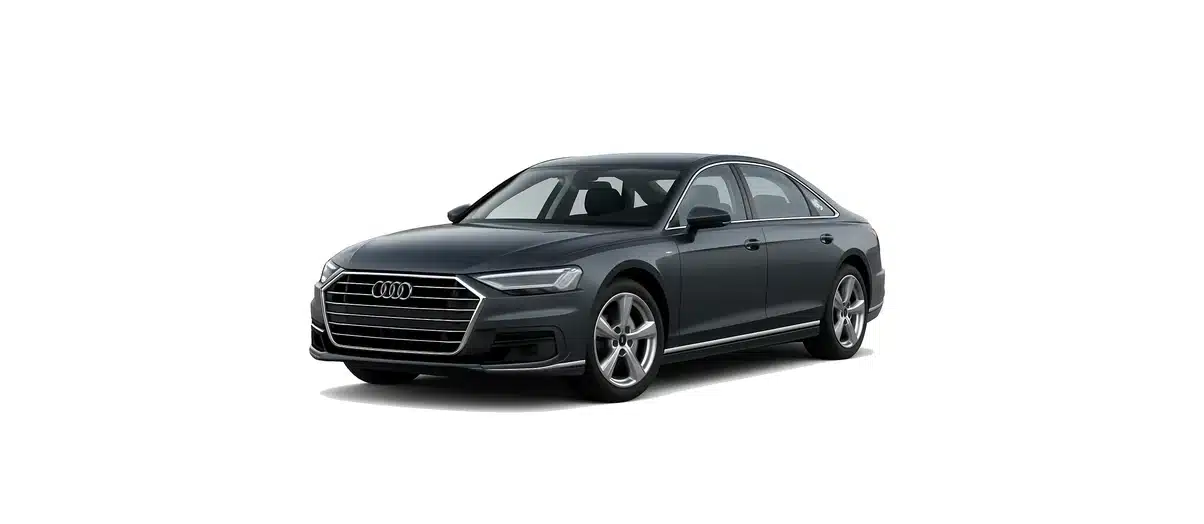
The Audi A8 TFSIe is a luxury plug-in hybrid saloon, offered in both A8 and long-wheelbase A8 L forms on current UK Audi pages. It combines a 3.0-litre TFSI V6 petrol engine with an electric motor, giving drivers the ability to complete many shorter journeys on electric power while retaining petrol flexibility for longer trips.
Because the A8 TFSI e is a plug-in hybrid rather than a full battery-electric vehicle, its charging needs are different from those of a BEV. It has a relatively modest battery compared with a fully electric car, uses Type 2 AC charging, and does not support DC rapid charging. For most UK owners, the best charging routine is simple: top up regularly at home, at work, or on suitable public AC charge points so that the electric side of the powertrain is available as often as possible.
View Audi A8 TFSIe Charging Cables
Audi A8 TFSIe Battery and Charging Specifications
Current UK Audi information lists the A8 and A8 L Sport 60 TFSI e quattro tiptronic with a 14.4 kWh usable battery capacity. Audi MediaCenter technical information also gives a gross battery capacity of 17.9 kWh and a net capacity of 14.4 kWh. Audi UK quotes a maximum AC charging capacity of 7.4 kW and an approximate 0-100% charging time of 2 hours 30 minutes from a 7 kW home wallbox.
| Vehicle type | Plug-in hybrid electric vehicle (PHEV) |
|---|---|
| Current UK battery capacity | 17.9 kWh gross / 14.4 kWh usable |
| Connector | Type 2 AC only |
| Maximum AC charging rate | 7.4 kW |
| Typical 7 kW wallbox charge time | Approximately 2 hours 30 minutes, 0-100% |
| DC rapid charging | Not supported |
| Current UK WLTP electric range | Up to 36 miles, with Audi UK listing 33-36 miles depending on trim and equipment |
Battery Options
For current UK A8 and A8 L 60 TFSI e quattro tiptronic models, Audi lists a usable battery capacity of 14.4 kWh. Audi MediaCenter adds the corresponding gross figure of 17.9 kWh. This is the most relevant specification for current UK model pages.
However, used-car buyers should be aware that earlier launch-era A8 L 60 TFSI e information referred to a smaller 14.1 kWh high-voltage battery and an electric range of up to 28.6 miles WLTP. For that reason, it is best not to assume that every A8 TFSI e has the same battery capacity or range figure. If you are buying a replacement charging cable for an older car, check the vehicle handbook, charge flap labelling, or the original specification where available.
The practical charging advice remains broadly similar across A8 TFSI e versions: this is an AC-charging plug-in hybrid designed for regular top-ups rather than high-power rapid charging.
AC Charging Speed
The Audi A8 TFSIe is rated for up to 7.4 kW AC charging. In UK terms, that makes a single-phase 32A Type 2 charging cable the most practical match for the car’s onboard charger. When connected to a suitable 7 kW home wallbox, Audi quotes an approximate 0-100% charging time of 2 hours 30 minutes.
Some public AC charge points are advertised as 11 kW or 22 kW, but the A8 TFSI e will not charge above its own 7.4 kW AC limit. A higher-rated post cannot force the car to charge faster than the onboard charger allows. Likewise, a 22 kW Type 2 cable may be physically usable at many Type 2 posts, but it will not make the car charge at 22 kW.
For everyday use, this means you do not need to plan your life around long charging stops. A full charge from empty is short enough to fit easily into an evening at home, a morning at the office, or a visit to a destination with AC charging.
DC Rapid Charging Speed
DC rapid charging does not apply to the Audi A8 TFSIe. Audi UK’s charging information distinguishes plug-in hybrid cars from fully electric models, stating that plug-in hybrid cars have only an AC port while DC/CCS charging is for fully electric Audi models.
That means you should not plan motorway rapid-charging stops in the way a battery-electric vehicle driver might. There is no relevant 10-80% DC rapid-charging time for the A8 TFSI e, and a CCS rapid charger is not the correct charging option for this model.
This is not necessarily a disadvantage for the way the car is intended to be used. As a plug-in hybrid, it can use electric power for shorter journeys and petrol for longer-distance flexibility. The key is to make AC charging convenient enough that the battery is regularly replenished.
Range and Efficiency
Current Audi UK figures list a WLTP electric range of up to 36 miles for the A8 TFSI e, with 33-36 miles shown depending on trim and optional equipment. As with any plug-in hybrid, the real distance you achieve on electric power will depend on speed, temperature, route profile, cabin heating or cooling demand, driving style, and how much of the car’s performance you use.
The A8 TFSI e is a large luxury saloon, so its electric range should be viewed in context. It is well suited to shorter commutes, local journeys, low-emission urban driving, school runs, station trips and regular business mileage where charging is available between journeys. It is not intended to behave like a long-range BEV with hundreds of miles of electric-only range.
To get the best from the plug-in hybrid system, charge little and often. If the car is charged overnight and topped up when convenient during the day, many routine journeys can begin with useful electric range available.
Charging at Home
A 7 kW home wallbox is the most convenient charging solution for most Audi A8 TFSIe owners. It is well matched to the car’s 7.4 kW AC capability and should allow a full charge in the time Audi quotes: around 2 hours 30 minutes from 0-100% under suitable conditions.
If your wallbox is untethered, you will need a Type 2 charging cable. A single-phase 32A Type 2 cable is the natural fit because it supports the car’s maximum AC charging rate. If your wallbox is tethered and already has a Type 2 connector attached, you may still want a separate cable for untethered public AC charge points.
A domestic 3-pin charger is generally best suited as a backup or occasional charging solution, but can be used regularly if a qualified electrician has confirmed the socket and electrical installation are suitable for sustained EV charging. Plug-in hybrid batteries are smaller than BEV batteries, so a 3-pin charge can still be useful in some circumstances, but a properly installed wallbox is usually faster, safer and more convenient for routine use.
Because the A8 TFSI e has petrol backup, some owners may be tempted not to charge often. However, the more consistently you charge, the more often you can use the electric side of the powertrain and the more benefit you are likely to see from owning a plug-in hybrid.
Public Charging
For public charging, focus on AC charge points with Type 2 sockets. These are commonly found in car parks, hotels, workplaces, shopping centres, gyms and town-centre charging locations. The A8 TFSI e is best suited to these destination-style chargers rather than rapid charging hubs.
When using an untethered public AC post, connect with a Type 2 cable. If the post is rated above 7.4 kW, the car will still draw only what it can accept. A 7 kW public charger is already a good match for the A8 TFSI e’s charging capability.
Public charging is most useful when it fits naturally into your schedule. For example, charging during a meeting, hotel stay, lunch stop or shopping visit can add meaningful electric range without requiring a dedicated wait. For a PHEV with this battery size, frequent short AC top-ups are generally more useful than occasional attempts to charge on long journeys.
Vehicle-Specific Features
The Audi A8 TFSIe uses Audi’s 60 TFSI e quattro tiptronic plug-in hybrid powertrain. Current Audi UK and Audi MediaCenter data lists a system output of 462 PS and 700 Nm of system torque, combining electric assistance with the petrol engine and quattro all-wheel drive.
Audi also states that the current A8 and A8 L TFSI e models are supplied with three charging cables: one for 7.4 kW public charging, one for an industrial socket and one for a household domestic socket. If you are buying a used vehicle, it is worth checking which cables are still present with the car, as accessories can be lost or replaced during ownership.
The Audi virtual cockpit can display useful plug-in hybrid information such as battery status, remaining electric range and charging information. These displays help you judge when to charge and how much electric range is available before your next journey.
Charging Tips
- Choose the right cable: A single-phase 32A Type 2 cable is the practical match for the A8 TFSI e’s 7.4 kW onboard AC charger.
- Do not rely on rapid chargers: The A8 TFSI e does not support DC/CCS rapid charging, so plan around AC charging instead.
- Top up regularly: Short, frequent charges help keep electric range available for local journeys.
- Use a 7 kW wallbox where possible: It suits the car’s charging capability and makes everyday charging straightforward.
- Check older vehicles carefully: Earlier A8 L TFSI e material used different battery and range figures, so confirm the specification of the exact car if needed.
- Keep a public cable in the boot: Many UK AC posts are untethered, especially at destinations and workplace sites.
Frequently Asked Questions
Is the Audi A8 TFSIe a full electric car?
No. The Audi A8 TFSIe is a plug-in hybrid electric vehicle. It has a rechargeable battery and electric motor, but it also has a petrol engine for longer journeys and when electric range is depleted.
What charging cable does the Audi A8 TFSIe use?
It uses a Type 2 AC connection. For most UK owners, a single-phase 32A Type 2 cable is the best match for the car’s 7.4 kW AC charging capability.
Can the Audi A8 TFSIe use a 22 kW public charger?
It can connect to many Type 2 AC posts, including posts rated above 7.4 kW, but it will not charge faster than the car’s onboard AC limit. A 22 kW post or cable will not make the A8 TFSI e charge at 22 kW.
Does the Audi A8 TFSIe support DC rapid charging?
No. Audi UK states that plug-in hybrid cars have only an AC port, while DC/CCS charging is for fully electric Audi models. There is therefore no DC rapid-charging time to quote for the A8 TFSI e.
How long does the Audi A8 TFSIe take to charge at home?
Audi UK quotes approximately 2 hours 30 minutes for a 0-100% charge from a 7 kW home wallbox on current A8 and A8 L TFSI e models.
What electric range does the Audi A8 TFSIe offer?
Current Audi UK information lists up to 36 miles WLTP, with 33-36 miles depending on trim and optional equipment. Earlier launch-era information for the A8 L TFSI e used a lower range figure, so used-car buyers should check the exact model year and specification.
What This Means for Drivers
The Audi A8 TFSIe makes most sense when it is treated as a luxury plug-in hybrid that benefits from regular AC charging. Its 7.4 kW onboard charger and current 14.4 kWh usable battery are well suited to a 7 kW home wallbox, workplace charging and destination AC charging. It is not a car that needs DC rapid-charging planning, and it should not be approached like a full BEV.
For cable selection, the key point is straightforward: use a Type 2 AC charging cable, with a single-phase 32A cable being the practical match for the car’s maximum AC charging rate. Keep the battery topped up whenever convenient, and the A8 TFSI e can deliver the quiet, smooth electric driving that suits a luxury saloon while still offering petrol flexibility when you need it.
Looking for a Charging Cable for Audi A8 TFSIe?
If you need a replacement or spare cable, We offer Audi A8 TFSIe charging cables suitable for Type 2 AC charging, including options for home wallboxes and untethered public charge points.
View Audi A8 TFSIe Charging Cables
Please note that this information is intended as a guide. Charging specifications may change due to model and year of manufacture. For precise information, always refer to your vehicle user manual.

