
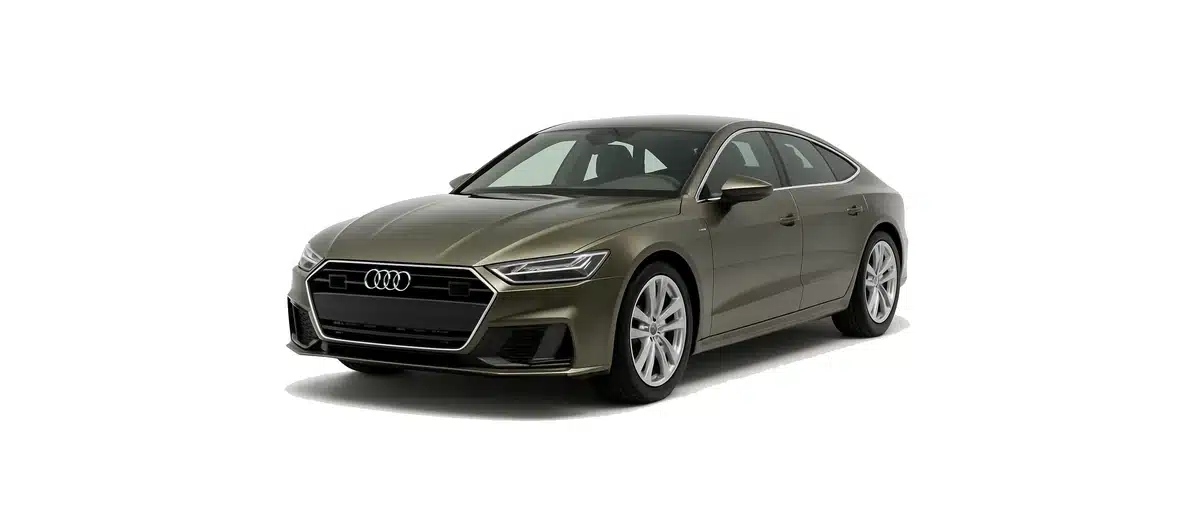
The Audi A7 TFSIe is a plug-in hybrid version of the A7 Sportback, combining a 2.0-litre TFSI petrol engine with an electric motor, quattro all-wheel drive and an S tronic automatic gearbox. It is important to treat it as a PHEV rather than a fully electric car: it can be charged from a plug for local electric driving, but longer journeys are supported by the petrol engine once the battery has been depleted.
For many owners, the key to getting the best from the A7 TFSIe is simple: charge it often on AC power. This is not a car that benefits from motorway rapid-charging stops or high-power DC charging plans. Instead, it is designed around Type 2 AC charging at home, at work or at public destination chargers. A good 7 kW home wallbox and the correct Type 2 cable will usually be the most useful charging setup.
UK buyers should also be careful when comparing used examples. Earlier launch-era A7 Sportback 55 TFSI e models were described with a 14.1 kWh battery, while later C8 technical data for the 50 TFSI e quattro and 55 TFSI e quattro lists a 17.9 kWh gross battery with 14.4 kWh net capacity. That difference affects electric-range expectations and makes it worth checking the exact model year and specification.
View Audi A7 TFSIe Charging Cables
Audi A7 TFSIe Battery and Charging Specifications
The Audi A7 TFSIe uses a Type 2 AC charging connection in the UK and Europe. The confirmed maximum AC charging capacity for later cars is 7.4 kW, with Audi technical data giving a 0-100% AC charging time of around 150 minutes, or about 2 hours 30 minutes, for the later 17.9 kWh-gross battery versions.
| Vehicle type | Plug-in hybrid petrol/electric Sportback |
|---|---|
| Charging port | Type 2 AC only |
| Maximum AC charging | 7.4 kW |
| Typical 0-100% AC charge time | About 2 hours 30 minutes on later 17.9 kWh-gross models |
| DC rapid charging | Not supported / not applicable |
| Official UK electric range | Approximately 38-41 miles, depending on trim and equipment |
A 32 amp Type 2 to Type 2 Mode 3 cable is the appropriate choice for untethered home wallboxes and public AC charge points. A higher-rated three-phase cable may still work where compatible, but it will not make the A7 TFSIe charge beyond its onboard 7.4 kW AC limit.
Battery Options
Battery information for the A7 TFSIe needs a little care because not every used car has the same pack. Later C8 Audi A7 Sportback 50 TFSI e quattro and 55 TFSI e quattro technical data lists a 17.9 kWh gross battery and 14.4 kWh net capacity. These later cars are the ones associated with the quoted 7.4 kW AC charging rate and around 150-minute 0-100% AC charging time.
Earlier launch-era A7 Sportback 55 TFSI e models, around 2019 to 2021, were described by Audi with a 14.1 kWh lithium-ion battery and a WLTP electric range of over 40 km. If you are buying used, do not assume that every A7 TFSIe has the later 17.9 kWh-gross battery. Check the registration year, build date, Audi documentation and vehicle specification before comparing range or charging expectations.
There is also some inconsistency in public wording around battery capacity. Audi UK has referred to 17.9 kWh as usable capacity on its retired UK model page, while Audi MediaCenter technical data lists 17.9 kWh gross and 14.4 kWh net. For practical ownership guidance, the gross/net distinction is worth noting, especially when estimating charge time and energy used from the wall.
AC Charging Speed
The A7 TFSIe is best understood as a 7.4 kW AC car. On a suitable 7 kW or 7.4 kW home wallbox, later versions should charge from empty to full in roughly 2 hours 30 minutes in good conditions. In real life, charge times can vary slightly due to temperature, battery state, the wallbox, cable rating and the car’s charging management.
Because the onboard charger is limited to 7.4 kW, a three-phase 11 kW or 22 kW public AC post will not make the vehicle charge at 11 kW or 22 kW. The charge point may be capable of more, but the car decides how much AC power it can accept. For the A7 TFSIe, that confirmed maximum is 7.4 kW.
This is why a 32 amp Type 2 charging cable is the sensible recommendation. It matches the car’s AC charging capability on UK single-phase charging and gives you flexibility for untethered home and public AC charging.
DC Rapid Charging Speed
DC rapid charging is not applicable to the Audi A7 TFSIe. The model is a plug-in hybrid and uses AC charging only. There is no confirmed CCS rapid-charging inlet for the UK/EU A7 TFSIe PHEV, and Audi’s own charging guidance distinguishes plug-in hybrid AC charging from DC charging used by fully electric models.
That means there is no 10-80% rapid-charging time to plan around. If you are travelling a long distance, the car operates like a hybrid once the plug-in battery range has been used, relying on the petrol engine and hybrid system rather than a DC rapid-charging stop. For many owners, the most effective routine is to charge at home overnight or between trips, then use the electric range for commuting, school runs and local journeys.
Range and Efficiency
Audi UK quoted an official electric range of around 38-41 miles for the A7 TFSIe, depending on trim and equipment. European late-model technical data gives similar figures, with the 50 TFSI e listed up to around 44 miles and the 55 TFSI e up to around 42 miles, depending on configuration.
As with any plug-in hybrid, real-world electric range can be lower than the official figure. Cold weather, motorway speeds, short winter trips, cabin heating, tyre choice and vehicle load can all affect how far the car travels before the petrol engine is needed. Conversely, gentle urban and suburban driving is where the plug-in hybrid system is most likely to show its benefits.
The A7 TFSIe is therefore well suited to drivers who can recharge regularly and whose daily mileage often sits within the electric range. If your routine includes a 20-mile commute each way and charging at home or work, the car can spend a lot of time running electrically. If you regularly cover long motorway journeys without charging between them, it will behave more like a conventional petrol hybrid for much of the distance.
Charging at Home
Home charging is the most convenient way to run an A7 TFSIe. A dedicated 7 kW or 7.4 kW wallbox is a strong match for the car’s maximum AC charging capability and should allow a full charge in about 2 hours 30 minutes on later battery versions. For many owners, this means the battery can be replenished in the evening, between appointments or overnight.
If your wallbox is untethered, you will need a Type 2 to Type 2 cable. A 32 amp cable is appropriate for the A7 TFSIe because the car can use up to 7.4 kW AC charging. If your wallbox is tethered, it will already have its own attached cable, but you may still want a separate Type 2 cable for public AC charging.
Some owners may also have access to a domestic 3-pin charging lead. A 3-pin charger is generally best suited as a backup or occasional charging solution, but can be used regularly if a qualified electrician has confirmed the socket and electrical installation are suitable for sustained EV charging. A dedicated wallbox is usually faster, more convenient and better suited to routine plug-in hybrid charging.
Public Charging
Public charging for the A7 TFSIe means AC destination charging, not DC rapid charging. Look for Type 2 AC posts at supermarkets, hotels, workplaces, town-centre car parks and leisure destinations. These are useful when the car will be parked for an hour or more, allowing you to add meaningful electric range while you are doing something else.
On an untethered public AC post, you will normally use your own Type 2 to Type 2 cable. Even if the post is rated at 11 kW or 22 kW, the A7 TFSIe will still be limited by its 7.4 kW onboard charger. This is not a fault; it is simply how the vehicle is designed.
Motorway rapid chargers are generally not the right charging plan for this model. Many rapid-charging hubs focus on CCS DC charging for fully electric vehicles, and the A7 TFSIe does not use that charging method. On longer trips, start with a full battery where possible, use EV mode for the most suitable sections of driving, and rely on petrol/hybrid operation once the plug-in charge has been used.
Vehicle-Specific Features
The A7 TFSIe combines the practical shape of the 5-door A7 Sportback with plug-in hybrid hardware. Later 50 TFSI e quattro versions are listed at 220 kW / 299 PS system output, while later 55 TFSI e quattro versions are listed at 270 kW / 367 PS. Both use quattro all-wheel drive and an S tronic automatic transmission.
The plug-in hybrid installation does affect packaging compared with some non-hybrid versions. Audi technical data lists boot capacity at 380 litres for the TFSI e. That is still usable for daily life, but it is worth considering if you regularly carry bulky luggage, pushchairs or business equipment.
Because no confirmed model-year-specific source is provided for features such as vehicle-to-load, vehicle-to-grid, vehicle-to-home, heat pump equipment or battery preconditioning, this guide does not treat those as A7 TFSIe charging features. The important confirmed charging facts are the Type 2 AC inlet, 7.4 kW maximum AC charging rate and lack of DC rapid charging support.
Charging Tips
- Charge little and often: PHEVs are most efficient when the battery is regularly topped up for local electric driving.
- Use a 32 amp Type 2 cable: This matches the A7 TFSIe’s 7.4 kW AC charging capability on suitable UK single-phase charge points.
- Do not overvalue 22 kW charging: A 22 kW post or cable rating does not make the car charge faster than its onboard limit.
- Check the battery version when buying used: Early cars may have the 14.1 kWh battery, while later cars are listed at 17.9 kWh gross / 14.4 kWh net.
- Pre-plan public AC charging: Destination chargers are useful; DC rapid chargers are not applicable to this model.
- Keep a cable in the car: Many public AC posts are untethered, so carrying your own Type 2 cable avoids missed charging opportunities.
Frequently Asked Questions
Is the Audi A7 TFSIe fully electric?
No. The Audi A7 TFSIe is a plug-in hybrid petrol/electric model. It can drive on electric power for shorter trips when charged, but it also has a petrol engine for longer journeys and hybrid operation.
What charging cable does the Audi A7 TFSIe use?
For UK and European AC charging, it uses a Type 2 connection. For untethered home wallboxes and public AC posts, a Type 2 to Type 2 Mode 3 cable is the standard choice.
Can the Audi A7 TFSIe use rapid chargers?
No. The A7 TFSIe should be treated as AC-only for plug-in charging. It does not have a confirmed CCS/DC rapid-charging inlet, so 10-80% rapid-charging times are not applicable.
How long does the Audi A7 TFSIe take to charge at home?
Later 17.9 kWh-gross models are listed at around 150 minutes, or about 2 hours 30 minutes, for a 0-100% AC charge using a suitable 7.4 kW wallbox. Earlier cars with the smaller battery may differ.
Should I buy an 11 kW or 22 kW cable for the Audi A7 TFSIe?
The car’s confirmed maximum AC charging rate is 7.4 kW, so a 32 amp Type 2 cable is sufficient for its charging capability. A higher-rated cable may be compatible in some situations, but it will not increase the vehicle’s onboard charging limit.
What This Means for Drivers
The Audi A7 TFSIe works best when you treat charging as part of your daily routine rather than as an occasional motorway stop. A full battery at the start of the day can cover many local journeys on electric power, while the petrol engine gives flexibility for longer trips. The biggest mistake is expecting it to behave like a full EV at rapid-charging hubs.
For most UK owners, the ideal setup is a 7 kW or 7.4 kW home wallbox and a 32 amp Type 2 cable for untethered AC charging. Used buyers should also check whether the car is an earlier 14.1 kWh version or a later 17.9 kWh-gross version, as that will shape expectations for electric range and charge time.
Looking for a Charging Cable for Audi A7 TFSIe?
If you need a suitable Type 2 charging cable for your Audi A7 TFSIe, We offer compatible options for home wallboxes and public AC charging, with 32 amp Type 2 cables well matched to the car’s 7.4 kW AC charging capability.
View Audi A7 TFSIe Charging Cables
Please note that this information is intended as a guide. Charging specifications may change due to model and year of manufacture. For precise information, always refer to your vehicle user manual.

