
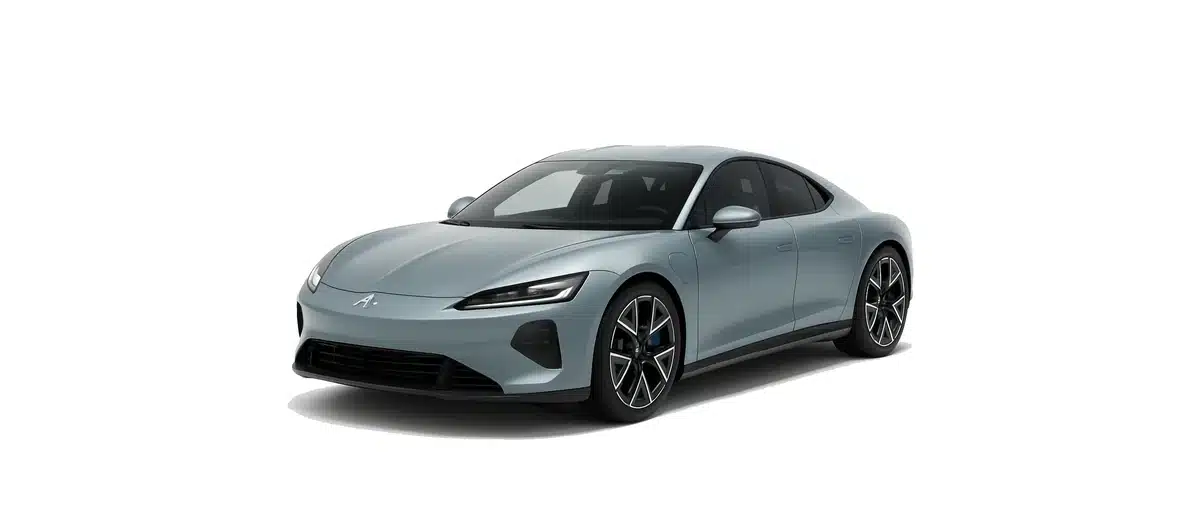
The Alpine A390 is a 100% electric five-seat sport fastback, designed to combine everyday usability with Alpine’s performance focus. For UK drivers, the key charging point is that the A390 is not simply defined by its headline rapid-charging figure. Charging speed depends on the version you choose, the AC charging equipment fitted, the charger you plug into and the battery conditions at the time.
UK information for the A390 lists an 89 kWh net battery, Type 2 AC charging and CCS Combo 2 rapid charging. The GT is listed with up to 150 kW DC charging, while the GTS is listed with up to 190 kW DC charging. AC charging is also worth checking carefully: 11 kW appears to be the standard on-board AC capability in base specifications, while 22 kW AC is listed as standard on the GT Premiere Edition and optional on some other versions in UK material.
Alpine notes that some technical specifications may change before official homologation, particularly around pre-launch and GTS details, so buyers should confirm the latest figures with Alpine UK or their retailer before ordering. This guide explains what UK owners need to know about charging the Alpine A390 at home, at work and on longer motorway journeys.
View Alpine A390 Charging Cables
Alpine A390 Battery and Charging Specifications
| Vehicle | Alpine A390 |
|---|---|
| Powertrain | Battery-electric vehicle (BEV) |
| Body style | 5-door, 5-seat sport fastback / hatchback |
| Battery capacity | 89 kWh net, with EV Database estimating 94 kWh gross |
| AC charging connector | Type 2 |
| DC rapid charging connector | CCS Combo 2 |
| AC charging capability | 11 kW standard in base listings; 22 kW trim-dependent or optional in UK material |
| DC rapid charging capability | Up to 150 kW on GT; up to 190 kW on GTS |
| WLTP range | Up to 345 miles, with UK material showing a range band depending on trim and wheels |
| Estimated real-world range | Approximately 290 miles, depending on conditions and driving style |
The A390 uses the Renault Group AmpR Medium electric platform with Alpine-specific engineering, including three electric motors, all-wheel drive and Alpine Active Torque Vectoring. From a charging perspective, the important details are the 89 kWh usable battery, Type 2 / CCS charging layout, and the difference between GT and GTS rapid-charging capability.
Battery Options
Current UK information points to a single main battery size for the Alpine A390 range: an 89 kWh net NMC lithium-ion battery. EV Database estimates the gross capacity at 94 kWh, which is consistent with the idea of a usable portion being reserved for day-to-day operation and battery protection.
For the A390 GT and GT Premiere Edition, Alpine states up to 345 miles WLTP on 20-inch wheels. For the A390 GTS, UK brochure information gives a combined WLTP range band of around 345 to 312 miles depending on wheel and trim configuration, although final homologated figures should be rechecked before publication or purchase. Larger wheels, colder weather, sustained high-speed driving and heavy use of heating can all reduce the range achieved in normal UK driving.
Because the battery is relatively large, the A390 is well suited to home charging. Many owners will not need to charge from empty to full every day. Instead, typical use is likely to involve topping up overnight or a few times per week, with rapid charging reserved for longer trips.
AC Charging Speed
AC charging is used for home wallboxes, workplace chargers, destination chargers and many public charging posts. The Alpine A390 uses a Type 2 inlet for AC charging. UK material indicates that 11 kW AC is the standard on-board charger in base GT/GTS specifications, while 22 kW AC is listed as standard on the GT Premiere Edition and optional on GT/GTS versions.
For most UK homes, however, the limiting factor will be the property’s electrical supply rather than the A390’s maximum AC capability. A typical single-phase UK home wallbox supplies up to 7.4 kW. Even if the car can accept 11 kW or 22 kW AC, a single-phase 7.4 kW wallbox will normally charge at around that level.
As a broad guide, a 7.4 kW home wallbox could add a substantial overnight charge to the A390, while a full charge from a low state of charge may take roughly half a day or more depending on losses and the exact starting percentage. An 11 kW or 22 kW AC session requires suitable three-phase charging equipment and a car configured to accept that speed. In the UK, three-phase power is more common at commercial sites than at domestic properties.
If you use untethered public AC chargers, a Type 2 to Type 2 cable is the correct cable type. For flexibility, a 32 amp Type 2 cable is generally the sensible choice. To make use of 22 kW AC, the charging post must support three-phase 22 kW output and the A390 must be fitted with the 22 kW AC charger.
DC Rapid Charging Speed
For long-distance journeys, the Alpine A390 uses CCS Combo 2 rapid charging. This is the standard connector type used by most modern UK and European DC rapid chargers.
The main detail to understand is that not every A390 version has the same peak DC charging rate. The A390 GT is listed at up to 150 kW DC, with Alpine quoting a 15-80% charge in 29 minutes. The A390 GTS is listed at up to 190 kW DC, with Alpine quoting a 15-80% charge in around or under 25 minutes, depending on the source wording.
Alpine’s official figures are quoted for 15-80%, not 10-80%. Some independent databases estimate 10-80% times, but those should not be treated as Alpine’s official figures. In real use, rapid-charging speed will vary according to charger capability, battery temperature, state of charge, site load and whether the vehicle has preconditioned the battery before arrival.
As with most electric vehicles, the fastest part of a rapid charge is usually at lower to mid battery percentages. Charging to 80% is normally the most efficient long-journey strategy. Charging beyond 80% can be useful when you genuinely need the extra range, but it usually takes longer because the car reduces charging power to protect the battery.
Range and Efficiency
The Alpine A390’s headline WLTP figure is up to 345 miles, but this should not be read as a guaranteed range for every version or every journey. UK brochure material shows a range band of around 345 to 312 miles depending on wheel and trim configuration. EV Database estimates a real-world range of around 290 miles, which is a useful planning figure for mixed UK driving.
In practice, range will depend on temperature, road speed, driving style, passenger and luggage load, wheel size, tyre choice and use of climate control. Motorway driving at higher speeds is likely to use more energy than slower A-road or urban driving. Cold, wet winter conditions can also reduce efficiency.
The A390 is fitted with a heat pump, which can help improve cold-weather efficiency compared with relying purely on resistive heating. It is still good practice to pre-heat the cabin while plugged in where possible, especially before a long winter journey, because that allows the car to use mains power rather than drawing as much energy from the battery at the start of the trip.
Charging at Home
For most UK A390 owners, home charging will be the easiest and cheapest way to run the car. A dedicated 7.4 kW single-phase wallbox is likely to suit many households, even though the car may support higher AC speeds in some specifications. Overnight charging is usually enough to restore the energy used in normal daily driving.
A tethered wallbox has a cable permanently attached, which is convenient for everyday use. An untethered wallbox has a socket, so you use your own Type 2 to Type 2 cable. Untethered units can be neater and more flexible if your household changes vehicle in future, but you need to keep a suitable cable available.
Some drivers ask whether they can charge the A390 from a normal 3-pin domestic socket. A 3-pin charger is generally best suited as a backup or occasional charging solution, but can be used regularly if a qualified electrician has confirmed the socket and electrical installation are suitable for sustained EV charging. It will charge much more slowly than a wallbox, so it is not ideal for quickly replenishing a large battery like the A390’s 89 kWh pack.
If you have access to three-phase power at home or at business premises, an 11 kW or 22 kW AC charger may be worth considering. Before investing in that equipment, confirm your exact A390 specification, because 22 kW AC is not listed as standard on every UK version.
Public Charging
Public charging falls into two main categories: AC destination charging and DC rapid charging. AC charging is common at hotels, car parks, workplaces and town-centre locations. These chargers often require you to bring your own Type 2 cable, so carrying a Type 2 to Type 2 cable in the car is useful.
DC rapid charging is used for motorway services, charging hubs and long-distance route stops. These chargers have their own fixed CCS cable, so you do not need to use your own charging cable for the DC part of the session. Choose a charger rated at or above your car’s capability where possible: a 150 kW or higher unit is suitable for the GT, while the GTS can benefit from higher-powered chargers when conditions allow.
The A390’s Google built-in route planning supports automatic or manual battery preconditioning for charging stops. This can help the battery reach a more suitable temperature before arriving at a rapid charger, improving charging consistency, particularly in cold weather. For the best results, set the rapid charger as a destination in the car’s navigation rather than simply driving to it manually.
Vehicle-Specific Features
Alpine has confirmed several features that are relevant to charging and energy use. The standard heat pump is useful for UK winter driving, while the battery preconditioning function can help prepare the battery before rapid charging. These features do not remove the effect of cold weather entirely, but they can make the car more efficient and predictable.
The A390 also includes Alpine’s three-motor all-wheel-drive layout and Alpine Active Torque Vectoring. These performance systems are not charging features, but they help explain why the A390 should be viewed as a performance EV rather than a simple family hatchback. Efficient driving will still matter if you want to maximise range.
Alpine references V2G and V2L functions in relation to the A390, but UK owners should treat availability cautiously. V2L operation may depend on the correct option or accessory, while V2G or V2H use requires compatible equipment, energy services and local implementation. Before planning around these features, confirm the exact support available with Alpine UK, your retailer and your charger provider.
Charging Tips
- Check your version. The GT and GTS have different DC rapid-charging peaks, and 22 kW AC is not standard across every UK A390 listing.
- Use a 7.4 kW wallbox for normal home charging. This will suit most UK households and most daily mileage patterns.
- Carry a Type 2 cable. Many public AC chargers are untethered, so a Type 2 to Type 2 cable is useful for destination charging.
- Use CCS rapid chargers on long journeys. The GT can use up to 150 kW DC and the GTS up to 190 kW DC when conditions allow.
- Plan rapid stops to around 80%. Charging beyond 80% is usually slower and is best saved for journeys where you need the extra range.
- Use the built-in navigation for rapid charging stops. This allows battery preconditioning to work as intended.
- Pre-heat while plugged in. In winter, cabin pre-conditioning from mains power can help preserve driving range.
Frequently Asked Questions
What charging cable does the Alpine A390 use?
The Alpine A390 uses a Type 2 connector for AC charging and CCS Combo 2 for DC rapid charging. For public AC charging and untethered home wallboxes, you will need a Type 2 to Type 2 cable.
Can the Alpine A390 use a 22 kW AC charger?
UK material indicates that 22 kW AC is standard on the GT Premiere Edition and optional on some GT/GTS versions, while base specifications appear to list 11 kW AC. You should confirm the fitted on-board charger on your exact car. A 22 kW AC charge also requires a compatible three-phase charge point.
How fast does the Alpine A390 rapid charge?
The A390 GT is listed at up to 150 kW DC, with Alpine quoting 15-80% in 29 minutes. The A390 GTS is listed at up to 190 kW DC, with Alpine quoting 15-80% in about or under 25 minutes. Real charging speeds depend on the charger, battery temperature and state of charge.
What is the real-world range of the Alpine A390?
The maximum WLTP figure is up to 345 miles, but the UK brochure shows a range band depending on trim and wheels. EV Database estimates around 290 miles in real-world use. Your own range will vary with weather, speed, route and driving style.
Should I charge the Alpine A390 to 100% on rapid chargers?
For most long journeys, charging to around 80% is the practical approach because charging slows beyond that point. Charging to 100% can be useful before a long trip or when you need the extra range, but it is usually less time-efficient at public rapid chargers.
What This Means for Drivers
The Alpine A390 should be straightforward to live with if you match your charging setup to your usage. For most UK drivers, a 7.4 kW home wallbox and a good Type 2 public charging cable will cover daily and destination charging. The larger 89 kWh net battery means you are unlikely to need a full charge every night unless you regularly cover high mileage.
For longer journeys, the A390 is best treated as a CCS rapid-charging EV with useful but variant-dependent charging performance. The GT’s 150 kW capability is already strong for motorway use, while the GTS’s 190 kW peak can reduce stop times when used with suitable high-power chargers. The built-in Google route planning and battery preconditioning should help make those rapid stops more consistent.
The main ownership advice is to check your exact specification. Confirm whether your A390 has 11 kW or 22 kW AC charging, remember that Alpine’s official rapid-charging figures are quoted from 15-80%, and recheck final UK details for GTS models as homologation and ordering information is updated.
Looking for a Charging Cable for Alpine A390?
We offer charging cables suitable for the Alpine A390, including Type 2 to Type 2 options for home wallboxes and public AC charging posts. Choose a cable that matches how you charge most often, and confirm your vehicle’s AC charging specification if you plan to use 22 kW public or workplace charging.
View Alpine A390 Charging Cables
Please note that this information is intended as a guide. Charging specifications may change due to model and year of manufacture. For precise information, always refer to your vehicle user manual.

