
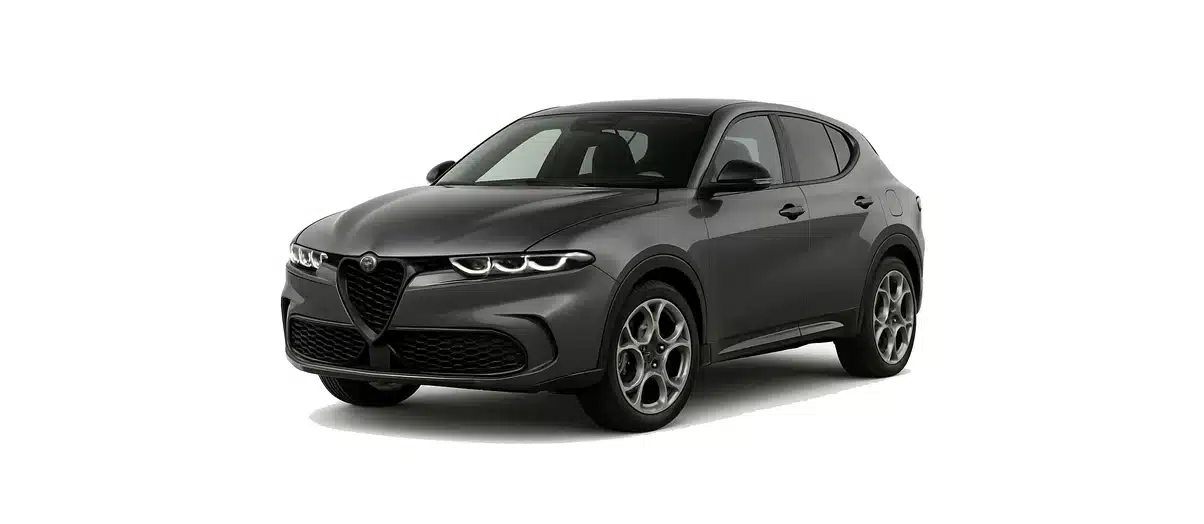
The Alfa Romeo Tonale is a compact SUV/crossover with an important charging detail for UK drivers: not every Tonale plugs in. Current UK MY26 information includes 1.5 mild-hybrid petrol versions, which do not use an external charging cable, and the 1.3 PHEV 270 AT Q4, which is the plug-in hybrid model this guide focuses on.
If you own, lease or are considering the Tonale Plug-in Ibrida Q4, charging is refreshingly straightforward. The car uses AC charging through a Type 2 connection, with Alfa Romeo UK quoting up to 7.4 kW and an approximate 2.5-hour charge time when using a suitable Mode 3 cable and charging point. That makes a 7.4 kW home wallbox or public AC post the most practical match for the car.
View Alfa Romeo Tonale Charging Cables
Alfa Romeo Tonale Battery and Charging Specifications
The key point is to identify which Tonale you have. The 1.5 Ibrida mild-hybrid models are self-contained petrol hybrids and do not need plugging in. The 1.3 Plug-in Ibrida Q4 is the model with a charge port, high-voltage battery and electric driving range.
| Vehicle type | Plug-in hybrid SUV/crossover, for the 1.3 PHEV 270 AT Q4 |
|---|---|
| Battery capacity | 15.5 kWh gross, according to Alfa Romeo material |
| Official UK electric range | 36–38.5 miles WLTP combined, depending on specification |
| Charging connector | Type 2 AC |
| Maximum AC charging rate | Up to 7.4 kW |
| Typical full AC charge time | About 2.5 hours on a suitable 7.4 kW charge point |
| DC rapid charging | No reliable UK source confirms DC rapid charging for the Tonale PHEV |
Alfa Romeo’s current UK price and specification information also lists Mode 2 and Mode 3 charging cables as included for PHEV versions. Even so, many owners still choose an additional or replacement cable for convenience, for example keeping one cable at home and another in the boot.
Battery Options
For the UK plug-in Tonale, the relevant battery is the 15.5 kWh high-voltage battery fitted to the 1.3 PHEV 270 AT Q4. The usable capacity is not clearly stated in the current UK official sources reviewed, so it is better to treat the official range and charge-time figures as the most useful ownership reference.
The PHEV battery packaging also affects practicality. Current UK specification information lists the Tonale PHEV with 385 litres of boot space with the rear seats up, which is less than the mild-hybrid Tonale. That is worth knowing if you are comparing the plug-in and non-plug-in versions as company cars or family cars.
AC Charging Speed
AC charging is the Tonale PHEV’s main charging method. Alfa Romeo UK states that a Mode 3 cable at 7.4 kW can charge the Tonale Plug-in Ibrida Q4 in about 2.5 hours. In practical terms, this means a typical UK single-phase 7.4 kW home wallbox is the right match for the vehicle.
Using a higher-rated public AC post, such as an 11 kW or 22 kW unit, will not necessarily make the car charge faster. The limiting factor is the vehicle’s onboard AC charger, so you should expect the Tonale to top out at around 7.4 kW where the charging point, cable and supply allow it.
For cable selection, a Type 2 to Type 2 Mode 3 cable is the standard choice for untethered home chargers and many destination charging points. A 32 amp cable is the appropriate rating for 7.4 kW single-phase charging. A higher-rated three-phase cable can still be used on compatible AC posts, but it will not increase the Tonale’s vehicle-side charging limit.
DC Rapid Charging Speed
DC rapid charging is not the focus for the Alfa Romeo Tonale Plug-in Ibrida Q4. No reliable current UK source reviewed confirms a DC fast-charging capability for the Tonale PHEV, and professional review material for the updated car states that there is no DC charge option.
That means typical rapid-charging advice used for full battery-electric vehicles, such as planning around 10–80% DC charging stops, does not apply here. Instead, Tonale PHEV owners should plan around home charging, workplace charging and public AC destination charging. The car’s petrol engine and hybrid system cover longer journeys, while charging little and often helps maximise electric running on shorter trips.
Range and Efficiency
Current UK MY26 data lists the Tonale PHEV’s WLTP combined electric range at 36–38.5 miles, depending on specification. Earlier launch material used higher urban-context figures, but for current UK combined range comparisons the 36–38.5 mile WLTP figure is the more relevant reference.
Real-world electric range will vary with temperature, speed, traffic, terrain, tyre choice, cabin heating or air-conditioning use and how often the petrol engine is called upon. In gentle town and suburban use, some drivers may see range close to or above the official combined figure, while sustained faster roads and winter conditions can reduce it.
The Tonale PHEV makes most sense when your regular journeys fit within its electric range and you can recharge regularly. If your commute, school run or local errands are under about 35 miles, starting each day with a full battery can significantly reduce petrol use. If you rarely plug in, the car will behave more like a conventional hybrid with extra battery weight, so the ownership benefit is reduced.
Charging at Home
Home charging is the easiest way to get the best from the Tonale Plug-in Ibrida Q4. A 7.4 kW wallbox gives the car access to its likely maximum AC charging rate and can refill the battery in around 2.5 hours, according to Alfa Romeo UK. For many owners, that means charging after work, overnight, or during a cheaper off-peak electricity period.
If you have a tethered home charger, the cable is permanently attached to the wallbox, so you simply plug the Type 2 connector into the car. If your charger is untethered, you will need a Type 2 to Type 2 cable. Untethered chargers are common in the UK and are also useful if your household may use different EVs in future.
A 3-pin domestic charger is generally best suited as a backup or occasional charging solution, but can be used regularly if a qualified electrician has confirmed the socket and electrical installation are suitable for sustained EV charging. Standard domestic sockets were not primarily designed for repeated long-duration high-load EV charging, so a professionally installed wallbox is the better long-term solution for most owners.
Because the Tonale has a modest PHEV battery compared with a full EV, it does not need many hours to recharge. This is one of the main advantages of a plug-in hybrid: short, regular top-ups can keep the battery ready without needing to plan around long charging sessions.
Public Charging
For public charging, look for AC charge points with Type 2 connections. These are common at supermarkets, hotels, town-centre car parks, gyms, workplaces and retail parks. Some AC chargers are tethered, while others are untethered and require you to bring your own Type 2 cable.
Destination charging suits the Tonale PHEV particularly well. If you are parked for an hour or two while shopping, working or eating, you may add a useful amount of electric range. If you are parked for around 2.5 hours on a suitable 7.4 kW AC charger, the car may be able to reach a full charge from low battery conditions.
On motorway journeys, it is usually not worth thinking of the Tonale like a full EV. Rapid hubs are primarily designed around DC charging for battery-electric cars, and the Tonale PHEV is better served by AC charging when parked for longer periods. On longer trips, use the hybrid system and petrol engine as intended, then recharge at your destination if AC charging is available.
Vehicle-Specific Features
The Tonale PHEV combines a 1.3-litre petrol engine with plug-in hybrid hardware and Q4 electric all-wheel drive. Current UK MY26 information lists the PHEV output as 270hp, while some earlier launch material referred to 280hp. When comparing specifications, it is worth checking that you are looking at current UK documentation for the exact model year and trim.
The plug-in model’s charging appeal is less about ultra-fast charging and more about making regular electric mileage easy. With a Type 2 AC setup and a battery that can be recharged in a few hours, the Tonale can cover many local trips electrically if it is plugged in consistently.
The most important ownership feature is therefore not a headline charging speed, but the routine you build around it. Keeping the car charged at home, taking advantage of workplace AC charging and using destination chargers when convenient will do more for running costs than chasing faster chargers that the vehicle is not designed to use.
Charging Tips
- Check your powertrain first: only the 1.3 Plug-in Ibrida Q4 needs a charging cable. The 1.5 Ibrida mild-hybrid does not plug in.
- Use Type 2 AC charging: this is the normal connection for home wallboxes and public destination chargers.
- Choose a 32 amp Type 2 cable: this suits the Tonale’s 7.4 kW AC charging capability when used with a suitable charger.
- Do not expect 22 kW charging: a higher-rated AC post will not override the car’s onboard charging limit.
- Charge little and often: topping up frequently helps you make the most of the 36–38.5 mile WLTP combined electric range.
- Prioritise home charging: a 7.4 kW wallbox is the practical sweet spot for the Tonale PHEV.
- Keep a cable in the boot: useful for untethered public AC chargers, hotels and workplace charging.
Frequently Asked Questions
Is the Alfa Romeo Tonale a fully electric car?
No. In the UK, the Tonale range includes mild-hybrid petrol versions and a plug-in hybrid version. The Tonale is not currently a full battery-electric vehicle in the UK range reviewed for this guide.
Which Alfa Romeo Tonale models need a charging cable?
The 1.3 PHEV 270 AT Q4 Plug-in Ibrida needs a charging cable. The 1.5 Ibrida mild-hybrid versions do not plug in and do not use an external charging cable.
What charging cable does the Alfa Romeo Tonale PHEV use?
The Tonale PHEV uses Type 2 AC charging. For untethered home chargers and many public AC posts, a Type 2 to Type 2 Mode 3 cable is the usual choice.
How fast can the Alfa Romeo Tonale PHEV charge?
Alfa Romeo UK quotes up to 7.4 kW AC charging and around 2.5 hours for a charge using a suitable Mode 3 cable and charging point.
Can the Alfa Romeo Tonale PHEV use DC rapid chargers?
Based on the sources reviewed, DC rapid charging is not confirmed for the Tonale PHEV, and updated review material states there is no DC charge option. Owners should plan around Type 2 AC charging instead.
What is the electric range of the Alfa Romeo Tonale PHEV?
Current UK MY26 information lists a WLTP combined electric range of 36–38.5 miles, depending on specification. Real-world range will vary with conditions and driving style.
What This Means for Drivers
The Alfa Romeo Tonale Plug-in Ibrida Q4 is best understood as a plug-in hybrid that rewards regular AC charging. It is not a full EV, and it is not a rapid-charging car, but its 15.5 kWh battery and 7.4 kW AC charging capability make it easy to refill at home or at a destination charger.
For UK owners, the ideal setup is simple: a 7.4 kW home wallbox, a suitable Type 2 cable for untethered charging, and a habit of plugging in whenever convenient. If your daily mileage fits within the official electric range, this approach can make the Tonale feel much more electric in everyday driving while keeping petrol flexibility for longer journeys.
Looking for a Charging Cable for Alfa Romeo Tonale?
We offer Type 2 charging cable options for the Alfa Romeo Tonale Plug-in Ibrida Q4, suitable for home wallboxes and public AC charging points.
View Alfa Romeo Tonale Charging Cables
Please note that this information is intended as a guide. Charging specifications may change due to model and year of manufacture. For precise information, always refer to your vehicle user manual.

