
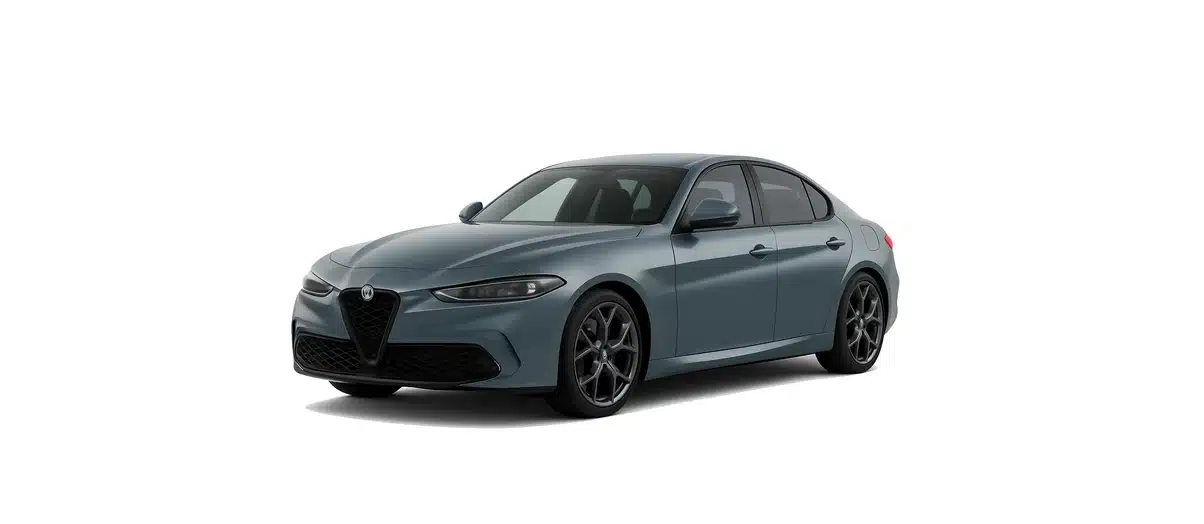
The Alfa Romeo Giulia is a sporting saloon with a strong driver-focused reputation, but current UK-market Giulia models are not battery-electric vehicles or plug-in hybrids. Official UK Alfa Romeo information lists the regular Giulia range as petrol-powered, with Sprint and Veloce versions using a 2.0 Turbo Petrol 280 hp engine, while the Giulia Quadrifoglio is listed separately as a petrol 520 hp rear-wheel-drive performance model.
That matters because a standard UK Alfa Romeo Giulia does not have a plug-in traction battery, a Type 2 charging inlet, a CCS rapid-charging port, or any published AC or DC charging specification. In practical terms, Giulia owners do not need an EV charging cable for the car. If you were looking for charging information because you own, or are considering, an Alfa Romeo Junior Elettrica, Alfa Romeo Tonale Plug-in Hybrid Q4, or another electrified model, you should follow the charging guidance for that specific model instead.
View Alfa Romeo Giulia Charging Cables
Alfa Romeo Giulia Battery and Charging Specifications
For the current UK Alfa Romeo Giulia, battery and charging specifications are not applicable. The Giulia sold in the UK is a petrol saloon, not a BEV, PHEV, or range-extender electric vehicle. Official UK price and specification information focuses on petrol engine output, rear-wheel drive, an eight-speed automatic gearbox, WLTP fuel consumption and CO2 figures rather than electric range or charging performance.
This means there is no EV battery capacity to quote, no usable battery figure, no charging curve, no onboard AC charger rating and no rapid-charging capability. A Giulia driver should not try to match the vehicle to a Type 2 cable, CCS connector or domestic three-pin EV lead, because there is no charging socket on the car for those accessories.
It is also important not to confuse the Giulia with other Alfa Romeo models. The Alfa Romeo Junior Elettrica and Tonale Plug-in Hybrid Q4 sit in a different part of the range and require their own model-specific charging advice. Charging information from those vehicles should not be copied across to the Giulia.
Battery Options
There are no plug-in battery options for the current UK Alfa Romeo Giulia. The regular Giulia range is listed with petrol power, and the Giulia Quadrifoglio is also petrol-powered. Because there is no traction battery designed to be charged from the mains, there is no choice of battery size, no electric-only range and no charging upgrade to consider when selecting a Giulia trim.
If you have seen references online to future electric Alfa Romeo saloons, concept plans or next-generation platform rumours, treat those separately from the current UK-market Giulia. Future model plans can change, and they should not be used as buying guidance for cables or charging equipment for today’s petrol Giulia.
AC Charging Speed
AC charging speed is not applicable to the current UK Alfa Romeo Giulia. AC charging is the type of charging usually used at home wallboxes, workplace charge points and many slower public charging locations. It normally relies on a Type 2 connection in the UK and Europe, with the vehicle’s onboard charger converting AC power into DC power for the battery.
The Giulia does not have that charging hardware. There is no onboard AC charger rating, no Type 2 inlet and no expected home-charging time. A 7 kW home wallbox, 11 kW three-phase post or untethered Type 2 cable cannot be used to charge a standard Giulia because the car has no plug-in charging system.
DC Rapid Charging Speed
DC rapid charging is also not applicable. Rapid and ultra-rapid public chargers are designed for battery-electric vehicles and, in some cases, compatible plug-in vehicles. They typically use a CCS connector for modern UK and European EVs.
The current UK Giulia has no CCS charging inlet and no DC rapid-charging capability. There is therefore no 10-80% rapid-charge time, no maximum kW figure and no rapid-charging advice specific to the Giulia. If you are planning long journeys in a petrol Giulia, your stops will be for fuel, rest breaks and route planning rather than public EV charging sessions.
Range and Efficiency
EV range figures do not apply to the Alfa Romeo Giulia because it is not a plug-in electric car. There is no WLTP electric range, no real-world EV range estimate and no miles-per-kWh efficiency figure to calculate.
Instead, official UK information for the Giulia refers to petrol fuel consumption and CO2 emissions. Those figures are assessed differently from EV range data and depend on engine, trim, wheels, tyres, driving conditions and driving style. For owners, the relevant day-to-day considerations are fuel economy, petrol tank range and servicing rather than charging efficiency or battery management.
Charging at Home
A standard UK-market Alfa Romeo Giulia cannot be charged at home because it has no plug-in charging port. You do not need to install a home EV charge point for the Giulia itself, and you do not need a Type 2 charging cable or three-pin EV charging lead for this vehicle.
If your household also has an electric car or plug-in hybrid, home charging may still be useful for that other vehicle. In that case, choose charging equipment based on the plug-in vehicle’s requirements, not on the Giulia. For many UK EVs and PHEVs, a dedicated home wallbox fitted by a qualified installer is the preferred regular charging solution. A 3-pin charger is generally best suited as a backup or occasional charging solution, but can be used regularly if a qualified electrician has confirmed the socket and electrical installation are suitable for sustained EV charging.
For Giulia-only ownership, however, home EV charging equipment is unnecessary. If you are unsure which Alfa Romeo you have, check the vehicle’s handbook, fuel filler and any charging flap location, or confirm the exact model with your supplying dealer.
Public Charging
Public EV charging networks are not used by the current Alfa Romeo Giulia. The vehicle is refuelled like a conventional petrol car, so Type 2 destination chargers, AC posts and CCS rapid chargers are not relevant for normal Giulia operation.
Confusion can happen because some public charging sites sit at motorway services, supermarkets and car parks where petrol or diesel drivers may also stop. A Giulia can use those locations for parking or rest breaks, but it should not occupy an EV charging bay unless local rules explicitly allow non-charging parking, which is uncommon. EV charging bays are intended for vehicles that are actively charging.
If you intended to search for an Alfa Romeo plug-in model, public charging guidance will depend on the exact vehicle. A full EV and a plug-in hybrid can have very different charging needs, cable requirements and charging speeds.
Vehicle-Specific Features
The key vehicle-specific point for the Alfa Romeo Giulia is simple: it is a petrol rear-wheel-drive saloon in current UK specification, not an EV platform. Official UK technical data for the 2.0 Turbo Petrol 280 model lists rear-wheel drive and a ZF eight-speed automatic transmission. The Quadrifoglio variant is also described as petrol-powered and rear-wheel drive.
Because the car is not a plug-in model, EV-specific charging features are not part of the Giulia ownership experience. There is no charging flap to locate, no cable storage requirement, no app-based charge scheduling and no public charging account needed for the car itself.
This can actually make the buying decision more straightforward. If you want a petrol sports saloon, the Giulia should be assessed on performance, handling, running costs, insurance, servicing, fuel economy and practicality. If you want electric driving, home charging and public charging access, you should look at a confirmed electrified Alfa Romeo model rather than assuming the Giulia has plug-in capability.
Charging Tips
Although the Giulia does not need charging advice in the EV sense, the following tips can help avoid incorrect purchases and model confusion:
- Do not buy a Type 2 cable for a UK Alfa Romeo Giulia. The car has no Type 2 inlet.
- Do not buy a CCS cable or rapid-charging accessory. CCS rapid charging does not apply to the Giulia.
- Do not buy a three-pin EV charging lead for the Giulia. There is no charging port for it to connect to.
- Check the exact Alfa Romeo model name. Junior Elettrica, Tonale Plug-in Hybrid Q4 and Giulia are different vehicles with different powertrains.
- Use current UK information. Overseas specifications, future rumours and older online discussions may not reflect the car currently sold in the UK.
- Ask before ordering charging equipment. If you are buying for someone else, confirm the vehicle has a plug-in charging port before choosing a cable.
Frequently Asked Questions
Is the Alfa Romeo Giulia electric?
No. Based on current UK Alfa Romeo information, the Giulia is listed as a petrol saloon. The regular range is shown with a 2.0 Turbo Petrol 280 hp engine, and the Giulia Quadrifoglio is also petrol-powered.
Is the Alfa Romeo Giulia a plug-in hybrid?
No current UK plug-in hybrid Giulia specification was found in the supplied research. The Giulia should not be treated as a PHEV for cable selection.
What charging cable does an Alfa Romeo Giulia need?
A standard UK Alfa Romeo Giulia does not need an EV charging cable. It has no plug-in charging socket, so Type 2, CCS and three-pin EV charging cables are not applicable.
Can I charge an Alfa Romeo Giulia at a public charging point?
No. Public EV charging points are for plug-in vehicles. A petrol Giulia cannot connect to or use a public EV charger.
Could I be confusing the Giulia with another Alfa Romeo model?
Yes. If you were expecting charging information, you may have meant the Alfa Romeo Junior Elettrica, the Alfa Romeo Tonale Plug-in Hybrid Q4, or another electrified Alfa Romeo. Use the charging guidance for the exact model you own.
Will a future electric Giulia use the same cable information?
Not necessarily. Any future electric or plug-in Giulia would need to be assessed using its official UK specifications at the time it goes on sale. Current petrol Giulia information should not be mixed with future or rumoured EV details.
What This Means for Drivers
For current UK Alfa Romeo Giulia drivers, the conclusion is clear: there is no EV charging requirement for the car. You do not need a home charge point, Type 2 cable, CCS compatibility check, public charging account or emergency three-pin EV lead for the Giulia itself.
If you are shopping for a Giulia, make your decision using petrol-car criteria such as performance, comfort, fuel economy, emissions, servicing, insurance and overall running costs. If you are specifically looking for an Alfa Romeo that can drive on electric power and connect to a charger, the Giulia is not the model to use for charging-cable research.
For website navigation and product selection, this page is best treated as a clarification. It helps prevent drivers from buying an unnecessary cable and points Alfa Romeo owners toward the correct model-specific charging information when they actually own a plug-in hybrid or electric model.
Looking for a Charging Cable for Alfa Romeo Giulia?
We sell this page to help clarify cable compatibility: the current UK Alfa Romeo Giulia is petrol-only, so it does not require an EV charging cable; if you meant a different plug-in Alfa Romeo model, choose the cable guidance for that exact vehicle instead.
View Alfa Romeo Giulia Charging Cables
Please note that this information is intended as a guide. Charging specifications may change due to model and year of manufacture. For precise information, always refer to your vehicle user manual.

